
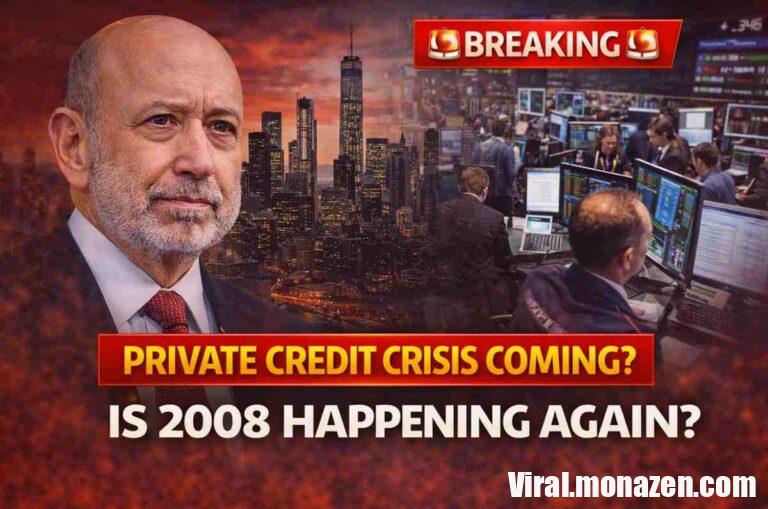
Nearly two decades after the global financial system was pushed to the brink of collapse, warnings about potential vulnerabilities in modern credit markets are once again capturing attention across Wall Street. This time, the concern centers on the rapidly expanding private credit industry, a sector that has grown dramatically in the years since the 2008 financial crisis.
Among those sounding the alarm is Lloyd Blankfein, the former chief executive of Goldman Sachs, who recently suggested that stresses emerging within the private lending market carry troubling similarities to conditions that preceded the last financial meltdown.
While Blankfein stopped short of predicting a repeat of 2008, his remarks have reignited debate among economists, investors, and regulators about whether the financial system is once again accumulating hidden risks beneath the surface.
The Rise of Private Credit
Private credit—sometimes called direct lending—refers to loans issued by non-bank institutions such as private equity firms, hedge funds, and specialized asset managers. These loans typically go to companies that may struggle to secure financing through traditional banks.
Over the past decade, the sector has grown into one of the fastest-expanding corners of global finance.
Following the 2008 crisis, banks faced tighter regulations designed to limit risky lending practices. As a result, many banks scaled back their corporate lending operations. Private investment firms quickly stepped in to fill the gap.
Today, the private credit market is estimated to be worth more than $1.5 trillion globally, according to several industry analyses.
Supporters argue that private lenders provide valuable financing for businesses that might otherwise struggle to access capital. Critics, however, worry that the sector has grown so rapidly that oversight and transparency have not kept pace.
Blankfein’s Warning
Speaking recently about the financial environment, Blankfein said the stress building in parts of the private credit market “smells like 2008.”
The remark has resonated widely because Blankfein was at the helm of Goldman Sachs during the global financial crisis, when banks, investors, and governments scrambled to prevent a complete collapse of the financial system.
According to Blankfein, the concern lies not simply in the size of the private credit market but in the lack of visibility into its underlying risks.
Unlike traditional bank lending, many private credit deals occur outside the heavily regulated banking system. That means regulators and even some investors may have limited information about how much leverage companies are carrying or how vulnerable they are to economic downturns.
Blankfein emphasized that the situation is not identical to the conditions that triggered the last crisis—but he suggested the parallels are worth examining.
A Different Kind of Financial System
One of the defining lessons of the 2008 crisis was the danger posed by “shadow banking”—financial activity occurring outside traditional banks.
At the time, complex financial instruments tied to mortgage-backed securities allowed risks to spread throughout the global economy in ways few regulators fully understood.
In response, policymakers introduced sweeping reforms aimed at strengthening banks and improving transparency.
Ironically, those reforms helped accelerate the growth of private credit.
As banks faced stricter rules on lending and capital requirements, many large investment firms expanded their private lending operations.
These lenders often operate through private funds that are less tightly regulated than traditional banks.
For companies seeking financing, the appeal is clear: private lenders can move quickly and are often willing to take on deals that banks might avoid.
For investors searching for higher returns, private credit has also been attractive.
But critics argue that the very factors that fueled the sector’s growth may also create vulnerabilities.
Signs of Stress Emerging
Recent economic conditions have begun to test the resilience of the private credit market.
Higher interest rates have increased borrowing costs for companies that rely on loans from private lenders. At the same time, slower economic growth in some sectors has made it harder for businesses to generate the revenue needed to service their debts.
These pressures have led to a rise in loan restructurings and delayed repayments, raising concerns about how widespread such problems might become.
Some analysts warn that if economic conditions deteriorate further, certain borrowers could struggle to meet their obligations.
Because many private credit loans are held by investment funds rather than banks, losses would likely be borne by investors rather than triggering immediate systemic banking failures.
However, the scale of the market means that widespread defaults could still ripple through financial markets.
Why Investors Still See Opportunity
Despite the warnings, many financial professionals remain confident in the private credit sector.
They argue that the structure of private lending—particularly its direct relationships between lenders and borrowers—can actually reduce risk compared with complex securitized products.
Unlike the mortgage-backed securities that contributed to the 2008 crisis, private credit deals are often negotiated directly between lenders and companies. This allows lenders to monitor borrowers more closely and renegotiate terms if problems arise.
In addition, private credit funds typically require borrowers to provide detailed financial information and collateral.
Supporters of the industry say these safeguards help mitigate some of the risks associated with rapid growth.
Still, even advocates acknowledge that the sector is entering a more challenging phase.
The Role of Interest Rates
Another major factor shaping the private credit landscape is the global shift toward higher interest rates.
For years after the financial crisis, ultra-low interest rates encouraged investors to seek alternative sources of yield. Private credit funds benefited enormously from that environment.
But as central banks raised interest rates to combat inflation, borrowing costs increased significantly.
Companies that took out loans during the era of cheap money may now find themselves paying far more in interest than they initially expected.
That dynamic could become particularly problematic for highly leveraged firms operating in industries facing slowing demand.
Lessons From the Past
The comparison to 2008 inevitably raises questions about whether regulators and investors have learned from the previous crisis.
Most economists agree that today’s financial system is better capitalized than it was before the collapse of Lehman Brothers.
Banks hold more reserves, and regulators conduct regular stress tests to evaluate their resilience.
However, financial innovation tends to shift risk rather than eliminate it.
As traditional banks became safer, other sectors—such as private credit—expanded to fill the space.
Blankfein’s warning reflects a broader concern that risk may simply have migrated to areas where oversight is less developed.
What Happens Next?
For now, most analysts believe the private credit market remains stable.
Defaults remain relatively limited, and many funds continue to report strong returns.
But the coming years will likely test the sector’s resilience.
If economic conditions worsen, private lenders may face difficult decisions about restructuring loans, absorbing losses, or extending credit to struggling companies.
Investors will also be watching closely to see how transparent these funds are about their portfolios.
A Market at a Crossroads
The rapid rise of private credit represents one of the most significant shifts in global finance over the past decade.
What began as a niche lending strategy has evolved into a trillion-dollar industry influencing corporate financing across the world.
Whether that growth proves sustainable—or exposes hidden vulnerabilities—remains an open question.
For observers like Lloyd Blankfein, the early signs of stress are a reminder that financial markets rarely remain calm forever.
History has shown that periods of rapid expansion can sometimes mask deeper risks.
And while today’s financial system may look different from the one that collapsed in 2008, the lessons of that crisis continue to echo through every corner of global finance.
As investors and regulators monitor the private credit market, one thing is clear: vigilance remains essential in a world where financial innovation moves faster than the safeguards designed to contain it.