
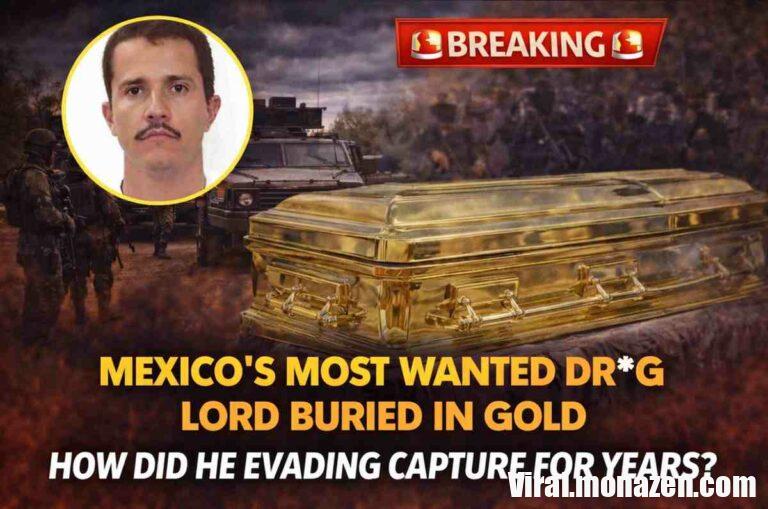
For years, Nemesio Oseguera Cervantes — better known by his alias “El Mencho” — stood at the center of one of the most powerful criminal organizations in the Western Hemisphere. As the alleged leader of the Jalisco New Generation Cartel (CJNG), he built a reputation that combined ruthless violence, sophisticated trafficking networks, and an almost mythical ability to evade capture.
Now, according to circulating reports, the story of the man once considered one of Mexico’s most wanted figures may have ended in dramatic fashion. Accounts suggest he died during a violent confrontation with Mexican security forces — a clash that, if confirmed, would mark the end of one of the most consequential criminal careers in modern Latin American history.
But what has captured the public’s imagination even more than the alleged firefight is a curious detail tied to his reported final wish: to be buried in a gold coffin worth millions.
Whether literal fact or symbolic legend, the image of a cartel leader laid to rest in a golden casket has sparked renewed debate about power, wealth, and the strange mythology surrounding organized crime.
From Rural Beginnings to Cartel Leadership
Nemesio Oseguera Cervantes was born in the Mexican state of Michoacán, a region that has long struggled with organized crime and economic hardship. Like many figures who later rose in cartel hierarchies, his early life reportedly unfolded far from the global networks he would eventually command.
During his younger years, Oseguera Cervantes spent time in the United States before returning to Mexico. Over time he became involved in criminal networks tied to drug trafficking — a business that, by the early 2000s, had evolved into one of the most profitable underground industries in the world.
By the late 2000s, he had emerged as a key figure in what would become the Jalisco New Generation Cartel.
The Rise of the CJNG
The CJNG grew rapidly in the early 2010s, gaining notoriety for its aggressive tactics and ability to challenge rival organizations. While other cartels were weakening due to arrests or internal divisions, the group led by Oseguera Cervantes expanded quickly.
Security analysts describe CJNG as a highly organized network with international reach. Authorities have linked it to trafficking routes that stretched across North America, Europe, and parts of Asia.
But its reputation was shaped not only by its economic reach but also by its violent confrontations with rival cartels and Mexican security forces.
In several widely reported incidents, CJNG fighters displayed heavy weaponry and military-style tactics. These actions turned the organization into one of the most feared groups in Mexico’s ongoing struggle against organized crime.
A Man Who Evaded Capture for Years
Despite being one of the most wanted individuals in Mexico and the United States, El Mencho remained elusive for years.
Authorities launched multiple operations to locate him, and international agencies offered substantial rewards for information leading to his arrest.
Yet he repeatedly avoided capture, fueling a growing sense of mystery around his whereabouts.
Some analysts believe his survival was due to an extensive protection network, including loyal security teams and informants who helped him stay ahead of law enforcement.
Others argue that CJNG’s decentralized structure made it difficult to dismantle the organization by targeting a single leader.
The Reported Final Clash
Recent reports claim that Oseguera Cervantes died during a confrontation between his security detail and Mexican special forces attempting to detain him.
Details surrounding the alleged firefight remain unclear, and officials have not publicly confirmed every aspect of the event.
What is known, however, is that clashes between cartel groups and government forces remain a recurring feature of Mexico’s struggle with organized crime.
These confrontations often occur in remote areas where cartel influence is strong and law enforcement operations face significant risks.
If confirmed, the reported death of “El Mencho” would represent one of the most significant developments in Mexico’s long battle against cartel violence.
The Legend of the Gold Coffin
Perhaps the most unusual element of the story is the claim that Oseguera Cervantes wished to be buried in a gold coffin.
According to circulating accounts, the luxurious casket symbolized the enormous fortune he accumulated during years at the helm of CJNG.
The cartel was widely believed to generate billions of dollars through trafficking operations.
For some observers, the image of a golden coffin represents the ultimate symbol of excess — a final display of wealth that mirrors the extravagant lifestyles sometimes associated with cartel leadership.
Yet others see the story less as literal truth and more as a powerful metaphor for the strange blend of myth and reality that surrounds organized crime.
The Culture of Cartel Mythology
Throughout history, major criminal figures have often been surrounded by larger-than-life stories.
In Mexico, figures linked to cartels sometimes become the subjects of “narcocorridos”, a type of folk music that recounts the exploits of traffickers.
These songs and stories can blur the line between fact and legend.
Experts say the mythologizing of cartel leaders can contribute to their notoriety and influence, sometimes portraying them as rebellious figures who defied authorities.
The story of a gold coffin may be part of this broader cultural phenomenon.
What Happens to the Cartel Now?
The potential death of a major cartel leader often raises a critical question: what happens next?
Historically, the removal of a powerful figure can lead to internal power struggles within criminal organizations.
These conflicts sometimes result in splinter groups competing for control — a process that can increase violence in the short term.
However, some organizations adapt quickly by appointing new leadership structures.
Analysts say the CJNG’s future will depend on how effectively it manages any transition in leadership.
A Larger Struggle
Beyond the fate of one individual, the story reflects a broader challenge facing Mexico and many other countries.
The global drug trade remains a powerful economic force, fueled by demand in multiple regions and supported by complex international networks.
Governments have invested enormous resources in combating organized crime, yet the problem persists.
Many experts argue that addressing the issue requires not only law enforcement but also economic development, institutional reform, and international cooperation.
The Final Question
If the story of the gold coffin proves accurate, it will likely remain one of the most striking images associated with El Mencho’s life.
A man who once commanded vast power, wealth, and influence would ultimately be remembered not only for the violence linked to his cartel but also for the symbolic extravagance of his final wish.
But in the end, the image raises a deeper question.
Can wealth and power truly outlast the life of the person who possessed them?
For Nemesio Oseguera Cervantes — whether buried in gold or not — the answer may lie less in the material symbols left behind and more in the lasting impact of the world he helped shape.