
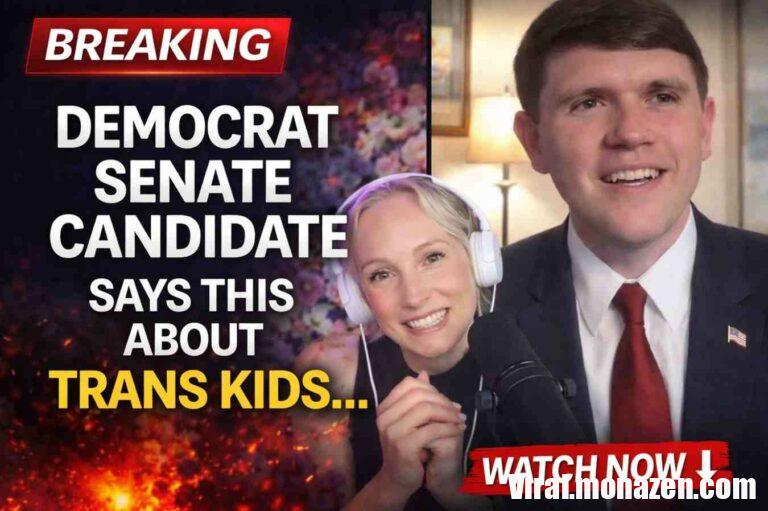
A short clip from a political interview has ignited an intense debate across social media and political circles after Texas Democrat and U.S. Senate candidate James Talarico responded to a question about something he loves outside of family and friends with a simple answer: “Trans children.”
The exchange, which occurred during a podcast interview, quickly spread online, prompting reactions from supporters, critics, and commentators across the political spectrum. For some, the remark was seen as a reflection of compassion and advocacy for a vulnerable group. For others, it became another flashpoint in the ongoing cultural and political battle over transgender issues in the United States.
The controversy illustrates how deeply polarized discussions around gender identity, youth healthcare, and education have become in American politics—especially in states like Texas, where those issues are central to legislative debates and election campaigns.
The Interview Moment That Went Viral
During the interview, the host asked Talarico a light but revealing question often used in conversations to understand a person’s passions.
“Something that you love that’s not family or friends?” the host asked.
Talarico responded without hesitation: “Trans children.”
Within hours, the short exchange began circulating widely online, with some commentators framing the remark as evidence of Talarico’s strong support for transgender youth, while others criticized it as politically motivated or controversial.
As with many viral political clips, the conversation quickly expanded beyond the original context and became part of a larger national debate.
Who Is James Talarico?
James Talarico is a Democratic member of the Texas House of Representatives who has gained national attention in recent years for his outspoken positions on education policy, healthcare access, and civil rights issues.
Before entering politics, Talarico worked as a public school teacher, an experience that has heavily shaped his political messaging. Throughout his career, he has often framed policy debates through the lens of students and young people.
His campaign for the U.S. Senate has focused on issues including public education funding, healthcare affordability, economic opportunity, and civil liberties.
Supporters say his background in education gives him a unique perspective on youth-related issues.
Critics, however, argue that his progressive positions place him outside the political mainstream in a state that remains one of the strongest Republican strongholds in the country.
The Political Context: Transgender Issues in Texas
The controversy surrounding Talarico’s comment cannot be separated from the broader political environment in Texas.
In recent years, the state has been at the center of national debates over transgender policies. Several high-profile legislative battles have focused on issues such as:
• Transgender participation in school sports
• Access to gender-related healthcare for minors
• School policies regarding gender identity
• Parental rights and educational oversight
Republican lawmakers in Texas have passed legislation restricting transgender athletes from competing in sports divisions that do not match their biological sex at birth. Other proposals have addressed healthcare treatments related to gender transition for minors.
Supporters of those laws say they are necessary to protect fairness in sports and ensure careful oversight of medical decisions involving young people.
Opponents argue that such policies discriminate against transgender youth and contribute to stigma and mental health challenges.
In that environment, statements about transgender issues often become politically charged very quickly.
Supporters Defend the Comment
Supporters of Talarico argue that his remark should be understood as an expression of empathy toward a group that faces significant social and psychological challenges.
Advocacy groups for transgender youth frequently highlight statistics showing higher rates of bullying, depression, and suicide risk among LGBTQ youth compared with their peers.
From that perspective, supporters say Talarico’s statement reflects a commitment to supporting young people who may feel marginalized.
Some defenders also noted that political leaders often express solidarity with specific communities as part of broader discussions about human rights and inclusion.
Critics Push Back
Critics of Talarico’s comment have framed the statement very differently.
Some conservative commentators argue that the remark reflects what they see as an excessive focus on gender identity issues within parts of the Democratic Party.
Others say political leaders should emphasize policies affecting all children rather than highlighting particular identity groups.
In online discussions, critics also questioned whether such statements are designed primarily to appeal to activist constituencies rather than the broader electorate.
The debate quickly spread across political media outlets, where it became part of larger conversations about cultural values and political priorities.
A Broader National Debate
The reaction to Talarico’s comment mirrors a much larger national conversation.
Across the United States, transgender issues have become one of the most visible cultural debates in politics.
Questions about healthcare, education, sports participation, and legal protections have increasingly appeared in legislative sessions, court cases, and election campaigns.
Both major political parties have incorporated the issue into their messaging.
Democrats generally emphasize civil rights protections and anti-discrimination policies.
Republicans often frame the debate around parental rights, fairness in sports, and concerns about medical treatments involving minors.
Because of those sharply different perspectives, even brief comments—like the one made during Talarico’s interview—can quickly become national talking points.
The Role of Viral Media
The episode also highlights how modern political debates often unfold through short video clips rather than long policy discussions.
In the era of social media, a few seconds of footage can circulate widely, often detached from the broader conversation in which it occurred.
Political strategists from both parties have increasingly relied on viral clips to mobilize supporters and energize their bases.
However, critics say this environment can also amplify misunderstandings and intensify polarization.
When political messages are condensed into brief moments, nuance is often lost.
What It Means for the Senate Race
For Talarico, the controversy comes at an important moment as he seeks to build support for a U.S. Senate campaign in a state where Republicans have dominated federal elections for decades.
Texas has become more competitive in recent years, but statewide Democratic victories remain rare.
Campaign strategists say issues related to culture and identity often play a major role in mobilizing voters in Texas.
As a result, comments about transgender issues are likely to remain a focal point in the political conversation.
Supporters believe Talarico’s willingness to speak openly about controversial topics demonstrates authenticity and moral conviction.
Critics argue it could alienate moderate voters in a state where many remain skeptical of progressive cultural policies.
The Continuing Political Divide
Ultimately, the reaction to Talarico’s interview remark reveals less about a single statement and more about the broader divisions shaping American politics today.
Questions about gender identity, youth healthcare, and civil rights have become defining issues in the country’s political landscape.
And as the next election cycle approaches, debates over those topics are likely to grow even more intense.
For candidates like James Talarico, navigating that environment will require balancing advocacy with the realities of a highly polarized electorate.
Whether his comments strengthen support among his base or create new political challenges remains to be seen.
But one thing is certain: in today’s political climate, even a brief answer to a simple interview question can spark a nationwide debate.