
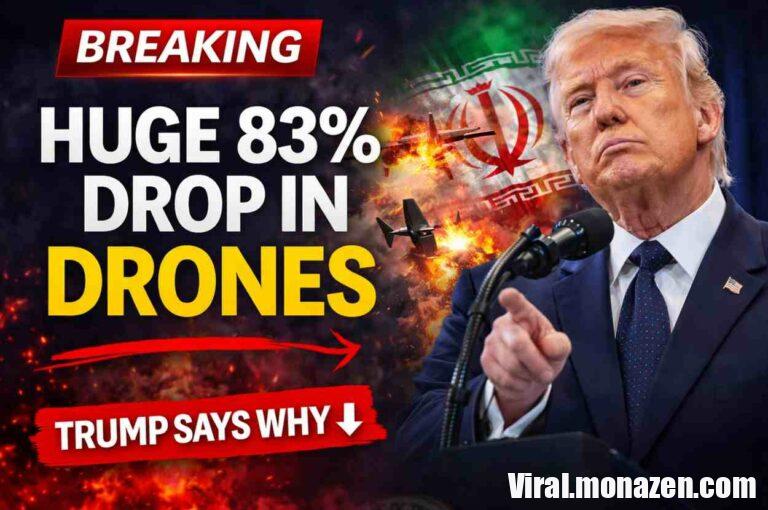
U.S. President Donald Trump said this week that Iranian drone launch activity has dropped by 83 percent since the beginning of the latest Middle East conflict, describing the decline as evidence that military pressure on Tehran is producing results.
The remarks came during a briefing in which the president discussed the ongoing confrontation involving the United States, Israel, and Iran—a conflict that erupted earlier in the week and quickly escalated into one of the most tense regional crises in years.
Trump’s statement suggested that the coordinated military response from the United States and its allies may be significantly degrading Iran’s ability to launch unmanned aerial attacks, a weapon that has become central to Tehran’s regional strategy.
While U.S. officials say the decline is encouraging, analysts caution that the situation remains fluid and that Iran retains the capability to resume drone operations at any moment.
A War Defined by Drones
Drone warfare has played a defining role in the conflict.
Iran has invested heavily in unmanned aerial vehicles (UAVs) over the past decade, building what military analysts describe as one of the largest drone arsenals in the region.
These drones have been used both directly by Iranian forces and by allied militias across the Middle East.
In recent years, Iranian drones have appeared in conflicts in Iraq, Syria, Yemen, and elsewhere, often targeting military installations, infrastructure, or shipping routes.
When the latest confrontation erupted earlier this week, drones quickly became one of Iran’s primary tools for striking targets while avoiding direct engagement with more advanced air forces.
The widespread use of drones reflects a broader shift in modern warfare, where relatively inexpensive unmanned systems can challenge technologically superior adversaries.
Trump’s Statement
Speaking about the current situation, Trump said the number of Iranian drone launches has fallen sharply since the early days of the conflict.
According to the president, the decrease is the result of intensified defensive operations and strikes aimed at disrupting launch sites and logistical networks.
“Compared to the beginning of the conflict, we’ve seen an 83 percent drop in drone launches,” Trump said.
He suggested that the change reflects both military pressure and the effectiveness of air defense systems deployed by the United States and its allies.
“Our forces are doing an incredible job protecting American interests and our partners,” the president said. “The results are very clear.”
Defensive Systems Under Pressure
Much of the success in intercepting drones has been attributed to advanced air defense technologies.
Systems such as Patriot missile batteries, Iron Dome interceptors, and electronic warfare tools have been deployed to detect and neutralize incoming drones.
These systems have become increasingly important as drone warfare evolves.
Unlike traditional missiles, drones can fly at lower altitudes and follow unpredictable routes, making them harder to detect.
They are also significantly cheaper to produce, allowing adversaries to launch large numbers simultaneously.
Military experts say that defending against drone swarms requires a combination of radar tracking, missile interception, and electronic disruption.
In recent days, U.S. and allied forces have reportedly relied on a layered defense approach to prevent drones from reaching their intended targets.
Iran’s Drone Strategy
Iran’s reliance on drones reflects a broader strategic doctrine focused on asymmetric warfare.
Rather than matching Western militaries in conventional weapons systems, Iran has developed capabilities designed to exploit weaknesses in more technologically advanced forces.
Drones allow Tehran to project power across the region while maintaining a degree of plausible deniability.
Many of the drones used in attacks are launched by allied militias rather than Iranian forces directly.
This approach complicates military responses and increases the risk of wider regional escalation.
Even with the reported drop in drone launches, analysts say Iran likely retains significant reserves.
“It’s possible the reduction is temporary,” said one regional security expert. “Iran could be regrouping or adjusting its tactics.”
Regional Implications
The confrontation between the United States, Israel, and Iran has raised concerns across the Middle East.
Several neighboring countries fear that the conflict could expand beyond its current scope.
Shipping routes in the Persian Gulf remain under close monitoring, and energy markets have already reacted to the heightened tensions.
Oil prices briefly surged following the initial outbreak of hostilities, reflecting fears that critical supply routes could be disrupted.
Although the reported reduction in drone launches may ease immediate pressure, many analysts say the situation remains extremely volatile.
The Role of Intelligence
Behind the scenes, intelligence operations have played a critical role in countering drone threats.
U.S. surveillance systems—including satellites, reconnaissance aircraft, and cyber intelligence platforms—have been used to track drone launch sites and supply chains.
By identifying these locations, military planners can target them before drones are deployed.
This intelligence-driven approach has become central to modern counter-drone warfare.
Officials say improved coordination between U.S. forces and regional allies has also enhanced the effectiveness of these operations.
Political Reactions
Trump’s statement about the decline in drone activity quickly drew reactions in Washington.
Supporters of the administration’s policies argued that the data demonstrates the effectiveness of strong military deterrence.
Critics, however, cautioned against drawing conclusions too quickly.
Some lawmakers noted that short-term decreases in attacks do not necessarily indicate long-term strategic success.
They also emphasized the need for diplomatic channels to prevent further escalation.
“Military operations can reduce threats in the short term,” one policy analyst said, “but lasting stability requires political solutions.”
A Conflict Still Unfolding
Despite the reported drop in drone launches, the broader conflict shows no immediate signs of resolution.
Both sides continue to monitor the situation closely.
Military planners remain on high alert, anticipating the possibility that Iran or its regional allies could attempt new attacks.
The rapid pace of events has also underscored how quickly modern conflicts can escalate.
Technological advancements—especially in drone warfare—have introduced new complexities into military strategy.
Even relatively small systems can now have significant strategic impact.
Looking Ahead
For now, the reported 83 percent reduction in Iranian drone launches represents a significant development in the early stages of the conflict.
Whether the trend will continue remains uncertain.
Much will depend on Iran’s next strategic decisions, the effectiveness of ongoing military operations, and the broader geopolitical dynamics shaping the region.
For policymakers in Washington and beyond, the situation serves as a reminder of how fragile stability in the Middle East can be.
And as the conflict unfolds, the role of drones—once considered a secondary tool of warfare—may continue to reshape the battlefield in ways few anticipated just a decade ago.