
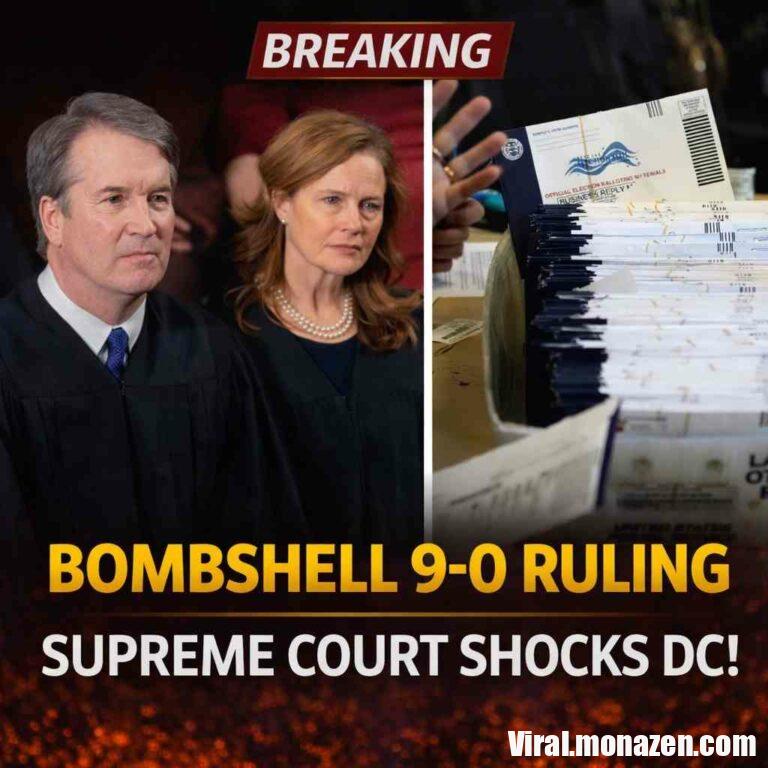
Washington, D.C. is no stranger to political drama, but few developments generate as much attention as a unanimous decision from the U.S. Supreme Court. When all nine justices agree on a case involving elections and federal authority, the ruling often carries consequences that extend far beyond the courtroom.
That is precisely what happened this week when the Supreme Court issued a 9–0 decision in a case tied to election procedures and federal oversight, a ruling that has already sparked debate among lawmakers, election officials, and constitutional scholars.
While the decision itself focused on legal questions about how election-related disputes should be handled, the broader implications could shape how future election challenges move through the courts—particularly as the United States approaches another contentious political cycle.
The ruling is being widely interpreted as a signal from the Court that certain legal strategies surrounding election disputes must follow clearer procedural rules.
A Case That Drew National Attention
The case at the center of the ruling involved a challenge to how federal courts handle election-related lawsuits. Specifically, the dispute revolved around whether certain claims should be heard by a special three-judge federal panel before potentially reaching the Supreme Court.
Such panels are sometimes required when lawsuits challenge the constitutionality of federal election laws or congressional district boundaries.
The procedural details may sound technical, but the outcome could influence how quickly and efficiently election disputes reach higher courts—especially during politically sensitive periods like midterm or presidential elections.
Legal observers say the case is significant not because it changes voting laws directly, but because it clarifies the legal pathways through which election challenges can move.
Why the Decision Was Unanimous
Perhaps the most notable aspect of the ruling was the rare unity among the Court’s nine justices.
In recent years, the Supreme Court has often been portrayed as sharply divided along ideological lines. However, this case produced consensus across the entire bench.
According to legal analysts, that unanimity reflects the Court’s focus on procedural clarity rather than political ideology.
The justices agreed that the lower court involved in the case had incorrectly handled the procedural requirements for election-related litigation.
By sending the case back through the proper legal framework, the Court emphasized that even highly political disputes must follow strict judicial processes.
In other words, the Court’s message was less about election policy and more about how the law should function.
Election Law Under Increasing Scrutiny
The decision arrives at a time when election laws are under intense national scrutiny.
Over the past decade, disputes about voting rules, mail-in ballots, voter identification requirements, and district boundaries have increasingly ended up in federal courts.
These legal battles have become central to the broader political debate about election integrity and voter access.
Supporters of stricter election procedures argue that stronger safeguards are necessary to maintain public confidence in the system. Advocates for expanded voting access say restrictive rules risk disenfranchising eligible voters.
Courts often find themselves navigating these competing arguments while focusing strictly on constitutional and statutory interpretation.
The Role of Federal Courts in Election Disputes
Election law cases frequently move quickly through the legal system because of tight timelines surrounding voting deadlines and certification of results.
Federal courts, including district courts and appellate courts, play a crucial role in determining whether challenges to election procedures are legally valid.
In some cases, federal law requires that three-judge panels hear specific constitutional challenges before they can proceed to the Supreme Court.
The purpose of these panels is to ensure that major election-related disputes receive careful consideration before reaching the highest court.
The Supreme Court’s latest ruling reinforces the importance of following these procedural requirements precisely.
What the Ruling Means for Future Cases
Although the decision does not directly alter election rules, it may influence how future election lawsuits are filed and heard.
Legal experts say the ruling serves as a reminder that procedural errors can derail cases before courts even examine the underlying arguments.
Attorneys bringing election-related lawsuits must ensure they follow the correct legal channels, particularly when constitutional questions are involved.
Failure to do so could lead to delays or dismissals—an especially critical issue when election deadlines are approaching.
In this sense, the Court’s decision may affect the strategies used by political campaigns, advocacy groups, and state governments when they challenge election policies.
Reaction From Legal Experts
Constitutional scholars have offered a range of interpretations about the significance of the ruling.
Some say the unanimous decision reflects the Court’s desire to avoid becoming the central battleground for election disputes.
Others believe the ruling highlights the judiciary’s role as a neutral referee rather than a political participant.
“The Court is emphasizing process,” one election law expert explained. “Before we even get to the substance of a case, the rules governing how the case reaches the Court must be followed.”
That focus on procedure may help prevent rushed or poorly structured lawsuits from overwhelming federal courts during election seasons.
Political Implications Ahead of Future Elections
Although the case is primarily legal in nature, it inevitably carries political implications.
Election-related lawsuits have become increasingly common during campaign seasons, and both major political parties have used the courts to challenge voting procedures.
The Supreme Court’s clarification of procedural requirements may shape how such disputes unfold in the future.
For political strategists, the ruling underscores the importance of building legally sound cases before bringing them before federal judges.
For election officials, it may offer reassurance that courts are reinforcing established legal frameworks rather than rewriting election laws.
A Reminder of the Court’s Institutional Role
Perhaps the most important takeaway from the ruling is the Court’s effort to reinforce its institutional role.
The Supreme Court does not create election policies; it interprets the Constitution and federal law.
By issuing a unanimous ruling centered on legal procedure, the justices appear to be signaling that election disputes must remain grounded in established judicial principles rather than partisan arguments.
That approach may help preserve the Court’s credibility at a time when public trust in institutions is frequently tested.
The Broader Debate Continues
Even with the Supreme Court’s guidance, debates about election laws are unlikely to disappear.
Questions about voting access, election security, and the role of federal oversight remain central issues in American politics.
State legislatures continue to propose changes to election procedures, advocacy groups continue to file lawsuits, and courts continue to interpret the complex legal landscape governing elections.
The Supreme Court’s latest decision does not settle those debates—but it does clarify one important aspect of the legal process.
Looking Ahead
As the United States prepares for future election cycles, legal battles over voting procedures are almost certain to continue.
The Court’s unanimous ruling may not dominate political headlines for long, but its procedural guidance could influence how election cases unfold in the coming years.
For now, the decision serves as a reminder that even in the most politically charged disputes, the judiciary remains bound by rules designed to protect fairness, consistency, and constitutional order.
And in Washington, where every legal ruling can quickly become part of the political conversation, a unanimous Supreme Court decision is often the clearest signal that the law—not politics—has the final word.