
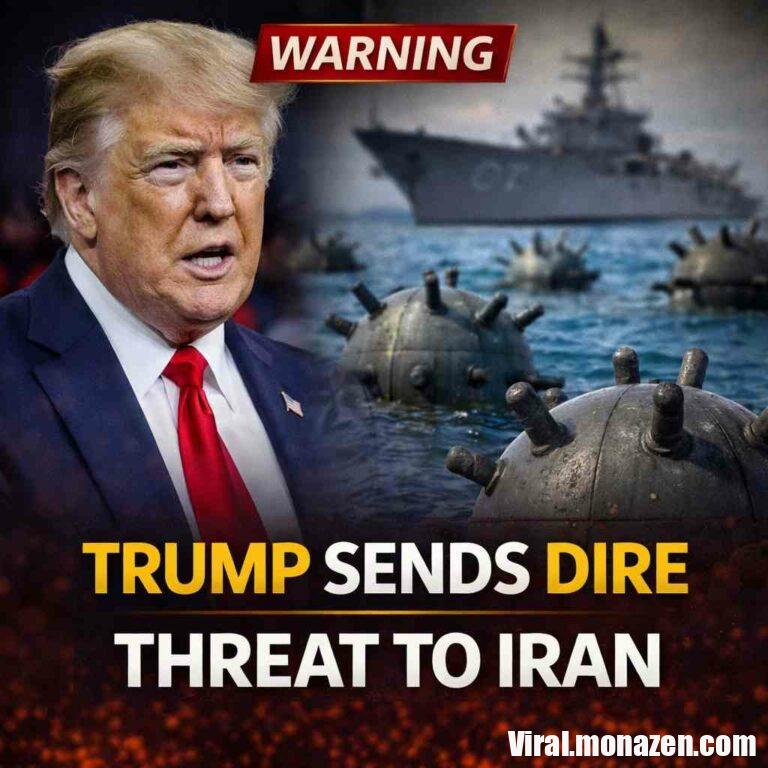
Tensions in the Middle East intensified dramatically this week after U.S. President Donald Trump issued a strong warning to Iran regarding reports that naval mines may have been placed in the strategically vital Strait of Hormuz. In a statement posted on social media, Trump said that if Iran had deployed mines in the narrow waterway, they must be removed immediately—or face severe military consequences.
The president’s remarks come at a time of already heightened geopolitical tension in the region, where the ongoing conflict involving Iran, the United States, and Israel has disrupted shipping and raised fears of a wider global crisis.
According to reports, the statement was prompted by intelligence concerns that Iran could be preparing to disrupt traffic through one of the world’s most important energy corridors.
Trump’s Warning: “Consequences Never Seen Before”
In his public message, Trump made clear that the United States would not tolerate attempts to block or threaten shipping lanes in the Strait of Hormuz.
“If Iran has put out any mines in the Hormuz Strait, and we have no reports of them doing so, we want them removed immediately,” Trump wrote. He added that if mines were placed and not removed promptly, the military consequences for Iran would occur “at a level never seen before.”
The statement also suggested that removing any mines that may have been deployed would be viewed as a positive step toward de-escalation.
Shortly after the warning, Trump indicated that U.S. forces had already destroyed several vessels suspected of being capable of laying naval mines, though details surrounding those operations remain limited.
The blunt tone of the message highlights the fragile state of relations between Washington and Tehran.
Why the Strait of Hormuz Matters
The Strait of Hormuz is widely considered one of the most strategically important maritime passages in the world.
Located between Iran and Oman, the narrow waterway connects the Persian Gulf to the Gulf of Oman and the Arabian Sea. It serves as the primary route for oil exports from major Middle Eastern producers including Saudi Arabia, Kuwait, Iraq, Qatar, and the United Arab Emirates.
On average, about 20 million barrels of oil per day move through the strait—roughly one-fifth of the world’s global petroleum supply.
Because of this, even minor disruptions to traffic through the strait can send shockwaves through global energy markets.
Analysts note that any mining of the waterway could halt commercial shipping, push oil prices sharply higher, and trigger a rapid military response from the United States and its allies.
Escalation in an Already Volatile Conflict
The warning from Washington arrives amid a broader military confrontation involving Iran and Western forces.
The current crisis began earlier this year following coordinated military strikes by the United States and Israel targeting Iranian infrastructure. In response, Iran launched missile and drone attacks against regional targets and issued threats against shipping in the Persian Gulf.
Since the conflict began, maritime traffic through the Strait of Hormuz has dropped significantly as shipping companies weigh safety concerns and insurance risks.
Several vessels have already been damaged in attacks, and casualties among sailors and port workers have been reported.
Against that backdrop, reports of potential naval mines have triggered alarm among international security officials.
Naval Mines: A Strategic Threat
Naval mines remain one of the most effective tools for disrupting maritime traffic.
Unlike large warships or missile systems, mines can be deployed relatively quickly and cheaply using small boats or submarines. Once placed in busy shipping lanes, they create a constant threat to tankers, cargo ships, and naval vessels.
Even a small minefield can effectively shut down a waterway until it is cleared.
Experts note that Iran possesses thousands of naval mines capable of being deployed by small vessels or fast attack craft.
Given the narrow geography of the Strait of Hormuz—only about 40 kilometers wide at its narrowest point—mining operations could quickly disrupt global shipping.
History of Tensions in the Strait
This is not the first time the Strait of Hormuz has become the focus of military tension.
During the Iran-Iraq War in the 1980s, naval mines were used to attack oil tankers in what became known as the “Tanker War.” In one notable incident in 1987, an Iranian mine struck a Kuwaiti tanker traveling under U.S. naval escort.
More recently, Iran has repeatedly threatened to close the strait during periods of conflict or economic sanctions.
In 2019, attacks on commercial tankers near the Strait of Hormuz heightened fears of a regional war, although responsibility for the attacks was disputed.
Because of the strait’s critical importance to global trade, any escalation in the region is closely watched by governments and markets worldwide.
Military Preparations and Global Concerns
Following the latest warning, U.S. military officials confirmed that they are evaluating options to ensure safe passage for commercial vessels.
These options may include escorting tankers through the strait or deploying specialized ships designed to detect and remove naval mines.
Mine-clearing operations are complex and dangerous. Specialized vessels must carefully scan the seabed using sonar equipment and remotely operated vehicles to locate explosive devices before they can be neutralized.
The U.S. Navy and allied forces maintain dedicated mine-countermeasure units for precisely this type of scenario.
Economic Impact and Oil Market Reaction
The possibility of disruption in the Strait of Hormuz has already had noticeable effects on global markets.
Oil prices briefly surged following reports that Iran may have begun preparing to deploy mines in the region. Traders and analysts are closely monitoring the situation because any sustained disruption could push energy prices sharply higher.
Countries across Asia, including China, Japan, and India, rely heavily on oil shipments passing through the strait.
As a result, governments around the world are watching the crisis carefully.
Even the possibility of a temporary closure could reshape global energy flows and force ships to take longer, more expensive routes.
Diplomatic Pathways Still Possible
Despite the strong rhetoric from Washington, analysts say diplomatic solutions remain possible.
Trump’s message itself included a potential path to de-escalation, noting that if Iran removes any mines that may have been placed, it would represent “a giant step in the right direction.”
Diplomatic backchannels between regional powers, European governments, and the United Nations are also likely to play a role in preventing the situation from spiraling into a broader conflict.
Historically, tensions in the Strait of Hormuz have often led to intense negotiations behind the scenes.
A Region on Edge
For now, the situation in the Persian Gulf remains highly volatile.
The combination of military operations, threats to shipping, and rising geopolitical tensions has created one of the most dangerous security environments in the region in years.
Trump’s warning to Iran underscores just how quickly the crisis could escalate if maritime routes are threatened.
At the same time, global leaders understand that the stakes extend far beyond the Middle East.
The Strait of Hormuz is not just a regional waterway—it is one of the lifelines of the global economy.
As governments and markets watch closely, the coming days may determine whether the latest confrontation leads to military escalation or diplomatic resolution.
Either way, the world’s attention is now firmly focused on the narrow stretch of water that carries a fifth of the planet’s oil supply—and the fragile balance of power that keeps it open.