A phrase that landed like a punch
It didn’t start as a policy paper or a televised debate.
It started the way most modern political storms begin: a graphic, a caption, and a few words that feel impossible to ignore.
“Send Barron.”
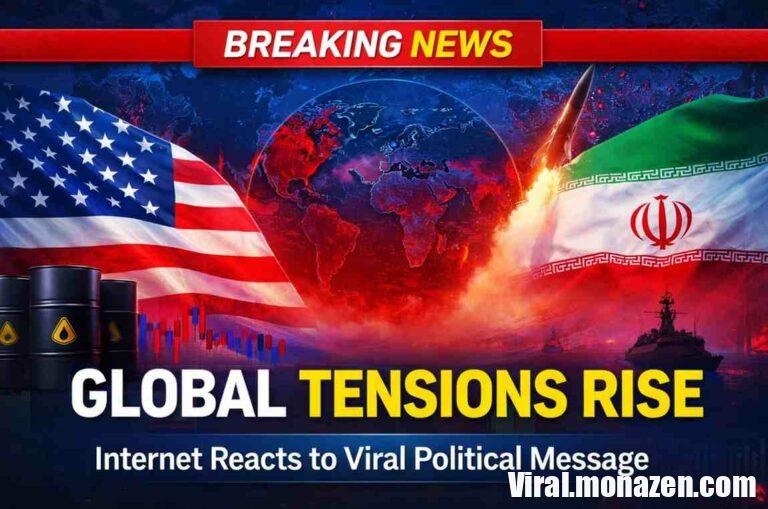
The phrase — referencing Barron Trump, the youngest son of former U.S. President Donald Trump — began circulating across social platforms alongside posts about escalating tensions involving Iran. Within hours, it was everywhere: reshared, remixed, translated, argued over, defended, condemned.
Some people posted it as dark sarcasm. Others used it as a moral question disguised as a meme. And many simply shared it because it captured a raw emotion that’s easy to feel but hard to say politely:
If leaders push toward conflict, should their families ever be treated as untouched by the consequences?
No one needs to agree with the slogan to understand why it spread.
The internet doesn’t reward nuance. It rewards impact. And “Send Barron” hit a nerve.
The hidden problem isn’t the slogan — it’s what it exposes
The real story here isn’t the three-word phrase. It’s the distance it reveals between decision-making and consequences.
For many people, war is no longer something that arrives on the doorstep. It’s something that arrives on a screen.
It comes as a “breaking news” banner, a clip, a headline, a statement from a podium. It gets framed as strategy, deterrence, national interest, security, alliances.
But for the families who live through it — soldiers, civilians, refugees, and the people who bury the dead — it isn’t strategy. It’s life.
That gap is what turns a political argument into a cultural rage.
And when tensions spike around Iran — a topic that often triggers fears of a wider regional conflict and global economic shocks — that rage becomes more combustible.
So a provocative slogan becomes a symbolic protest, a digital flare shot into the sky.
Why “Send Barron” became viral so fast
You can trace virality the way you trace weather: pressure, heat, and a front that suddenly collides.
This phrase had all the ingredients:
1) It’s emotionally loaded
It frames policy through the lens people understand fastest: fairness.
2) It’s extremely simple
Three words. No explanation needed to share it. That’s the entire point.
3) It invites instant debate
A slogan like this forces a reaction. People don’t scroll past it quietly.
4) It lands in a tense moment
When public anxiety rises — about war, oil prices, inflation, global stability — the internet searches for a symbol. It found one.
Whether it was shared as criticism, mockery, outrage, or commentary, it traveled because it was high-reactivity content.
What the phrase actually means — and what it doesn’t
Let’s be clear: people using the phrase are not literally drafting an individual into military service.
This is political rhetoric — sharper than most, but still rhetoric.
In plain terms, the slogan is saying:
“If leaders are comfortable with war, why do their families remain completely insulated from its risks?”
It’s an old argument in a new format. Similar sentiments have existed in different eras, in different countries, with different leaders.
What’s changed is the distribution system.
Today, the internet can turn a pointed moral claim into a global talking point before traditional media even catches up.
The Iran connection: why this topic triggers public fear
Iran isn’t just another foreign-policy headline. It’s a flashpoint that carries several real-world stakes at once:
- regional security in the Middle East
- alliances and military positioning
- sanctions and economic pressure
- risk of miscalculation
- global oil and shipping routes
- market uncertainty
Even when no direct conflict occurs, the perception of rising risk can ripple outward — affecting energy prices, investor confidence, and public mood.
That’s why online debate becomes intense so quickly.
When people hear “Iran tensions,” they don’t just think politics. They think:
What happens if this escalates?
The practical solution: how to read viral war content without getting manipulated
This is the part most people skip. But if you want to stay informed — and protect your community from misinformation spirals — you need a repeatable method.
Here’s a step-by-step system that works for Facebook groups and blog readers.
Step 1: Pause before sharing
Viral content is designed to trigger fast emotion. A 10-second pause lowers the chance you amplify something misleading.
Step 2: Identify what the post is doing
Ask: is it reporting, persuading, mocking, or provoking?
Most viral political graphics are persuasion tools, not news.
Step 3: Separate “symbol” from “fact”
A slogan can express a mood but still be detached from the actual policy details. Don’t confuse a viral message with a verified event.
Step 4: Look for the missing context
What happened before this trend?
What specific development triggered the reactions?
If a post doesn’t mention it, it’s probably engineered for rage-sharing.
Step 5: Confirm with two independent sources
Not one. Two.
If reputable outlets don’t confirm the core claim, treat the content as commentary — not reporting.
Step 6: If you run a group, pin a “context comment”
When you post the article, add a short comment like:
“Here’s what’s confirmed, what’s opinion, and what’s still unclear.”
That one move reduces arguments and increases trust.
Why this works (psychology, not politics)
This method works because virality exploits three predictable human tendencies:
Negativity bias
We pay more attention to threats than neutral information.
Moral outrage reward
Outrage feels like action. Sharing feels like doing something.
Tribal sorting
People use political content to signal identity. Algorithms amplify that behavior.
When you slow down and add context, you interrupt the loop the algorithm wants: react → share → fight → repeat.
Expert-style perspective: slogans are symptoms, not solutions
Political communication researchers often describe viral slogans as “compressed narratives.” They are not meant to teach. They are meant to frame.
“Send Barron” frames the Iran debate as a question of fairness and sacrifice.
That’s why it’s powerful — and why it’s risky.
Powerful, because it forces attention toward who pays the price.
Risky, because it personalizes a conflict debate in a way that can inflame anger, invite harassment, or distract from policy reality.
A seasoned observer will tell you:
When a slogan goes viral, it rarely clarifies the truth. It clarifies the mood.
And the mood right now — across many online communities — is anxious, distrustful, and tired of hearing leaders talk about conflict like it’s a chess match.
Common mistakes people make with viral political posts
Here’s what routinely goes wrong when these trends explode:
Mistake 1: Treating a meme like a news report
A meme is not a verified event.
Mistake 2: Sharing the strongest claim, not the most accurate one
Virality rewards intensity. Reality doesn’t.
Mistake 3: Assuming the trend represents everyone
A loud online trend can still be a minority view amplified by algorithms.
Mistake 4: Ignoring second-order consequences
A slogan may feel satisfying — but it can also increase polarization and hostility.
Prevention system: a repeatable habit for your audience
If you post political articles in a Facebook group, use this simple habit:
The 3C Rule: Claim → Context → Consequence
- Claim: What does the viral post imply?
- Context: What facts are confirmed?
- Consequence: What might happen if people believe this without verification?
Do this consistently, and your audience begins to trust your content as “the place where things get explained,” not “the place where people panic.”
Cost comparison: DIY outrage vs. informed discussion
DIY outrage (cheap, instant)
- fast engagement
- lots of comments
- high conflict
- low understanding
- trust declines over time
Neglect (do nothing)
- misinformation fills the gap
- group quality drops
- readers leave quietly
Professional approach (higher effort, higher trust)
- stable growth
- stronger reputation
- better long-term traffic
- more shares from thoughtful readers
- higher AdSense safety
Featured snippet (40–60 words)
“Send Barron” is a viral political slogan spreading online during renewed debate about U.S.–Iran tensions. The phrase is used symbolically by critics to question leadership accountability and the human cost of conflict. While provocative, it reflects broader public anxiety about war, fairness, and political decision-making.
FAQ
What does “Send Barron” mean?
It’s a symbolic slogan used online to criticize the idea of leaders supporting conflict while being personally insulated from its consequences.
Is it a real call to send someone to war?
No — it’s rhetorical commentary, not a literal proposal.
Why is it linked to Iran?
The phrase spread amid renewed discussion and fear of escalation connected to U.S.–Iran tensions.
Why do these slogans go viral?
Because they’re short, emotional, and instantly divisive — perfect for algorithm-driven platforms.
How should people respond to viral political content?
Pause, verify, seek context, and avoid sharing claims as “fact” unless confirmed by reliable sources.
The conclusion nobody wants to write — but everyone feels
The phrase “Send Barron” is not sophisticated policy analysis.
It’s something else.
It’s a blunt emotional protest against the idea that war can be discussed like a tool — without acknowledging who bleeds, who grieves, and who lives with the aftermath.
Whether you find the slogan unacceptable or understandable, the trend reflects a truth about our era:
People don’t trust the distance between power and consequence.
And when tensions rise — especially around flashpoints like Iran — the internet will keep producing slogans that force the same uncomfortable question:
Who pays the price?