
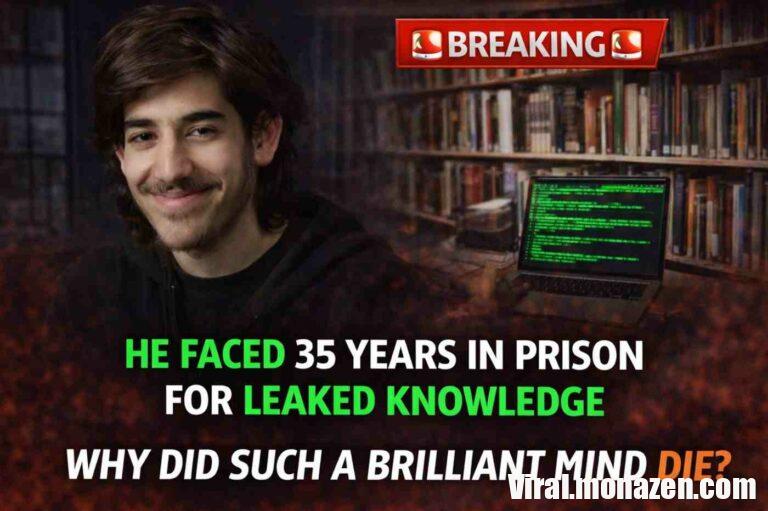
In the early years of the internet, a small group of young programmers quietly built technologies that would shape the digital world for decades. Among them was Aaron Swartz, a gifted coder, activist, and thinker whose life embodied both the promise and the tension of the modern information age.
By the time he was a teenager, Swartz had already contributed to tools that millions of people use every day. By his twenties, he had become a powerful voice in debates about open access to knowledge, internet freedom, and the future of information.
Yet his life ended tragically at just 26 years old after a high-profile legal battle that sparked global debate about justice, technology, and the price of challenging powerful institutions.
More than a decade later, the story of Aaron Swartz remains one of the most emotional and controversial chapters in the history of the digital era.
A Brilliant Mind From an Early Age
Aaron Swartz was born in 1986 in Chicago into a family that encouraged intellectual curiosity. His father ran a software company, and computers quickly became part of Aaron’s daily life.
Even as a child, he demonstrated an unusual ability to understand complex systems. At just 12 years old, he created an online encyclopedia called The Info Network, an early collaborative project similar in spirit to what Wikipedia would later become.
His passion for building tools that allowed people to share knowledge freely would become a defining theme throughout his life.
Helping Build the Infrastructure of the Internet
At 14 years old, Swartz became involved in developing RSS (Really Simple Syndication), a technology that allows websites to distribute updates automatically.
RSS became the backbone of how people subscribe to blogs, news sites, and podcasts. Even today, the concept remains embedded in many digital platforms that distribute content across the web.
Swartz was still a teenager when he joined a group of developers working on the Creative Commons licensing system, which allows creators to share their work legally while maintaining certain rights.
By his late teens, he was already regarded as a brilliant young figure within the internet community.
The Reddit Chapter
Swartz later co-founded Infogami, a startup focused on collaborative software. In 2005, the company merged with a young platform that would later become one of the most influential websites on the internet: Reddit.
Although Swartz’s time with Reddit was relatively short, the experience connected him with Silicon Valley and the rapidly growing tech startup ecosystem.
Yet unlike many entrepreneurs chasing billion-dollar valuations, Swartz’s interests increasingly turned toward activism and public policy.
He began to see the internet not simply as a business opportunity but as a powerful tool for social change.
A Voice for Open Information
Swartz believed strongly that information—particularly research funded by taxpayers—should be accessible to everyone.
Academic journals often sit behind expensive paywalls that can cost universities and individuals thousands of dollars each year. Critics argue this system limits access to knowledge that could benefit students, researchers, and the public.
Swartz became one of the most outspoken advocates for open access, a movement that seeks to make scholarly research freely available online.
In 2008, he wrote what became known as the “Guerrilla Open Access Manifesto,” calling on activists and researchers to challenge barriers that restrict knowledge.
To supporters, he was defending the idea that knowledge should belong to humanity.
To critics, his approach crossed legal boundaries.
The JSTOR Incident
In 2010 and 2011, Swartz used the Massachusetts Institute of Technology’s network to download millions of academic articles from the digital library JSTOR.
Authorities alleged that he used automated scripts to download the files in bulk.
Swartz’s supporters argued that his goal was not financial gain but to make academic research freely available to the public.
When the downloads were discovered, the material was returned to JSTOR, and the organization later declined to pursue legal charges.
However, the case did not end there.
A Federal Prosecution
Federal prosecutors charged Swartz with multiple counts under computer fraud laws, including the Computer Fraud and Abuse Act (CFAA).
The charges carried severe potential penalties — up to 35 years in prison and $1 million in fines if convicted on all counts.
Swartz’s legal team argued that the charges were disproportionate and that the case involved downloading academic papers, not hacking financial systems or stealing money.
Supporters, including prominent technologists and academics, began speaking out publicly.
They said the prosecution reflected outdated laws struggling to keep pace with the realities of the digital world.
The Emotional Toll
Throughout the legal proceedings, Swartz continued his activism.
He helped organize campaigns against internet censorship legislation such as SOPA (Stop Online Piracy Act), which many believed threatened the openness of the web.
But friends and colleagues later described how the ongoing legal pressure weighed heavily on him.
Swartz had previously spoken about experiencing depression, and the uncertainty of a prolonged federal trial added to the strain.
Negotiations between prosecutors and Swartz’s legal team continued for months as both sides discussed possible plea agreements.
A Tragic Ending
On January 11, 2013, Aaron Swartz was found dead in his Brooklyn apartment.
He was 26 years old.
News of his death spread quickly across the technology world.
Many who had followed his case were shocked and heartbroken. Vigils and memorials were held in cities across the United States and internationally.
His death also ignited a fierce debate about the justice system.
A Global Backlash
After Swartz’s passing, prominent figures in technology, law, and academia questioned whether the prosecution had been excessively aggressive.
Critics argued that prosecutors had pursued the case too harshly for a situation that involved no financial gain and where the data had already been returned.
Others defended the legal process, saying that unauthorized access to computer systems still represents a serious violation.
Regardless of where people stood on the legal arguments, Swartz’s story became a powerful symbol of the conflict between open information ideals and existing intellectual property laws.
Changes That Followed
In the years after Swartz’s death, discussions about reforming computer crime laws intensified.
Lawmakers introduced proposals informally known as “Aaron’s Law”, intended to narrow the scope of the Computer Fraud and Abuse Act.
Meanwhile, JSTOR released millions of academic articles for free public access in the years that followed.
Universities and publishers also began expanding open-access programs.
While these changes were not solely the result of Swartz’s activism, his story undoubtedly accelerated the global conversation about knowledge access.
A Legacy That Continues
Today, Aaron Swartz is remembered as a visionary who believed deeply in the power of the internet to democratize information.
To many technologists and activists, he represents the idea that technology should serve the public good.
His work continues to influence debates about digital rights, open access publishing, and internet freedom.
The questions raised by his story remain unresolved.
Who should control access to knowledge?
How should society balance intellectual property with public benefit?
And what responsibilities do institutions have when enforcing laws in the digital age?
The Human Cost of an Ideological Battle
Aaron Swartz’s life reminds us that the digital revolution is not only about code, servers, or platforms.
It is also about people — individuals whose ideas, actions, and struggles shape how technology evolves.
His story is ultimately not just about downloading academic papers or legal charges.
It is about a young man who believed passionately that knowledge should belong to everyone.
And about the complicated world that responded to that belief.