A potential campaign begins to take shape
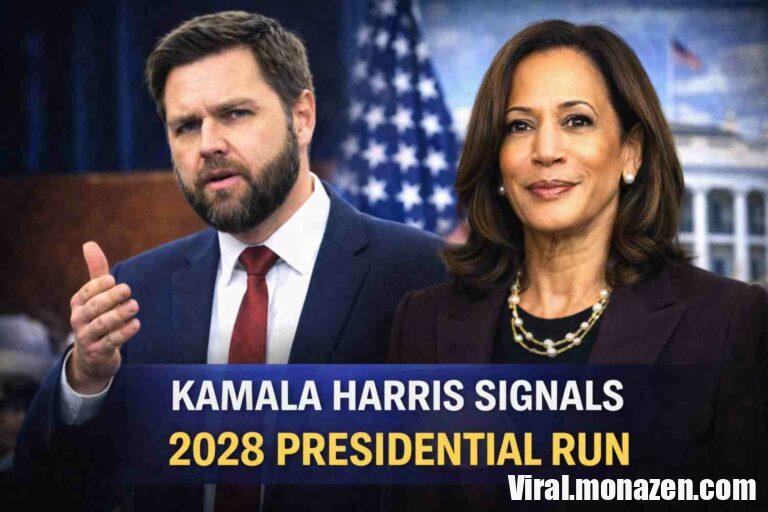
Discussion about the 2028 United States presidential election may seem premature to some observers, yet early political signals are already beginning to shape the conversation. Recent remarks attributed to Kamala Harris have sparked renewed speculation that she could seek the presidency when the next open race arrives.
While Harris has not formally declared a candidacy, comments suggesting she intends to remain active in national politics have drawn attention from analysts and political strategists alike. In Washington, even subtle signals about future ambitions can ripple across the political landscape.
For potential rivals within both major parties, the possibility of a Harris campaign introduces new calculations about timing, strategy, and coalition building.
Among the names frequently mentioned in early speculation is JD Vance, a rising Republican figure whose national profile has expanded rapidly in recent years.
Why the 2028 race is already drawing attention
Unlike many previous election cycles, the 2028 contest carries unusual significance because it is expected to follow a period of intense political polarization and generational transition in American leadership.
If current political patterns hold, both major parties could be entering a phase where new national figures attempt to redefine their party’s direction.
For Democrats, Harris represents continuity with the current administration while also embodying a younger generation of leadership. For Republicans, figures such as Vance are often seen as part of a broader shift toward populist and nationalist political themes.
Because of this dynamic, the early positioning of these figures is being watched closely by political insiders.
Harris’s path to national prominence
Kamala Harris’s rise in American politics has been both historic and closely scrutinized. Before becoming vice president, she served as Attorney General of California and later as a United States Senator.
Her election as vice president in 2020 marked a milestone in U.S. political history, making her the first woman, the first Black American, and the first person of South Asian heritage to hold the office.
Throughout her time in national politics, Harris has focused on issues including voting rights, healthcare access, economic opportunity, and criminal justice reform.
Supporters view her as a skilled prosecutor and policy advocate capable of navigating complex legislative debates. Critics, meanwhile, have sometimes questioned her political positioning or communication strategy.
Yet regardless of those debates, Harris remains one of the most recognizable figures in American public life.
JD Vance and the Republican future
Across the political aisle, JD Vance has emerged as a prominent voice within the Republican Party.
Known initially for his bestselling memoir Hillbilly Elegy, which examined the economic struggles of working-class communities in the United States, Vance later entered politics and won a Senate seat representing Ohio.
Since arriving in Washington, he has positioned himself as a strong advocate for economic nationalism, border security, and a foreign policy that emphasizes domestic priorities.
Many Republican strategists see him as part of a younger generation of leaders who could shape the party’s future direction.
Although it remains far too early to predict which candidates will ultimately compete in the 2028 race, Vance’s growing visibility has placed him among the figures frequently mentioned in early speculation.
The long road to a presidential campaign
In American politics, presidential campaigns often begin years before voters cast their ballots.
Potential candidates typically spend considerable time building networks of donors, advisors, and political supporters. They also travel extensively, speaking at policy forums, party events, and local gatherings in key states.
Even small public remarks can be interpreted as signals about future ambitions.
For Harris, the decision to pursue the presidency would likely depend on a variety of factors, including the political climate, the state of the Democratic Party, and her own assessment of the national mood.
Similarly, Republicans considering a run will evaluate their chances within a party that continues to debate its ideological direction.
Early positioning and political messaging
Political analysts note that early positioning allows potential candidates to test messages and gauge public reaction.
By discussing issues such as economic opportunity, national security, or healthcare reform, potential contenders can begin shaping the themes that might define their campaigns.
In Harris’s case, her speeches often emphasize themes of democratic participation and economic fairness.
Vance, on the other hand, has frequently highlighted concerns about globalization, industrial decline, and the cultural divisions that he believes have reshaped American politics.
These contrasting perspectives illustrate the broader ideological debates that could dominate the next presidential election cycle.
How early speculation shapes strategy
Although formal campaigning for 2028 remains years away, early speculation can still influence political strategy.
Party leaders, advocacy groups, and major donors often begin considering potential candidates long before official announcements occur.
Fundraising networks, grassroots organizers, and political consultants all play roles in shaping the environment in which campaigns eventually emerge.
For candidates, maintaining visibility while avoiding premature campaign declarations can be a delicate balancing act.
Too much early speculation can create unrealistic expectations, while too little visibility may leave a candidate struggling to gain recognition later.
The broader political landscape
The potential contest between figures like Harris and Vance also reflects deeper trends in American politics.
The United States has experienced growing ideological polarization over the past two decades, with major policy debates often dividing sharply along party lines.
Issues such as immigration, economic inequality, climate policy, and foreign relations continue to generate intense discussion among voters.
Whoever emerges as the leading candidates in 2028 will need to address these challenges while appealing to a diverse electorate.
Political analysts suggest that the next presidential race may also hinge on questions about generational change, economic transformation, and the role of the United States on the global stage.
A reminder of how quickly politics evolves
Despite the early speculation, seasoned observers caution that political landscapes can shift dramatically between now and 2028.
Unexpected events, economic changes, and emerging leaders can all alter the trajectory of an election cycle.
History offers numerous examples of candidates who appeared dominant years before an election only to see new figures rise unexpectedly.
As a result, analysts emphasize that discussions about potential campaigns should be viewed as part of a broader conversation rather than definitive predictions.
Looking ahead
For now, the possibility of Kamala Harris pursuing the presidency in 2028 remains just that—a possibility.
Yet even the suggestion of such a campaign has already begun to influence political discussion in Washington and beyond.
Whether Harris ultimately enters the race, and whether figures like JD Vance emerge as leading contenders, will depend on developments over the coming years.
What is clear, however, is that the next presidential cycle may represent a significant turning point in American politics.
With new leaders preparing to step onto the national stage, the early outlines of the 2028 race are beginning to come into view—long before the first ballots are cast.