
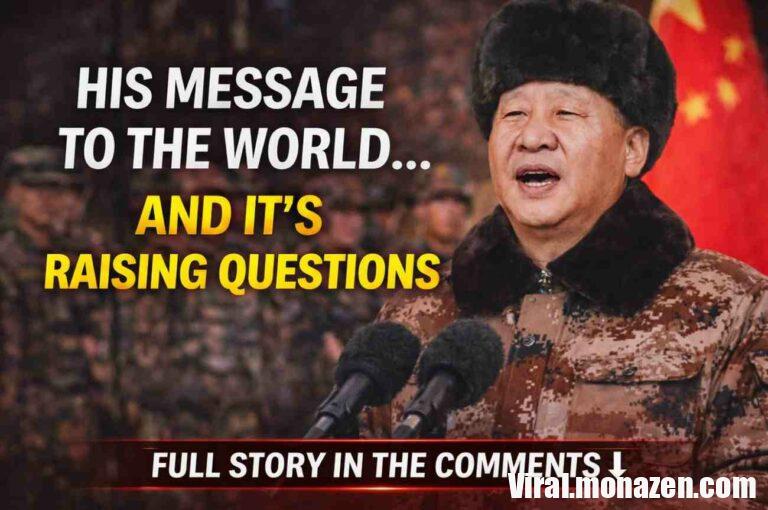
In a statement that has drawn attention from political analysts around the world, Xi Jinping declared that China does not seek global domination but instead aims to “liberate the world from those who believe they own it.”
The remark reflects a broader narrative often presented by the Chinese leadership: that China sees itself as a champion of global stability, economic cooperation, and multipolar governance.
Yet the statement has also triggered debate among diplomats and scholars, many of whom say the message highlights the widening ideological divide between China and Western nations over the future of the international system.
As tensions between major powers continue to shape global politics, Xi’s words offer a window into how Beijing views its role on the world stage.
China’s Vision of a Multipolar World
Chinese officials frequently emphasize the idea of a “multipolar world order.”
This concept refers to a global system where multiple powerful nations share influence, rather than one or two dominant superpowers shaping international rules.
For decades following the Cold War, the United States was widely seen as the leading global power.
China’s rapid economic rise, however, has shifted that balance.
Under Xi Jinping’s leadership, Beijing has promoted the idea that global governance should reflect the interests of many nations rather than a single dominant bloc.
Supporters of this approach argue that a multipolar system could reduce geopolitical tensions by distributing power more evenly among countries.
Critics, however, worry that such a shift could weaken international institutions and rules developed over decades.
Xi Jinping’s Leadership and Global Ambitions
Since becoming China’s president in 2013, Xi Jinping has overseen a period of significant transformation in China’s global strategy.
China has expanded its diplomatic influence, invested heavily in global infrastructure projects, and strengthened its military capabilities.
One of the most prominent initiatives under Xi’s leadership is the Belt and Road Initiative, which aims to connect Asia, Europe, Africa, and other regions through transportation, energy, and trade networks.
Chinese officials say the program promotes economic development and mutual prosperity.
However, critics in some countries argue that the initiative can create financial dependence on Beijing and increase China’s geopolitical influence.
These competing interpretations reflect broader disagreements about China’s long-term strategic goals.
The Language of “Liberation”
Xi’s recent remark about “liberating the world from those who believe they own it” echoes language that has appeared in Chinese diplomatic messaging in recent years.
Chinese leaders often frame their country’s rise as part of a broader effort to challenge what they describe as “hegemonic power structures.”
In this narrative, China positions itself as a defender of national sovereignty and development rights for countries that feel marginalized within the existing global system.
Beijing has also emphasized principles such as non-interference in domestic affairs and respect for different political systems.
These ideas resonate with many developing nations that have historically resisted external political pressure.
At the same time, critics argue that China’s rhetoric about sovereignty sometimes conflicts with its own assertive policies in regions such as the South China Sea.
The Western Perspective
Governments in Western countries often interpret China’s growing influence through a different lens.
Some policymakers argue that Beijing’s expanding economic, technological, and military capabilities represent a strategic challenge to existing international norms.
For example, concerns have been raised about issues such as:
- Technology competition and data security
- Military expansion in Asia-Pacific waters
- Trade imbalances and economic policies
The European Union and the United States have both sought to balance cooperation with China while addressing these concerns.
This balancing act reflects the complex reality of global interdependence: China remains a critical trading partner for many nations even as geopolitical tensions persist.
China’s Emphasis on Development and Stability
Chinese officials frequently emphasize economic development as the cornerstone of their international engagement.
They argue that poverty reduction, infrastructure investment, and technological cooperation can bring stability to regions facing economic challenges.
In speeches at international forums, Xi Jinping has often framed China’s rise as an opportunity for global progress.
China’s own development story is frequently cited as an example.
Over the past four decades, the country has lifted hundreds of millions of people out of poverty, transforming itself into the world’s second-largest economy.
Supporters of China’s global approach say this experience positions the country to contribute meaningfully to development initiatives around the world.
Strategic Rivalries and Global Competition
Despite Beijing’s emphasis on cooperation, strategic competition between major powers remains a defining feature of modern geopolitics.
China’s growing military capabilities, particularly in the Indo-Pacific region, have led to increased attention from neighboring countries and global alliances.
Nations such as Japan, India, and Australia have strengthened security partnerships in response to shifting regional dynamics.
Meanwhile, the United States has deepened cooperation with allies through frameworks such as security dialogues and regional partnerships.
These developments illustrate the broader strategic competition shaping international relations today.
Diplomacy in a Divided World
Xi Jinping’s message also reflects China’s effort to present itself as a stabilizing force in global affairs.
In recent years, Beijing has taken part in diplomatic initiatives related to trade negotiations, climate agreements, and regional conflicts.
Chinese leaders often argue that dialogue and economic cooperation are preferable to confrontation.
However, geopolitical realities mean that diplomacy is often accompanied by strategic maneuvering.
Countries frequently pursue cooperation in some areas while competing fiercely in others.
This dual dynamic has become a defining feature of international relations in the twenty-first century.
Global Reactions to Xi’s Statement
Xi’s recent remarks have sparked a wide range of reactions from political leaders, analysts, and commentators.
Some observers see the statement as part of China’s effort to reshape the narrative surrounding its rise.
Others view it as a reflection of deeper ideological competition between different visions of global governance.
For many countries, the question is less about choosing sides and more about navigating relationships with multiple major powers.
As global challenges such as climate change, economic instability, and security risks continue to evolve, cooperation among nations remains essential.
A World in Transition
Xi Jinping’s statement about liberating the world highlights the broader transformation currently underway in international politics.
The global system is increasingly defined by shifting alliances, rising powers, and new forms of competition.
For policymakers and citizens alike, understanding these changes is essential to navigating the future.
Whether China’s vision of global leadership will ultimately reshape international governance remains uncertain.
What is clear, however, is that the conversation about the future of global power—and the role China will play in it—has become one of the most important debates of our time.
And as the world continues to evolve, the balance between cooperation, competition, and diplomacy will shape the international order for decades to come.