
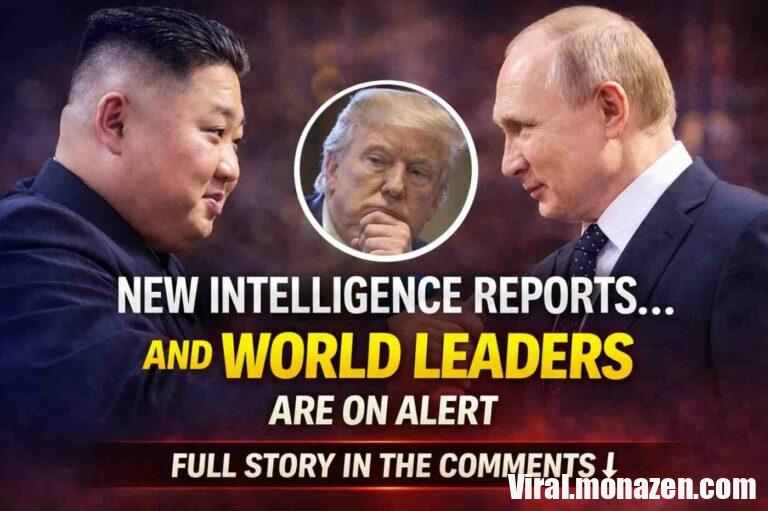
A series of emerging intelligence reports has drawn international attention to the growing complexity of global power dynamics. According to multiple sources cited by Western officials, concerns are mounting that sensitive military intelligence may have been shared between Russia and Iran, potentially involving information about American military positions in the Middle East.
At the same time, analysts say Kim Jong-un has reportedly increased military activity in North Korea, raising additional concerns among security experts who fear that overlapping geopolitical tensions could create new flashpoints in already volatile regions.
While the full details of the intelligence reports remain unclear, the developments have triggered debate among diplomats, military analysts, and policymakers about whether a new phase of strategic rivalry is emerging.
Intelligence Concerns in the Middle East
According to officials cited in various media reports, U.S. intelligence agencies are examining claims that Russia may have provided Iran with information related to American military deployments in the Middle East.
The alleged data could include details about:
- Locations of U.S. naval vessels operating in regional waters
- Flight patterns of military aircraft
- Positioning of troops and equipment in strategic bases
Some reports suggest that the intelligence may involve satellite imagery and electronic tracking data, which could theoretically allow foreign governments to monitor movements of U.S. military assets.
Officials have not publicly confirmed the specific nature or scope of the information.
However, security analysts say such intelligence sharing—if verified—could represent a notable development in the evolving relationship between Moscow and Tehran.
The Kremlin’s Response
Officials in the Russia have not confirmed the allegations.
In previous situations involving similar claims, Russian authorities have often rejected accusations of providing sensitive military intelligence to foreign governments.
Diplomatic observers note that Russia and Iran maintain a complex relationship that includes cooperation in several areas, including regional security and energy policy.
However, both countries have historically denied coordinating actions that could directly threaten U.S. forces.
Without official confirmation from either government, the current reports remain part of an ongoing intelligence assessment.
Rising Military Activity in North Korea
Adding another layer of concern, analysts say Kim Jong-un has recently overseen an increase in military exercises and weapons demonstrations.
North Korea has conducted numerous missile tests in recent years, often presenting them as demonstrations of its defensive capabilities.
Regional observers say such tests typically serve multiple purposes:
- Signaling military strength
- Demonstrating technological advancements
- Sending political messages to foreign governments
The timing of the recent activity has attracted attention because it coincides with rising tensions elsewhere in the international system.
Although there is no confirmed connection between North Korea’s actions and the situation involving Iran and Russia, experts say simultaneous developments across multiple regions can complicate diplomatic efforts.
The Strategic Importance of the Middle East
The Middle East has long been a focal point of global strategic competition.
Several major powers maintain military forces or alliances in the region, including the United States, Russia, and various regional governments.
American forces operate from bases across the Middle East and regularly conduct naval patrols and air operations designed to ensure freedom of navigation and regional security.
Because of this presence, intelligence related to U.S. troop movements or equipment deployments is considered highly sensitive.
Any attempt by rival powers to track or analyze those movements would likely draw strong concern from American defense officials.
The White House Reaction
Officials in the White House have responded cautiously to the reports.
According to statements provided to reporters, U.S. authorities are closely monitoring the situation but have not indicated that American military operations in the region have been disrupted.
Defense officials say the U.S. military routinely plans for potential intelligence leaks and maintains multiple safeguards designed to protect operational security.
These safeguards include encrypted communications, counterintelligence measures, and strategic redundancy in military planning.
As a result, even if adversaries obtain partial information about deployments, it does not necessarily compromise operational effectiveness.
Growing Cooperation Between Moscow and Tehran?
One of the key questions emerging from the reports is whether the alleged intelligence sharing reflects a broader deepening of ties between Russia and Iran.
Over the past decade, the two countries have increasingly cooperated in areas such as:
- Military coordination in regional conflicts
- Energy and economic partnerships
- Diplomatic alignment in international forums
Analysts note that geopolitical pressures—such as sanctions and global rivalries—have sometimes encouraged countries to expand partnerships with one another.
However, the extent of intelligence cooperation between Russia and Iran remains unclear.
Global Power Competition in a Changing World
The developments are unfolding during a period of significant global transition.
The international order that emerged after the Cold War is increasingly shaped by competition between major powers.
Countries such as Russia, China, and the United States are competing for influence across economic, technological, and military domains.
At the same time, regional powers are pursuing their own strategic objectives, which can intersect with global rivalries.
Experts say this environment creates a complex web of alliances and rivalries that can shift quickly depending on circumstances.
The Risk of Escalation
While no direct military confrontation has been confirmed, analysts caution that misunderstandings or miscalculations can escalate tensions rapidly.
Intelligence disputes, military exercises, and political messaging all play roles in shaping how nations interpret one another’s intentions.
Diplomatic channels are often used to prevent misunderstandings from escalating into larger crises.
Historically, even during periods of intense geopolitical rivalry, communication between major powers has been critical in avoiding unintended conflict.
The Role of Diplomacy
Despite the tensions, international diplomacy continues to operate behind the scenes.
Governments often engage in quiet negotiations aimed at reducing tensions, clarifying intentions, and preventing escalation.
International institutions and regional organizations also play roles in facilitating dialogue.
In many cases, diplomatic engagement occurs even while public rhetoric appears confrontational.
Experts say maintaining open lines of communication remains one of the most effective tools for preventing conflicts from spiraling out of control.
A World Watching Closely
As intelligence assessments continue and governments evaluate the reports, observers around the world are watching closely.
The situation illustrates how events in different regions—from Eastern Europe to the Middle East to East Asia—can intersect within the broader framework of global politics.
For policymakers, the challenge lies in balancing vigilance with restraint, ensuring that tensions are managed without escalating into wider confrontations.
Whether the current reports prove to be accurate or exaggerated, they serve as a reminder of how interconnected modern geopolitics has become.
And in a world where information travels instantly, even unconfirmed intelligence claims can shape perceptions, strategies, and diplomatic relationships across the globe.