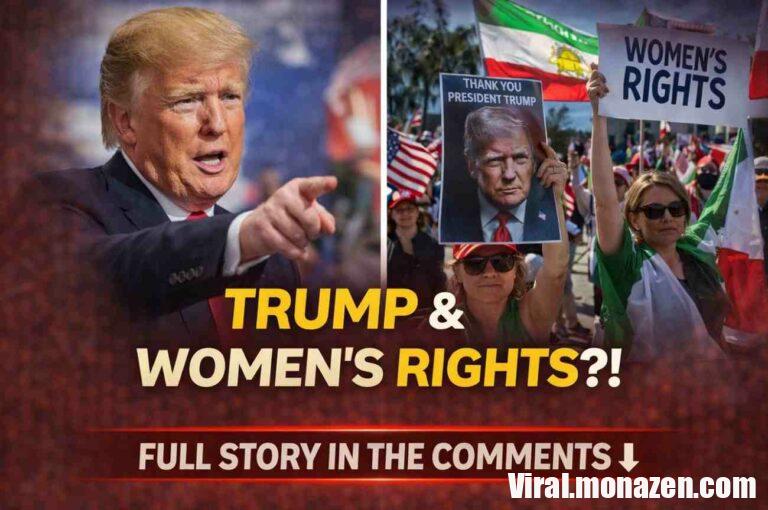
A viral political post circulating across social media platforms has reignited a familiar and deeply polarizing debate in American politics: which political leaders have done the most to advance women’s rights.
The post, shared widely by partisan political pages, claims that former President Donald Trump has “done more for women’s rights around the world than any Democrat alive today.” Supporters of the message argue that Trump’s foreign policy initiatives, anti-trafficking efforts, and economic policies helped improve conditions for women both domestically and internationally.
Critics, however, strongly dispute the claim, pointing to policies and controversies during Trump’s presidency that they argue undermined women’s rights in areas such as reproductive healthcare, workplace protections, and international aid.
The viral message highlights how debates about gender equality, global leadership, and political ideology remain central to the ongoing cultural and political divide in the United States.
The Origins of the Viral Claim
Posts praising Trump’s impact on women’s rights have circulated online for years, often resurfacing during election cycles or major political events.
Many of these posts cite several policies from Trump’s presidency between 2017 and 2021 as evidence that his administration prioritized protecting women and girls around the world.
Among the initiatives often mentioned by supporters are efforts to combat human trafficking, diplomatic agreements in the Middle East that supporters say improved stability in the region, and economic policies that some argue created opportunities for women in the workforce.
However, political analysts caution that viral posts frequently simplify complex policy records into highly partisan narratives.
In reality, the impact of any administration on global women’s rights is typically debated among scholars, activists, and policymakers.
Anti-Trafficking Efforts During the Trump Administration
One policy area frequently cited by Trump supporters is the administration’s emphasis on combating human trafficking.
During his presidency, the federal government increased funding for anti-trafficking programs and launched initiatives aimed at identifying and prosecuting trafficking networks.
The administration also established the President’s Interagency Task Force to Monitor and Combat Trafficking in Persons, bringing together multiple federal agencies to coordinate enforcement and victim support.
Supporters say these measures strengthened the federal response to exploitation and helped raise public awareness about trafficking.
Human rights organizations generally welcomed increased attention to the issue, although some advocates argued that broader immigration policies sometimes complicated protections for trafficking victims.
Economic Policies and Women in the Workforce
Supporters of the former president also point to economic indicators from the period before the COVID-19 pandemic.
In early 2020, data from the U.S. Labor Department showed that female unemployment rates had reached historic lows.
Some economists attribute part of that trend to broader economic growth during the late 2010s, which benefited multiple demographic groups.
Supporters argue that lower unemployment and tax reforms created new opportunities for women entrepreneurs and workers.
Critics counter that many of these economic trends began before Trump took office and that economic gains were uneven across different sectors and communities.
Foreign Policy and the Middle East
Another argument often raised by Trump supporters involves the Abraham Accords, the diplomatic agreements that normalized relations between Israel and several Arab nations.
Advocates of the policy say the agreements contributed to greater regional stability and economic cooperation, which could indirectly benefit women through expanded educational and employment opportunities.
However, critics note that the accords primarily addressed diplomatic recognition and trade relationships rather than specific women’s rights protections.
They argue that improvements in gender equality within Middle Eastern societies depend largely on internal reforms rather than external diplomatic agreements.
Critics Point to Controversial Policies
Opponents of the viral claim highlight a number of policies from the Trump era that they believe harmed women’s rights.
One frequently cited issue involves reproductive healthcare.
The Trump administration supported restrictions on federal funding for international family planning organizations that provided or discussed abortion services — a policy sometimes referred to as the “global gag rule.”
Advocates for reproductive rights argued that the policy reduced access to healthcare for women in developing countries.
Supporters of the policy, however, framed it as a measure intended to prevent taxpayer funding from supporting abortion services overseas.
Domestic Gender Policy Debates
Debates over women’s rights also intensified within the United States during Trump’s presidency.
Issues such as workplace harassment protections, Title IX regulations on sexual misconduct in schools, and the role of transgender athletes in women’s sports became major political flashpoints.
Supporters of Trump often argue that policies addressing fairness in sports and school policies were intended to protect opportunities for women.
Critics say some of those policies restricted protections for marginalized groups and complicated enforcement of anti-discrimination rules.
These disputes reflect broader disagreements about how gender equality should be defined and implemented.
Political Messaging and Partisan Narratives
The viral post praising Trump’s impact on women’s rights also illustrates how political messaging functions in the digital era.
Social media platforms allow political supporters to frame complex policy debates in simple, emotionally powerful terms.
Supporters often highlight achievements they believe demonstrate strong leadership, while critics emphasize policies they consider harmful.
Political scientists note that such messaging is not unique to any party.
Both major political movements in the United States use viral graphics, slogans, and posts to energize supporters and shape public perception.
The Global Context of Women’s Rights
Beyond American politics, the broader issue of women’s rights remains a global challenge.
Organizations such as the United Nations and the World Bank track progress in areas including education, healthcare access, workplace equality, and protection from violence.
While progress has been made in many countries, advocates note that gender inequality remains widespread.
Government policies — whether from the United States or other nations — can influence global initiatives through foreign aid, diplomacy, and international partnerships.
For this reason, debates about the role of American leadership in advancing women’s rights often extend beyond domestic politics.
Why the Debate Persists
The passionate reactions to the viral post reveal how deeply questions of gender equality are intertwined with broader political identity.
For Trump supporters, highlighting policies they believe benefited women reinforces their view that the former president challenged traditional political narratives.
For critics, the claim represents what they see as an attempt to rewrite or selectively interpret policy history.
These competing interpretations illustrate the difficulty of evaluating complex political legacies in a highly polarized environment.
The Bottom Line
The viral claim that Donald Trump has done more for women’s rights globally than any Democrat today reflects a broader political argument rather than a universally accepted fact.
Like many political debates, the issue involves competing interpretations of policy outcomes, economic trends, and international diplomacy.
Supporters point to anti-trafficking initiatives, economic growth, and foreign policy achievements as evidence of progress.
Critics point to healthcare restrictions, policy controversies, and other decisions they argue undermined gender equality.
Ultimately, the question of which leaders have most effectively advanced women’s rights remains a matter of perspective — shaped by political values, policy priorities, and differing interpretations of what progress looks like.
And as long as these issues remain central to American politics, debates like this one are likely to continue dominating both social media conversations and national political discourse.