
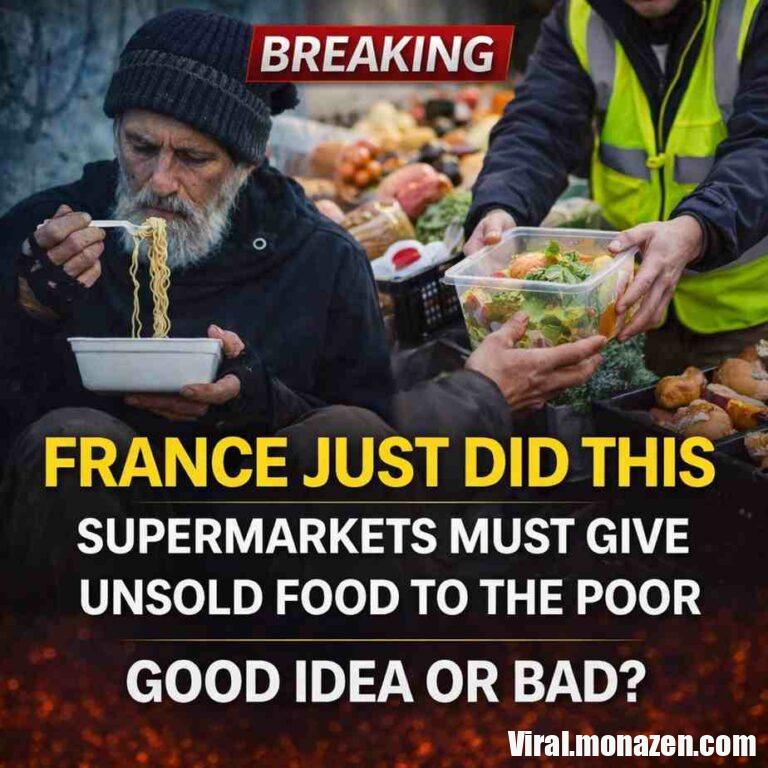
In recent years, the global conversation around food waste has grown louder, with policymakers, environmentalists, and humanitarian organizations highlighting the staggering amount of edible food that ends up in landfills every year. Amid this growing concern, France took a groundbreaking step that has since drawn international attention. Through a law widely known as the Loi Garot, the country became the first in the world to require large supermarkets to donate unsold but still edible food to charities rather than throw it away.
The measure, adopted in 2016, reflects a broader national commitment to addressing two interconnected issues: food insecurity and environmental sustainability. By forcing retailers to rethink how they handle unsold products, France has positioned itself at the forefront of innovative policies aimed at reducing waste while helping vulnerable populations.
The Problem of Food Waste
Globally, food waste is a massive challenge. According to estimates from international organizations, roughly one-third of all food produced worldwide is lost or wasted each year. This waste occurs across every stage of the food supply chain—from farms and factories to grocery stores and households.
In developed countries, supermarkets and consumers are responsible for a significant portion of that waste. Perfectly edible items are often discarded due to strict aesthetic standards, approaching expiration dates, or logistical inefficiencies in inventory management.
In France alone, prior to the adoption of the Loi Garot, millions of tons of food were being thrown away annually. At the same time, many families struggled to afford groceries, and food banks faced constant shortages in meeting rising demand.
For policymakers and social advocates, the contradiction was impossible to ignore: vast quantities of edible food were being destroyed while people went hungry.
The Birth of the Loi Garot
The law is named after Guillaume Garot, a former French minister and member of parliament who championed the legislation. Garot argued that food waste was not only an environmental problem but also a moral and social one.
The law was passed with overwhelming political support in the French parliament. Its central provision requires supermarkets larger than 400 square meters (about 4,300 square feet) to sign donation agreements with charities or food banks.
Instead of disposing of edible products nearing their sell-by dates, supermarkets must redirect them to organizations that distribute food to people in need.
Stores that fail to comply can face fines of up to €10,000, creating a clear incentive for retailers to participate in the program.
How the Law Works in Practice
The implementation of the law requires coordination between several actors: supermarkets, charities, food banks, and local governments.
Retailers must separate unsold food into categories. Products that remain safe to consume—such as packaged goods, fresh produce, or baked items—are collected by partner charities and redistributed through food assistance networks.
Many of these organizations already operated donation systems before the law was introduced, but the legislation significantly expanded the scale and consistency of the process.
To facilitate the transition, supermarkets also improved their inventory tracking systems and developed partnerships with local nonprofit organizations.
Some stores even designated specific areas for preparing food donations, ensuring that products remain safe and properly handled before distribution.
Environmental Benefits
Beyond its humanitarian impact, the Loi Garot also addresses environmental concerns.
Food waste contributes significantly to greenhouse gas emissions. When organic waste decomposes in landfills, it releases methane—a potent greenhouse gas that contributes to climate change.
By redirecting edible food away from landfills, the law reduces the environmental footprint of the food supply chain.
In addition, reducing waste helps conserve the resources used to produce food in the first place. Agriculture requires vast amounts of water, energy, and land. Preventing food from being wasted ensures that these resources are not squandered.
Environmental advocates have praised the law as an example of how policy can address climate issues while delivering social benefits.
Helping Families in Need
For charities and food banks, the impact of the law has been substantial.
Organizations such as Banques Alimentaires, one of France’s largest food bank networks, have reported significant increases in the volume of food donations since the law took effect.
This additional supply allows charities to reach more families struggling with food insecurity.
France, like many countries, has experienced rising economic pressures in recent years, including inflation and housing costs that place financial strain on households.
Access to donated food helps alleviate some of these pressures for vulnerable communities, including low-income families, retirees on fixed incomes, and people experiencing homelessness.
For many recipients, the program provides not only essential nutrition but also a sense of dignity, knowing that food is being shared rather than discarded.
Changing Corporate Behavior
One of the most interesting outcomes of the Loi Garot has been how it has changed the behavior of supermarkets themselves.
Rather than simply donating excess food, many retailers have taken steps to reduce waste earlier in the supply chain.
Improved inventory forecasting, dynamic pricing strategies for near-expiration products, and smaller batch ordering have all helped supermarkets minimize surplus stock.
Some retailers have introduced discounted sections specifically for products approaching their expiration dates, encouraging customers to purchase items that might otherwise be discarded.
In this way, the law has not only redirected waste but also encouraged businesses to rethink their overall approach to food management.
International Influence
France’s initiative has attracted global attention, inspiring similar conversations in other countries.
Several European nations—including Italy and Spain—have introduced measures aimed at reducing food waste, although their approaches vary.
Some countries emphasize tax incentives for donations rather than legal requirements. Others focus on educational campaigns aimed at reducing consumer waste.
Nonetheless, France’s model remains one of the most comprehensive and enforceable examples of anti-waste legislation.
International organizations and policymakers often cite the Loi Garot as a potential blueprint for other nations seeking to address both hunger and environmental sustainability.
Criticism and Challenges
Despite widespread praise, the law has also faced some criticism and logistical challenges.
Some retailers initially expressed concerns about the cost and complexity of implementing donation systems. Handling, transporting, and storing donated food requires coordination and resources.
Charities have also encountered challenges managing the increased volume of food, including ensuring adequate refrigeration and distribution infrastructure.
Another issue is that the law focuses primarily on supermarkets, while a significant portion of food waste occurs earlier in the supply chain or in households.
Critics argue that broader reforms—covering farms, restaurants, and consumers—are necessary to tackle the full scale of the problem.
Still, most observers agree that the law represents an important step forward.
A Cultural Shift
Beyond its legal framework, the Loi Garot has contributed to a broader cultural shift in how food waste is perceived in France.
Public awareness campaigns and media coverage surrounding the law have encouraged citizens to reconsider their own habits.
Consumers are increasingly conscious of buying only what they need, using leftovers creatively, and supporting businesses that prioritize sustainability.
Schools and community organizations have also incorporated lessons about food waste into educational programs, reinforcing the message that reducing waste is a shared responsibility.
A Model for the Future
Nearly a decade after its adoption, France’s supermarket food donation law continues to influence discussions about sustainable policy and social responsibility.
While no single law can eliminate food waste entirely, the Loi Garot demonstrates how targeted legislation can address multiple challenges simultaneously—reducing environmental harm while helping those in need.
As countries around the world search for solutions to climate change and food insecurity, France’s experience offers an important lesson: sometimes the most effective policies are those that transform everyday practices in simple but meaningful ways.
By ensuring that edible food reaches people rather than landfills, France has turned a problem of excess into an opportunity for solidarity.