
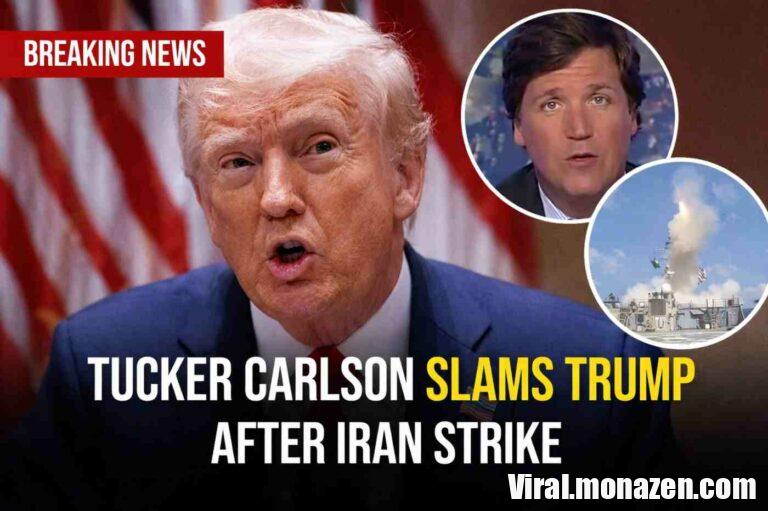
A political moment that quickly caught fire
Political disagreements inside the same ideological camp often attract the most attention. That was exactly the case when commentator Tucker Carlson delivered a pointed critique of former U.S. President Donald Trump following news related to tensions involving Iran.
Within hours, clips of Carlson’s remarks began circulating online. Social media feeds filled with reactions, analysis, and speculation about what his words might mean for the broader political conversation in the United States.
For many observers, the moment stood out not just because of what was said, but because of who said it. Carlson and Trump have often shared overlapping audiences and policy perspectives, particularly on issues like media criticism, populist politics, and American foreign policy.
When voices from similar political spaces disagree publicly, it tends to resonate more strongly with viewers and readers.
The context behind the criticism
Debate surrounding Iran has long been one of the most complex and sensitive areas of U.S. foreign policy.
Over the years, discussions have focused on several key issues:
- nuclear negotiations and international agreements
- regional security in the Middle East
- sanctions and economic pressure
- the risk of military escalation
Any action or statement connected to these topics can quickly become a global story.
In the situation that sparked Carlson’s comments, discussion centered around reports of a military strike and the broader strategy behind it. Analysts and commentators across the political spectrum began weighing in on whether such actions strengthen or weaken long-term stability.
Carlson’s remarks entered the conversation during this already heated debate.
A critique that surprised many viewers
During his commentary, Carlson questioned aspects of the decision-making and its potential consequences.
Rather than focusing solely on partisan arguments, he framed his criticism around a familiar theme in American political discussion: the cost of foreign conflicts and the importance of careful strategic planning.
This perspective has gained increasing traction in recent years among both conservative and progressive commentators who argue that military interventions abroad must be approached with caution.
Carlson’s remarks appeared to echo those concerns, emphasizing that foreign policy decisions often have ripple effects far beyond the immediate moment.
Why disagreements within political circles draw attention
Political debates are often framed as clashes between opposing parties. However, disagreements within the same political movement can be even more significant.
They signal that policy discussions are evolving rather than remaining fixed.
In this case, the exchange highlighted an ongoing conversation inside parts of the American political landscape about how the country should approach international conflicts.
Some leaders advocate strong military deterrence as a way to prevent larger crises.
Others argue that restraint and diplomacy may reduce the risk of unintended escalation.
These debates are not new. In fact, they have shaped U.S. foreign policy for decades.
The role of media voices in shaping political conversation
Commentators like Carlson play an influential role in modern political discourse.
Television hosts, podcast creators, and online personalities now operate alongside traditional journalists in shaping how audiences interpret major events.
Their commentary can influence public perception, raise questions that officials must address, and sometimes shift the tone of political discussion.
At the same time, media figures also face criticism for the way debates are framed. Supporters often view them as voices willing to challenge powerful institutions, while critics argue that commentary can sometimes oversimplify complex geopolitical issues.
Regardless of perspective, the reach of modern media ensures that moments like this travel quickly across platforms.
Social media accelerates the conversation
In previous decades, political debates unfolded more slowly.
Television broadcasts, newspaper editorials, and press conferences shaped the pace of discussion.
Today, social media compresses that timeline dramatically.
Clips from Carlson’s remarks spread rapidly across platforms such as X, Facebook, and YouTube. Within hours, the exchange had generated thousands of comments and reactions.
Some viewers applauded the critique as an example of independent thinking.
Others defended Trump’s approach to foreign policy and argued that strong actions are sometimes necessary to deter threats.
The result was a familiar digital phenomenon: a single moment becoming the center of a much larger online debate.
Why foreign policy debates are often so intense
Issues involving international conflict tend to provoke strong reactions because of what is at stake.
Military actions carry consequences that extend far beyond domestic politics. They affect alliances, regional stability, and the lives of people in multiple countries.
Even the possibility of escalation can influence global markets, particularly energy prices, which are closely tied to developments in the Middle East.
Because of these factors, discussions about Iran frequently attract worldwide attention.
Political leaders, journalists, and analysts all recognize that decisions made in moments of tension can shape international relations for years.
The broader question behind the disagreement
At its core, Carlson’s critique reflects a larger question that has surfaced repeatedly in American politics:
How should the United States balance military strength with diplomatic strategy?
Supporters of a more assertive approach argue that strong action deters adversaries and protects national security interests.
Those advocating restraint warn that escalating conflicts can create unintended consequences and long-term instability.
These perspectives often coexist within the same political coalition, which explains why debates can sometimes appear surprising to outside observers.
What this moment tells us about modern political debate
The exchange between Carlson and Trump illustrates how political conversations have evolved in the digital age.
Public figures no longer communicate solely through official speeches or press conferences. Instead, commentary, podcasts, and social media posts shape narratives almost instantly.
As a result, political disagreements can emerge quickly and spread widely before traditional reporting fully analyzes the situation.
For audiences, this environment requires a careful approach to interpreting viral content. Headlines and clips may highlight dramatic moments, but understanding the full context often requires deeper analysis.
Looking ahead
Whether Carlson’s remarks will have a lasting impact on the broader political landscape remains uncertain.
Moments like this sometimes fade quickly as new stories dominate the news cycle.
However, they can also signal underlying shifts in how influential voices approach major policy questions.
For voters and observers, the exchange serves as a reminder that political alliances are rarely monolithic. Even figures who share common audiences or ideological leanings may diverge when discussing complex issues such as foreign policy.
As tensions involving Iran continue to develop, debates about strategy, restraint, and international security are likely to remain central topics in political discourse.
And as this moment demonstrated, those debates can sometimes come from unexpected directions.