
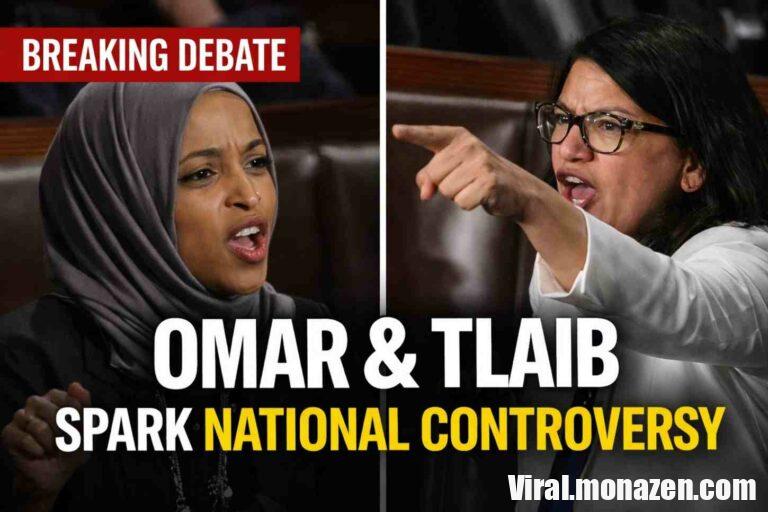
A question circulating widely online
In recent days, a provocative question has circulated across social media platforms and political forums: should members of Congress ever be removed from office because of their political views or public statements?
The discussion has frequently centered on two prominent figures in the U.S. House of Representatives — Ilhan Omar of Minnesota and Rashida Tlaib of Michigan.
Images, posts, and headlines have asked whether the two lawmakers should be removed from Congress, reflecting the increasingly polarized nature of political debate in the United States.
While such questions often generate strong reactions online, the reality of how Congress functions — and how elected officials can actually be removed — is far more complex than viral posts might suggest.
Who are Ilhan Omar and Rashida Tlaib?
Both Omar and Tlaib have become nationally recognized political figures since entering Congress in 2019.
Ilhan Omar made history as one of the first Muslim women elected to the U.S. Congress and the first Somali-American member of the House of Representatives.
Rashida Tlaib also broke barriers as one of the first Muslim women to serve in Congress and the first Palestinian-American woman elected to the body.
Since taking office, the two lawmakers have been associated with the progressive wing of the Democratic Party, often advocating policies related to economic reform, civil rights, and changes in U.S. foreign policy.
Their outspoken positions have drawn both strong support and sharp criticism, particularly regarding issues in the Middle East and U.S. international relations.
Why the controversy continues
Political controversy is hardly new in Washington. However, Omar and Tlaib have frequently found themselves at the center of national debates.
Supporters view them as outspoken voices willing to challenge long-standing political norms and advocate for marginalized communities.
Critics argue that some of their statements have been divisive or controversial, especially when addressing sensitive international issues.
These disagreements have played out repeatedly in congressional hearings, media commentary, and increasingly on social media platforms where political messaging spreads quickly.
In that environment, a single speech, tweet, or headline can spark widespread discussion within hours.
How removal from Congress actually works
Despite the dramatic tone often used in online debates, removing a member of Congress is extremely rare.
Under the rules of the U.S. House of Representatives, expelling a member requires a two-thirds vote of the entire chamber.
Historically, this measure has been used only in extraordinary circumstances, typically involving serious criminal conduct or actions considered incompatible with holding public office.
Political disagreements alone — even intense ones — generally do not meet that threshold.
In practice, the most common way members of Congress leave office is through elections, when voters decide whether to keep or replace their representatives.
The role of social media in shaping political narratives
The rapid spread of posts questioning Omar and Tlaib’s roles illustrates the powerful influence of digital media in modern politics.
Platforms such as Facebook, X (formerly Twitter), and YouTube allow political messages to reach millions of people almost instantly.
Content that sparks strong emotional reactions often spreads the fastest, especially when it frames issues as stark conflicts or simple yes-or-no questions.
As a result, complex constitutional processes can sometimes be overshadowed by dramatic headlines and viral graphics.
For many readers, distinguishing between commentary, opinion, and verified information has become increasingly important.
A broader debate about representation
At the heart of the controversy lies a deeper question about democratic representation.
Members of Congress are elected by voters in their districts to represent their views and priorities.
This means that lawmakers often express perspectives that may resonate strongly with supporters while provoking criticism from opponents.
In a diverse democracy, disagreements among elected officials — and among citizens — are inevitable.
Political systems are designed to manage those disagreements through debate, elections, and institutional rules rather than immediate removal from office.
Supporters and critics remain divided
Public opinion regarding Omar and Tlaib reflects the broader political divisions within the United States.
Supporters see them as courageous advocates who bring new perspectives into national policymaking.
Critics argue that their rhetoric can deepen political polarization and provoke controversy.
Both views are widely expressed in media discussions and public forums.
What is clear is that the debate surrounding their roles in Congress has become part of a larger conversation about political speech, representation, and the boundaries of public discourse.
The importance of informed discussion
As political debate increasingly unfolds online, experts often encourage readers to approach viral posts with caution.
Understanding the constitutional structure of government, the rules governing Congress, and the role of elections can help place sensational headlines in context.
While social media can amplify controversy, it can also create opportunities for broader civic engagement when discussions remain grounded in verified information and respectful dialogue.
Looking ahead
The debate over Omar and Tlaib’s place in Congress is unlikely to disappear anytime soon.
Both lawmakers remain influential voices in national politics, and their actions and statements will likely continue to generate strong reactions.
Ultimately, however, the future of any member of Congress rests largely in the hands of voters.
In democratic systems, elections remain the most powerful tool citizens have to shape representation and determine who speaks for them in government.