
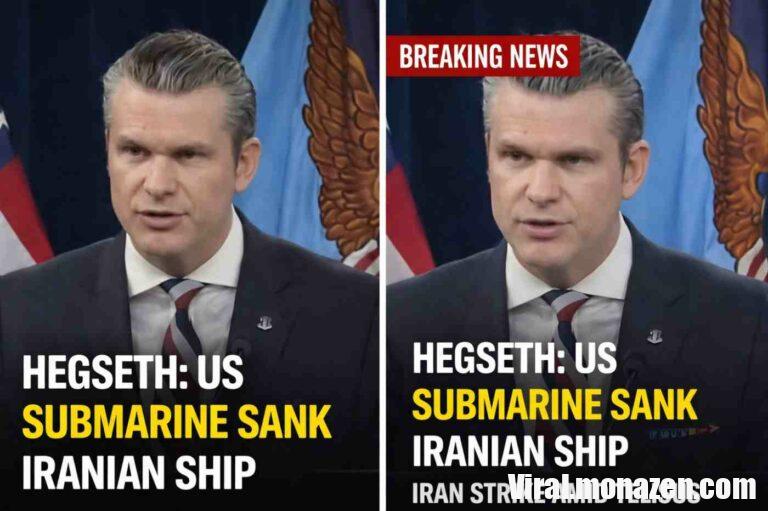
A statement that quickly drew global attention
A recent statement attributed to media commentator Pete Hegseth has stirred debate online after claims surfaced that a U.S. submarine sank an Iranian vessel during escalating tensions in the Middle East.
The remarks, which circulated widely through short video clips and social media posts, immediately triggered discussion among political analysts, military observers, and viewers trying to understand whether the claim reflects an actual military event or part of a broader political narrative.
In an era where geopolitical developments can unfold rapidly and information spreads instantly online, such claims often generate global reactions before official confirmation emerges.
Rising tensions in an already fragile region
The Middle East has long been a region where military movements and political statements can quickly ripple through international diplomacy.
Recent years have seen repeated moments of tension involving naval forces, drone incidents, sanctions, and strategic warnings between Iran and Western powers.
Naval activity in particular remains closely monitored because of the strategic importance of shipping routes such as the Strait of Hormuz, a narrow waterway through which a significant portion of the world’s oil supply travels.
Because of this strategic importance, even unverified reports involving naval engagements can quickly become major international stories.
The role of submarines in modern naval strategy
Submarines represent some of the most powerful and discreet assets in modern military fleets.
Unlike surface ships, submarines operate largely unseen beneath the ocean surface, allowing them to conduct surveillance, deterrence missions, and—if necessary—offensive operations.
Military analysts often describe submarines as “silent guardians” of naval power because their presence can influence strategic decisions even without direct engagement.
However, confirmed submarine attacks are extremely rare and typically involve complex military and diplomatic consequences.
For that reason, any suggestion that a submarine engagement occurred immediately draws attention from defense experts worldwide.
Online reactions and political commentary
Clips of Hegseth’s remarks spread quickly across social media platforms, where users debated whether the statement referred to an actual event, a hypothetical scenario, or a broader political argument about American military strength.
Supporters of a strong military posture interpreted the comments as a reminder of U.S. naval capabilities.
Others questioned whether the claim was based on verified information or whether it was part of political commentary often seen in television discussions about national security.
As with many viral political statements, the speed at which the clip spread made it difficult for audiences to immediately separate speculation from confirmed facts.
The importance of official confirmation
When claims involve potential military engagements between major nations, confirmation from official defense sources becomes crucial.
Governments typically release statements through defense departments, naval command structures, or official press briefings when such incidents occur.
Without those confirmations, analysts generally treat circulating claims cautiously.
Military incidents between countries can carry serious diplomatic implications, and governments often coordinate responses carefully before making information public.
Why naval incidents carry global consequences
Naval confrontations rarely remain isolated events. Because international waters involve multiple nations, shipping routes, and commercial interests, any conflict at sea can influence global markets and diplomatic relations.
Insurance rates for shipping companies, energy prices, and regional security policies can all be affected by reports of military action in strategic waterways.
This is why reports involving naval forces—even unverified ones—often attract worldwide attention from governments, investors, and media organizations.
The growing influence of media commentary
The modern media landscape has changed how geopolitical developments are discussed.
Television commentators, online personalities, and social media influencers now play a major role in shaping how audiences interpret international events.
Statements made during broadcasts or interviews can spread quickly beyond their original context, sometimes becoming headline topics on their own.
This dynamic highlights the growing intersection between political commentary, national security discussions, and viral media.
Navigating information in a fast-moving news cycle
Events involving military forces are among the most sensitive topics in international reporting.
For journalists and readers alike, verifying claims requires patience and careful examination of official sources, independent reporting, and expert analysis.
In fast-moving news cycles, early claims sometimes change significantly as more information becomes available.
Because of this, responsible reporting emphasizes caution until facts are confirmed through reliable channels.
A developing geopolitical narrative
Whether the statement reflects an actual incident or simply commentary on military capabilities, it has already become part of a larger conversation about tensions in the Middle East and the role of naval power in global security.
As the region continues to experience complex political dynamics, observers expect further debate over military strategy, deterrence, and diplomacy.
For now, analysts are watching closely for any official clarification that might shed light on the claims circulating online.
The broader takeaway
The episode serves as another reminder of how quickly geopolitical discussions can spread in today’s digital environment.
A single statement—captured in a short video clip—can trigger worldwide debate about military operations, international relations, and global stability.
In such moments, the most reliable understanding often comes not from viral headlines but from careful verification and balanced reporting.
Until more information emerges, the claim remains part of an ongoing conversation about security, strategy, and the fragile balance of power in one of the world’s most strategically important regions.