
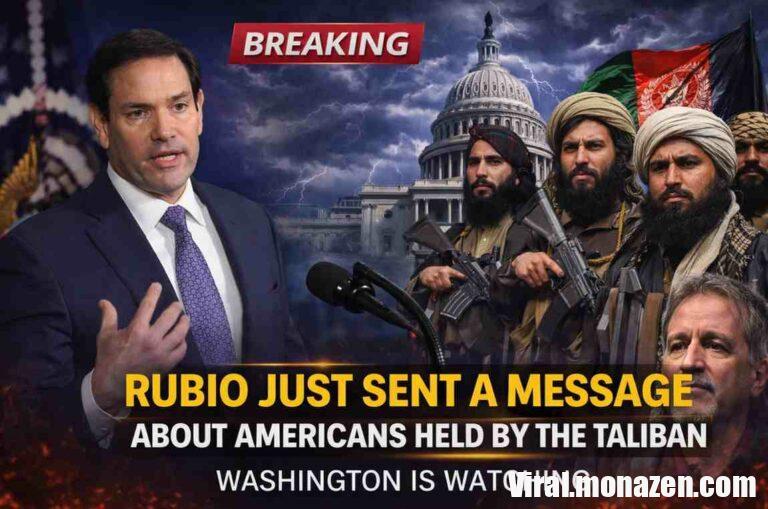
A fresh diplomatic dispute has emerged between the United States and the Taliban-controlled government in Afghanistan after an announcement by Marco Rubio accusing the Taliban of using detainees as leverage in negotiations with Washington.
Rubio said Afghanistan would be designated as a “State Sponsor of Wrongful Detention,” a label meant to highlight what U.S. officials say is the Taliban’s continued use of imprisonment to pressure foreign governments into making concessions. The announcement comes amid renewed concerns about Americans and dual nationals believed to be held by the Taliban since the group returned to power in 2021.
In his remarks, Rubio emphasized that the United States would not allow what he described as coercive tactics to dictate American policy.
“The Taliban continue to use terrorist tactics to seek policy concessions,” Rubio said, adding that such methods “won’t work under this administration.”
At the center of the dispute are several individuals the United States says are being unjustly detained in Afghanistan, including Americans Dennis Coyle and Mahmood Habibi, whose cases have become a focal point for lawmakers pushing for stronger diplomatic pressure on the Taliban.
Renewed Attention on Americans Held Abroad
The detention of Americans overseas has become an increasingly sensitive issue in U.S. foreign policy over the past decade. In recent years, Washington has faced a series of high-profile cases involving U.S. citizens detained in countries ranging from Iran and Russia to Venezuela and China.
U.S. officials often describe these situations as “wrongful detentions” or “hostage diplomacy,” arguing that some governments detain foreign nationals to extract concessions such as sanctions relief, prisoner exchanges, or diplomatic recognition.
Advocacy groups say the number of Americans detained abroad has grown steadily, prompting Congress and the State Department to expand efforts to secure their release.
Rubio’s announcement signals that lawmakers are increasingly willing to publicly confront governments they believe are using detainees as bargaining chips.
The Taliban’s Return to Power
The current tensions trace back to August 2021, when the Taliban rapidly seized control of Afghanistan following the withdrawal of U.S. and NATO forces after nearly two decades of war.
The collapse of the U.S.-backed Afghan government and the Taliban’s swift takeover created a complicated diplomatic landscape. While the United States does not formally recognize the Taliban as Afghanistan’s legitimate government, Washington has maintained limited communication channels with Taliban officials to address humanitarian aid, security concerns, and detainee cases.
Since taking power, the Taliban have sought international legitimacy while also facing widespread criticism over human rights, restrictions on women’s education, and the detention of foreign nationals.
Cases of Dennis Coyle and Mahmood Habibi
Among the individuals cited by Rubio are Dennis Coyle, an American believed to be detained in Afghanistan, and Mahmood Habibi, an Afghan-American businessman whose disappearance has raised alarm among U.S. officials and human rights advocates.
Habibi, a former Afghan aviation official and telecommunications executive, reportedly vanished in Kabul in 2022. Family members and supporters say they believe he was detained by Taliban authorities, although the Taliban have denied holding him.
The lack of clear information about his whereabouts has fueled growing frustration among U.S. lawmakers and diplomats.
Advocates for Habibi say his case highlights the challenges faced by Americans and dual nationals who remain in Afghanistan following the U.S. withdrawal.
Washington’s Diplomatic Strategy
Rubio’s proposed designation of Afghanistan as a “State Sponsor of Wrongful Detention” is part of a broader strategy designed to increase pressure on governments accused of holding Americans unjustly.
Although the label itself does not automatically trigger new sanctions, it can serve as a powerful diplomatic signal, encouraging international partners to apply additional scrutiny and pressure.
Some policymakers argue that public designations help draw global attention to detainee cases and increase the political cost for governments accused of holding foreign nationals for leverage.
Others caution that escalating rhetoric could complicate quiet negotiations that sometimes lead to prisoner releases.
The Broader Debate Over Hostage Diplomacy
The situation in Afghanistan reflects a wider debate about how the United States should respond when Americans are detained abroad under disputed circumstances.
Critics of prisoner exchanges argue that negotiating deals—especially those involving sanctions relief or prisoner swaps—can encourage future detentions.
Supporters counter that diplomacy and negotiations are often the most effective way to secure the safe return of detained Americans.
This dilemma has become increasingly common as geopolitical tensions rise and authoritarian governments seek leverage against Western nations.
Taliban’s Position
The Taliban have repeatedly rejected accusations that they detain foreigners as political bargaining tools.
Taliban officials often say that individuals held in Afghanistan are detained for alleged violations of local laws or security concerns.
However, international human rights organizations have expressed concern about the lack of transparency in Taliban detention practices and the limited access detainees have to legal representation or independent oversight.
The absence of formal diplomatic relations between the United States and the Taliban government further complicates efforts to resolve disputes over detainees.
Humanitarian and Political Dimensions
Beyond the diplomatic tensions, the issue also carries significant humanitarian implications.
Families of detained individuals frequently launch public campaigns urging the U.S. government to prioritize their loved ones’ release.
These cases often attract bipartisan attention in Congress, with lawmakers from both parties pressing administrations to take stronger action.
Rubio’s announcement reflects that bipartisan concern, as members of Congress increasingly demand more aggressive strategies to address what they describe as hostage diplomacy.
The Path Forward
Despite the strong rhetoric surrounding detainee cases, most experts agree that resolving such situations ultimately depends on sustained diplomacy.
Negotiations involving detained Americans often unfold quietly over months or even years, involving intermediaries, international partners, and humanitarian organizations.
Public statements, designations, and political pressure can raise awareness, but behind the scenes, diplomatic channels typically play the decisive role in securing releases.
For now, Rubio’s announcement marks another chapter in the ongoing effort by U.S. officials to bring attention to Americans held overseas.
Whether the new designation will lead to progress in the cases of Dennis Coyle, Mahmood Habibi, or other detainees remains uncertain.
But the message from Washington is clear: U.S. officials say they intend to keep the issue in the spotlight until those they believe are unjustly detained are brought home.