
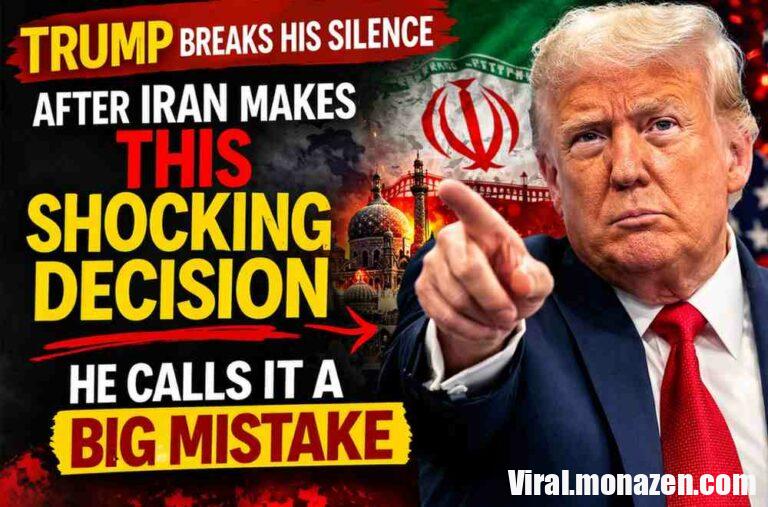
Trump Criticizes Iran’s Choice of Mojtaba Khamenei as Supreme Leader After Regional Escalation
The geopolitical tensions surrounding Iran’s leadership and the broader Middle East conflict have intensified following reports that Mojtaba Khamenei, the son of the late Ayatollah Ali Khamenei, has been selected as Iran’s new Supreme Leader. The development has drawn strong reactions from international observers, including former U.S. President Donald Trump, who criticized the decision and questioned its long-term stability.
Speaking publicly after the announcement, Trump expressed skepticism about Iran’s leadership transition and suggested that the choice could create further instability within the country’s political system.
“I think they made a big mistake,” Trump said when asked about Mojtaba Khamenei’s selection. “I don’t know if that decision will last. I think they got it wrong.”
The remarks come amid one of the most volatile periods in Middle Eastern geopolitics in years, following escalating hostilities involving Iran, Israel, and the United States.
A Leadership Transition in Tehran
Iran’s Assembly of Experts, a powerful body composed of senior clerics responsible for selecting and overseeing the country’s Supreme Leader, reportedly voted to appoint Mojtaba Khamenei as the successor to his father after Ayatollah Ali Khamenei was killed in an airstrike earlier in the conflict.
The Supreme Leader is the highest authority in Iran’s political system, holding significant influence over the military, judiciary, and key government institutions.
Ayatollah Ali Khamenei had held the position since 1989, shaping Iran’s domestic policies and its approach to international relations for more than three decades.
His death, if confirmed, would mark one of the most consequential developments in Iranian politics since the Islamic Revolution of 1979.
The appointment of his son has generated immediate debate among analysts and regional observers, many of whom question whether Iran’s clerical leadership structure was designed to accommodate such a succession.
Questions About Dynastic Leadership
Although Iran is officially a republic governed by a complex mixture of elected institutions and clerical authority, critics have long argued that the concentration of power among a small group of religious leaders resembles aspects of dynastic governance.
Mojtaba Khamenei has for years been considered a powerful behind-the-scenes figure within Iran’s political establishment. While he has never held a formal high-ranking government office, analysts say he has wielded influence through his close connections to the Islamic Revolutionary Guard Corps (IRGC) and senior clerics.
His appointment as Supreme Leader, however, raises significant questions about legitimacy and internal politics within Iran.
Many political observers believe that a direct father-to-son succession could provoke criticism both domestically and internationally, particularly among Iranians who favor political reform or a less centralized system of clerical authority.
Trump’s Reaction
Trump’s comments reflect the broader skepticism among some Western political figures regarding Iran’s leadership transition.
During his presidency, Trump pursued a hardline approach toward Iran, withdrawing the United States from the 2015 nuclear agreement and imposing a series of economic sanctions aimed at pressuring Tehran to renegotiate its nuclear program and regional policies.
The former president has frequently criticized Iran’s leadership structure, arguing that its political system concentrates too much power in the hands of unelected clerics.
His reaction to Mojtaba Khamenei’s appointment appears consistent with that stance.
Trump suggested that the leadership decision might not hold over time, implying that internal divisions or external pressures could challenge the new Supreme Leader’s authority.
Regional Implications
The leadership transition in Iran occurs against the backdrop of an escalating regional conflict involving Iran, Israel, and the United States.
Over the past several months, tensions have risen dramatically following a series of military confrontations, drone attacks, and retaliatory strikes across the Middle East.
The possibility of a broader regional war has raised alarm among international diplomats and security analysts.
Iran plays a central role in regional geopolitics through its support for allied groups in Lebanon, Syria, Iraq, and Yemen.
A sudden leadership change in Tehran could affect decision-making within Iran’s military and political leadership at a critical moment.
Some experts warn that leadership uncertainty could increase the risk of miscalculation during an already volatile conflict.
Others argue that a new Supreme Leader might seek to consolidate authority by adopting a more assertive posture toward perceived external threats.
International Reactions
Global reactions to the reported appointment have been cautious.
European leaders have called for restraint and emphasized the importance of diplomatic engagement to prevent further escalation in the region.
Meanwhile, regional governments are closely monitoring developments in Tehran.
Israel has long viewed Iran’s leadership as a major strategic threat, particularly due to Iran’s support for armed groups hostile to Israeli interests.
The United States, for its part, has maintained a complex relationship with Iran for decades, marked by periods of confrontation, negotiation, and strategic rivalry.
The emergence of a new Supreme Leader could reshape the diplomatic landscape depending on how Iran’s leadership chooses to engage with the international community.
Domestic Challenges for Iran
Beyond foreign policy concerns, Mojtaba Khamenei’s leadership will likely face significant domestic challenges.
Iran’s economy has struggled in recent years due to international sanctions, currency instability, and high unemployment among young people.
Public protests have periodically erupted across the country, reflecting dissatisfaction with economic conditions and political restrictions.
Leadership transitions in Iran have historically been sensitive moments that test the stability of the country’s political system.
The new Supreme Leader will need to navigate competing pressures from conservative clerics, reform-minded politicians, military leaders, and a population increasingly connected to global political debates.
A Defining Moment for the Region
The appointment of Mojtaba Khamenei represents a pivotal moment not only for Iran but also for the broader Middle East.
Leadership transitions in powerful regional actors often have ripple effects across international alliances, military strategies, and diplomatic relationships.
For the United States and its allies, the question will be whether Iran’s new leadership signals continuity or a shift in policy.
Trump’s critical remarks highlight the skepticism among some Western leaders about the stability and direction of Iran’s political system.
Yet many analysts caution that predicting Iran’s future trajectory remains difficult.
The country’s political structure is shaped by multiple institutions, including the Supreme Leader, the presidency, the Revolutionary Guard, and the clerical establishment.
Uncertainty Ahead
As the region continues to grapple with conflict and political transformation, Iran’s leadership transition adds another layer of uncertainty to an already complex geopolitical environment.
Whether Mojtaba Khamenei consolidates power quickly or faces internal challenges remains an open question.
What is clear is that the decision will influence regional politics, international diplomacy, and the strategic calculations of major global powers for years to come.
For now, Trump’s comments reflect just one voice among many reacting to a development that could reshape the Middle East’s political landscape.
The coming months will reveal whether Iran’s leadership change marks the beginning of a new chapter—or the start of another period of heightened instability in one of the world’s most strategically important regions.