
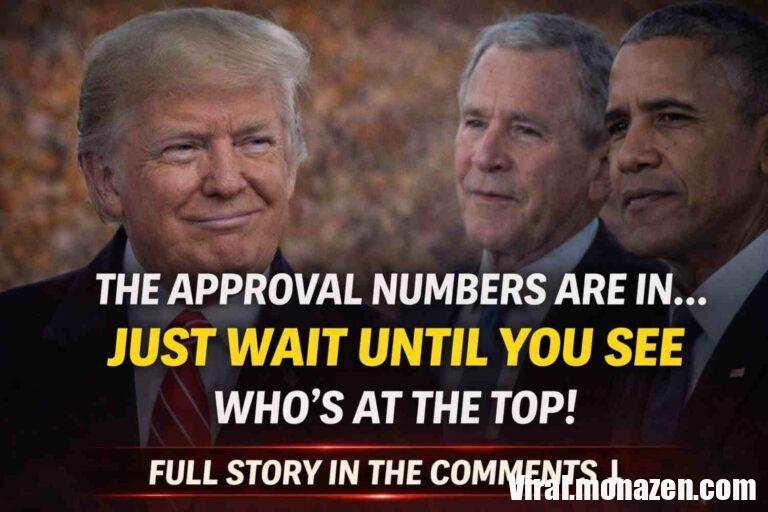
Recent polling averages have reignited a familiar debate in American politics: how public approval of a president evolves over time and how those numbers compare to previous administrations.
According to aggregated polling data reported by analysts and compiled by sources such as RealClearPolitics, approval ratings for Donald Trump in early 2026 have edged slightly above the numbers recorded by two previous presidents at similar points in their second terms.
The comparison has drawn particular attention because the benchmark includes both Barack Obama and George W. Bush, two leaders whose second terms were marked by intense political challenges and shifting public sentiment.
While polling numbers alone rarely capture the full complexity of political leadership, the comparison highlights how presidential approval ratings often reflect broader national debates about policy, media narratives, and global events.
What the Polling Data Shows
As of early March 2026, RealClearPolitics polling averages suggested that Trump’s approval rating hovered around 43.4 percent.
For comparison, historical polling data indicates that Barack Obama’s approval rating during the early months of 2014—roughly the same point in his second term—was approximately 42.5 percent.
George W. Bush’s numbers in early 2006 were somewhat lower, falling in the 39 to 40 percent range.
At first glance, these differences may appear relatively small.
Yet in the world of political polling, even a few percentage points can spark significant discussion about political momentum, media coverage, and voter attitudes.
The Context of Each Presidency
One reason such comparisons can be complicated is that each presidency unfolds under very different circumstances.
When Barack Obama entered his second term in 2013, the United States was emerging from the aftermath of the global financial crisis.
Economic recovery was underway, but political tensions in Washington remained high.
Meanwhile, George W. Bush’s second term began amid growing public frustration over the Iraq War, which significantly affected his approval ratings during the mid-2000s.
Donald Trump’s current political environment also includes its own set of challenges and controversies.
Debates about foreign policy, domestic economic issues, and political polarization continue to shape public perceptions of leadership.
How Presidential Approval Ratings Work
Presidential approval ratings are typically measured through national opinion polls conducted by research organizations.
These surveys ask Americans whether they approve or disapprove of the job the president is doing.
Poll results vary depending on methodology, sample size, and timing, which is why analysts often rely on averages of multiple polls rather than single surveys.
Organizations like RealClearPolitics aggregate polling results to provide a broader picture of public opinion.
However, approval ratings are only one measure of political success.
They can fluctuate rapidly in response to major events such as economic changes, legislative victories, or international crises.
The Role of Media Coverage
Another factor frequently discussed in debates about approval ratings is media coverage.
Supporters of Donald Trump often argue that negative reporting by major news organizations has contributed to lower approval numbers during his presidency.
Critics, however, contend that media scrutiny is a normal part of democratic accountability and applies to leaders of both major political parties.
Political scientists note that media ecosystems have evolved significantly in recent decades.
The rise of digital platforms, cable news networks, and social media has created a far more fragmented media landscape than existed during earlier presidencies.
This environment can amplify both criticism and support, sometimes reinforcing existing political divisions.
The Influence of Foreign Policy
Foreign policy events can also have a major impact on presidential approval.
Historically, military conflicts or international crises often produce short-term increases in approval ratings as voters rally behind national leadership.
However, prolonged conflicts or controversial decisions can have the opposite effect.
Recent developments involving tensions with Iran have become part of the broader political context shaping public debate.
Some voters view strong military responses as a sign of decisive leadership, while others express concern about the risks associated with escalating conflicts.
These competing perspectives illustrate how foreign policy decisions often divide public opinion.
The Historical Pattern of Second-Term Presidents
Approval ratings for second-term presidents tend to follow recognizable patterns.
During a president’s first term, public support often reflects campaign promises and early policy initiatives.
By the second term, however, the political environment can change dramatically.
Presidents may face a more skeptical public, stronger opposition from political rivals, and greater scrutiny of their policy outcomes.
Many second-term presidents—including Obama and Bush—experienced periods of declining approval before their numbers eventually stabilized.
Political historians note that approval ratings near the middle of a presidency often represent the most challenging phase of a leader’s tenure.
The Impact of Political Polarization
One of the defining features of modern American politics is the deep polarization between political parties.
Over the past two decades, voters have become increasingly likely to support candidates from their own party while opposing those from the other side.
This dynamic has a direct impact on presidential approval ratings.
In highly polarized environments, presidents often maintain strong support from their party’s base while facing intense opposition from the other party’s voters.
As a result, approval ratings may remain relatively stable within a narrow range rather than fluctuating widely.
This trend has been visible across multiple administrations.
Polling vs. Electoral Outcomes
Another important point in discussions about approval ratings is that polling numbers do not always predict election results.
Presidential elections depend on a variety of factors beyond approval ratings, including economic conditions, voter turnout, and campaign dynamics.
For example, presidents with relatively modest approval ratings have still won reelection in the past.
Conversely, leaders with strong polling numbers have sometimes faced unexpected challenges during election campaigns.
Because of this complexity, political strategists typically treat approval ratings as one piece of a much larger analytical puzzle.
Public Opinion in a Changing Political Landscape
The debate surrounding Trump’s approval numbers compared with Obama and Bush reflects broader questions about how Americans evaluate political leadership.
Public opinion is shaped by a combination of economic conditions, policy outcomes, media narratives, and personal perceptions of leadership style.
In recent years, rapid changes in technology and communication have further complicated the relationship between politicians and voters.
Social media platforms allow political messages to spread instantly, often bypassing traditional news outlets.
This shift has created new opportunities for leaders to communicate directly with supporters while also exposing them to immediate criticism.
Why the Comparison Matters
Although the differences between the approval ratings of Trump, Obama, and Bush may appear modest, the comparison highlights how historical context shapes political narratives.
For supporters of Trump, the numbers are often cited as evidence that his presidency maintains solid backing despite sustained criticism.
For critics, the focus may shift toward policy decisions, governance style, or broader concerns about political direction.
Ultimately, approval ratings represent a snapshot of public sentiment rather than a definitive measure of a presidency’s long-term impact.
Looking Ahead
As the political landscape continues to evolve, presidential approval ratings will remain a key indicator watched closely by both analysts and voters.
Economic trends, legislative developments, and international events will all influence how Americans evaluate their leaders.
Whether Trump’s approval rating continues to rise, stabilize, or decline will depend on how these factors unfold in the months ahead.
What remains clear is that comparisons between presidents—past and present—will continue to shape discussions about leadership, governance, and the direction of American politics.
And as history has repeatedly shown, the story of a presidency is rarely defined by a single statistic alone.