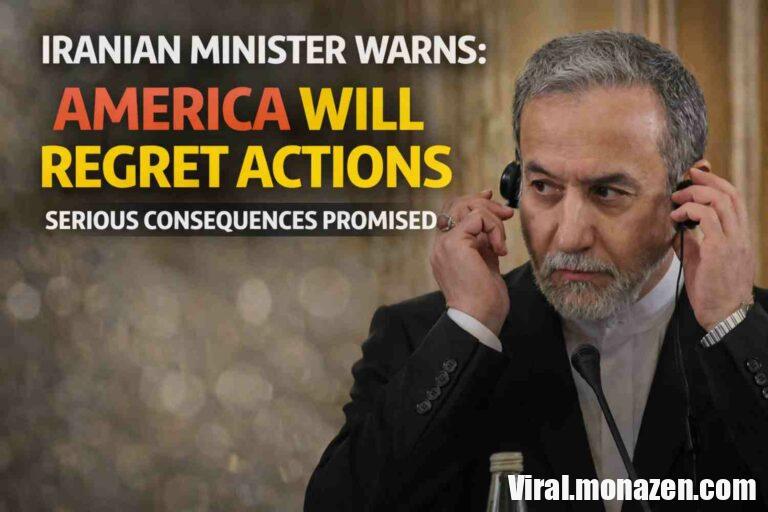
Amid growing geopolitical tensions and mounting international scrutiny, Iran’s Foreign Minister has delivered a strongly worded message suggesting that the United States could eventually regret what Tehran describes as actions taken against the Islamic Republic. The statement reflects a broader escalation in rhetoric between Iran and Western powers at a moment when the Middle East remains one of the most volatile regions in global politics.
The remarks, reported by regional media outlets, come as diplomatic relations between Iran and the United States remain strained and regional dynamics continue to evolve rapidly. While such statements are not uncommon during periods of heightened tension, they illustrate how both sides continue to frame the conflict in terms of long-term strategic consequences.
A Statement Reflecting Deep Political Friction
In his comments, Iran’s top diplomat suggested that Washington would eventually face repercussions for what he described as aggressive policies toward Iran. The remarks focused particularly on actions that Iranian officials argue have targeted the country’s sovereignty, infrastructure, and regional influence.
Although the tone of the statement was firm, analysts note that strong rhetoric has long been a characteristic feature of relations between Iran and the United States. For decades, political leaders on both sides have used public messaging to signal resolve, strengthen domestic political support, and influence international perception.
The current comments therefore fit into a broader pattern of diplomatic confrontation that stretches back several generations.
The Long History of U.S.–Iran Tensions
Relations between Tehran and Washington have been strained since the late 1970s, when the Iranian Revolution fundamentally transformed the country’s political system and led to the severing of diplomatic ties with the United States.
Several major events have shaped the relationship over the decades:
- The 1979 hostage crisis at the U.S. embassy in Tehran
- Economic sanctions imposed by successive U.S. administrations
- Disputes over Iran’s nuclear program
- Regional conflicts involving Iranian-backed groups
Each of these issues has contributed to a complex and often adversarial relationship.
As a result, statements from senior Iranian officials criticizing U.S. policy are often interpreted within the context of this long-standing geopolitical rivalry.
Diplomatic Language and Strategic Messaging
When foreign ministers speak publicly during times of tension, their words often carry multiple layers of meaning.
On one level, statements are intended for international audiences, signaling a government’s position on key issues. On another level, they are directed toward domestic audiences, reinforcing national unity and demonstrating political strength.
In the case of Iran’s recent comments, analysts believe the message may serve several purposes.
First, it emphasizes Iran’s determination to resist what it views as external pressure. Second, it signals to regional partners and adversaries that Tehran intends to remain a significant player in Middle Eastern affairs.
Finally, such statements can influence diplomatic negotiations by shaping the political atmosphere in which talks occur.
The Role of Regional Security Dynamics
The Middle East’s complex security environment often amplifies tensions between global powers.
Several ongoing issues contribute to the fragile regional balance, including:
- Conflicts in neighboring countries
- Competition for influence among regional powers
- Concerns over nuclear proliferation
- Military alliances involving global superpowers
Because Iran occupies a central geographic and political position in the region, its interactions with international actors frequently have wide-ranging implications.
Statements from Iranian officials are therefore closely monitored not only in Washington but also in capitals across Europe, Asia, and the Middle East.
Iran’s Diplomatic Strategy
In recent years, Iran has pursued a diplomatic strategy aimed at strengthening relationships with several non-Western powers, including China and Russia.
These partnerships have expanded in areas such as trade, energy cooperation, and infrastructure development. Iranian officials have often emphasized the importance of diversifying international partnerships to reduce the impact of economic sanctions imposed by Western governments.
At the same time, Iran has maintained diplomatic engagement with European countries, particularly in relation to negotiations over its nuclear program.
This multifaceted approach reflects Tehran’s effort to navigate a complicated international landscape while protecting its national interests.
The Influence of Public Statements
Political rhetoric can sometimes appear confrontational, but experts caution that such language does not always translate directly into military escalation.
Instead, statements made by senior officials often serve as signals in a broader strategic conversation between governments.
By expressing strong positions publicly, leaders can shape perceptions of strength and resolve, which may influence diplomatic negotiations behind closed doors.
In many cases, the intensity of rhetoric reflects the political pressures leaders face at home as well as the messages they wish to send abroad.
International Reactions
Responses to Iran’s latest remarks have varied widely depending on geopolitical perspective.
Some analysts interpret the statement as part of Tehran’s effort to deter further pressure from the United States and its allies. Others see it primarily as a rhetorical response to ongoing diplomatic and economic disputes.
Western governments have generally emphasized the importance of dialogue and diplomacy in addressing disagreements with Iran, particularly concerning nuclear activities and regional security.
For many policymakers, maintaining communication channels—even during periods of tension—remains essential for preventing misunderstandings that could lead to escalation.
The Importance of Diplomacy
Despite decades of political friction, diplomacy has periodically produced breakthroughs in U.S.–Iran relations.
The most notable example in recent years was the 2015 Joint Comprehensive Plan of Action (JCPOA), commonly known as the Iran nuclear agreement.
The deal aimed to limit Iran’s nuclear activities in exchange for sanctions relief, although its future has remained uncertain following shifts in U.S. policy and ongoing disputes over compliance.
Even when negotiations stall, the existence of diplomatic frameworks provides opportunities for dialogue that might otherwise be absent.
Economic and Energy Implications
Beyond political considerations, tensions involving Iran often carry significant economic implications.
Iran is a major player in global energy markets due to its substantial oil and natural gas reserves. Developments affecting the country’s energy sector can influence global supply dynamics and market prices.
Because of this, statements from Iranian leaders are frequently analyzed by investors, energy companies, and policymakers seeking to understand potential shifts in regional stability.
Economic sanctions and trade restrictions have also shaped Iran’s economic strategy, prompting efforts to develop alternative markets and strengthen regional trade networks.
The Global Perspective
For many international observers, the ongoing exchange of political messages between Iran and the United States reflects the broader challenges of managing geopolitical competition in a rapidly changing world.
As global power dynamics evolve, regional conflicts and diplomatic disputes increasingly intersect with economic interests, technological competition, and strategic alliances.
In this context, statements from senior officials can become focal points for broader debates about the future of international relations.
Understanding these dynamics requires careful analysis of both political rhetoric and the underlying strategic realities.
Looking Ahead
While strong language from political leaders often captures headlines, the long-term trajectory of international relations depends on a complex interplay of diplomacy, economic interests, and strategic calculation.
For now, the remarks from Iran’s foreign minister highlight the persistence of tensions that have shaped U.S.–Iran relations for decades.
Whether these tensions will escalate or eventually give way to renewed diplomatic engagement remains uncertain.
What is clear, however, is that developments involving Iran will continue to command global attention—reflecting the country’s central role in the geopolitical landscape of the Middle East and the wider international system.