
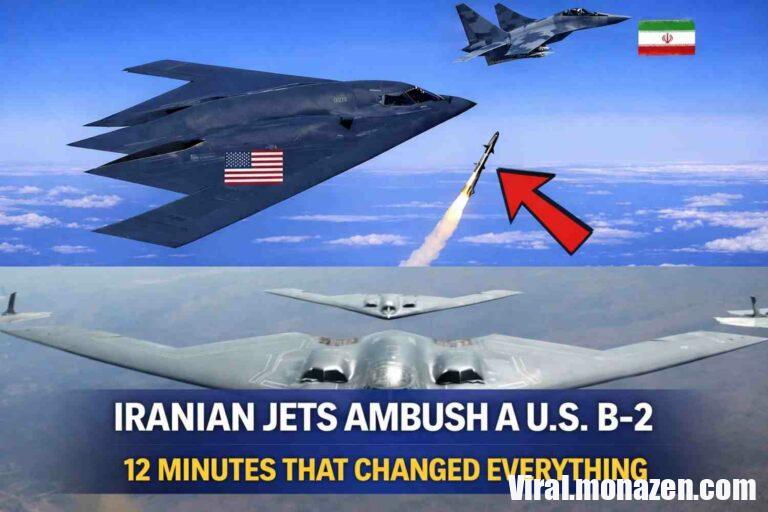
In recent days, dramatic headlines have circulated online describing a tense aerial confrontation between Iranian fighter jets and a U.S. B-2 stealth bomber—an encounter many posts claim lasted twelve minutes and nearly triggered a major military escalation.
The story, widely shared across social media platforms and various blogs, paints a cinematic picture: Iranian jets scrambling into the sky, a mysterious radar signature appearing over the horizon, and one of America’s most advanced stealth aircraft flying through contested airspace.
But what actually happened?
While the viral accounts contain elements drawn from real military tensions in the region, defense analysts caution that many details have been exaggerated or remain unconfirmed.
Still, the narrative has captured global attention, largely because it touches on a very real and serious topic: the strategic rivalry between the United States and Iran, and the role of advanced military technology in modern conflicts.
The B-2 Spirit: One of the World’s Most Advanced Aircraft
At the center of the story is the B-2 Spirit stealth bomber, a long-range aircraft designed to penetrate heavily defended airspace while remaining extremely difficult to detect.
First introduced into service in the 1990s, the B-2 is famous for its distinctive flying-wing design and radar-evading technology. The aircraft can travel thousands of miles without refueling and carry both conventional and strategic weapons.
Only about 20 B-2 bombers exist in the U.S. Air Force fleet, making them among the most valuable aircraft in the American military.
Their primary role is to deliver precision strikes against heavily fortified targets—often deep inside hostile territory—while avoiding enemy radar systems.
Because of these capabilities, the appearance of a B-2 bomber anywhere near contested airspace immediately attracts global attention.
Rising Military Activity in the Region
The story of the alleged interception also emerged at a time of heightened tensions in the Middle East.
Recent U.S. military operations have involved B-2 bombers, fighter jets, cruise missiles, and new types of drones targeting Iranian military infrastructure.
These operations are part of broader strategic efforts by the United States and its allies to counter regional threats and maintain military deterrence.
Iran, meanwhile, has invested heavily in its own air defenses and interceptor aircraft. Although many of its fighter jets are older models compared with Western counterparts, Iranian forces rely on radar networks and surface-to-air missile systems to monitor their airspace.
As a result, encounters between U.S. and Iranian forces—while rare—are not impossible.
The Viral “12-Minute Encounter”
According to widely shared online accounts, Iranian radar operators detected an unidentified aircraft approaching Iranian-controlled airspace.
Fighter jets reportedly scrambled to intercept the aircraft, which was later claimed to be a B-2 stealth bomber.
In the viral version of events, Iranian pilots attempted to track the aircraft for roughly twelve minutes before it disappeared from their radar screens.
Some posts even describe the situation as an “ambush,” suggesting Iranian jets had the bomber within range.
However, defense analysts note that these claims are difficult to verify and may be based on speculation rather than official military data.
In modern military operations, radar detections, interceptions, and escort maneuvers are relatively common events, particularly in regions where multiple air forces operate simultaneously.
The Reality of Air Intercepts
When a military aircraft approaches sensitive airspace, intercepting fighters are often sent to identify it.
This process is part of normal military protocol.
Pilots typically attempt to visually identify the aircraft, communicate via radio, and ensure the aircraft does not violate restricted airspace.
In many cases, the intercept ends without incident, with both aircraft maintaining safe distances.
Such encounters can last several minutes and are handled according to international aviation rules designed to prevent misunderstandings.
Experts say that even if Iranian fighters detected or approached a U.S. aircraft, it would not necessarily represent an unusual event.
Why the Story Went Viral
The viral popularity of the story reflects the fascination many people have with stealth technology and aerial warfare.
The idea of a stealth bomber—an aircraft designed to be invisible—encountering enemy fighters creates a dramatic narrative that spreads quickly online.
Images of fighter jets, missiles, and stealth aircraft often accompany these stories, further amplifying their impact on social media.
However, analysts caution that viral content frequently blends fact with speculation.
Without official confirmation from military authorities, it is difficult to determine exactly what occurred in the skies during the alleged encounter.
Strategic Messaging in Military Operations
Even when such encounters occur, they often carry strategic significance beyond the immediate situation.
Military flights can send signals to allies and rivals alike.
Deploying advanced aircraft like the B-2 bomber demonstrates military capability and readiness, while interceptor flights by other nations signal defensive vigilance.
These actions form part of a broader system of strategic communication between nations.
In many cases, both sides understand the boundaries of such encounters and take steps to avoid escalation.
The Importance of Verified Information
The viral spread of dramatic military stories highlights the challenges of the modern information environment.
Today, images and headlines can travel around the world in seconds, often long before official sources confirm what actually happened.
This rapid flow of information can create confusion and amplify rumors.
Defense experts therefore encourage readers to rely on verified reporting from reputable sources rather than viral claims.
A Reminder of the Stakes
Even if the viral account exaggerates the events, it reflects a deeper reality: military forces from different nations operate in close proximity in several regions of the world.
These situations require discipline, communication, and careful decision-making to prevent accidents or misunderstandings.
The B-2 bomber itself symbolizes the high level of technology involved in modern warfare.
At the same time, the alleged interception story reminds us how quickly tensions can capture global attention.
Looking Ahead
As geopolitical tensions continue to evolve, encounters between military aircraft will likely remain part of the strategic landscape.
For now, the “12 minutes that changed everything” story serves as an example of how military narratives can spread rapidly in the digital age—sometimes blending reality with speculation.
What remains certain is that the balance of power in the skies continues to play a critical role in international security.
And when advanced aircraft like the B-2 Spirit appear on the radar, the world is watching.