
As tensions in the Middle East continue to draw international attention, the global energy market is once again under scrutiny. The region, home to some of the world’s most critical oil shipping routes and production facilities, plays a pivotal role in the stability of global energy supply. Any suggestion of military confrontation involving Iran inevitably raises concerns about oil prices, supply disruptions, and economic ripple effects worldwide.
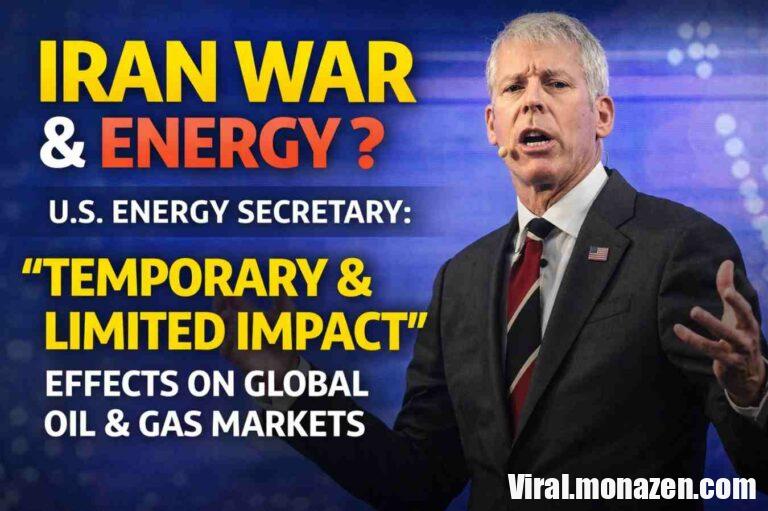
In a recent public statement, the U.S. Secretary of Energy suggested that the potential impact of a conflict involving Iran on global energy markets would likely be “temporary and limited.” The comment reflects a broader effort by policymakers to reassure global markets that the world’s energy system has become more resilient than it was in previous decades.
Still, the statement has sparked debate among analysts, economists, and geopolitical experts who continue to assess how vulnerable global energy supplies might be if tensions escalate further.
Why Iran Matters to Global Energy
Iran occupies a strategically critical position in the global energy landscape. The country holds some of the world’s largest proven oil and natural gas reserves and sits near one of the most important maritime routes for energy transportation: the Strait of Hormuz.
Approximately one-fifth of the world’s oil supply passes through this narrow waterway between the Persian Gulf and the Gulf of Oman. Any disruption to shipping in this area could have significant consequences for international energy markets.
For decades, analysts have viewed the Strait of Hormuz as a potential flashpoint during periods of geopolitical tension. Even the threat of disruption can cause immediate fluctuations in oil prices.
Because of this, statements from government officials about the likely impact of conflict are closely watched by investors and policymakers around the world.
A More Resilient Energy System
When the U.S. Energy Secretary described the potential impact of conflict as “temporary and limited,” the comment reflected confidence in the evolution of global energy infrastructure.
Several major changes over the past two decades have made the global energy system more diversified and resilient.
Among the most significant developments:
1. Expansion of U.S. energy production
The United States has become one of the world’s largest oil and gas producers, largely due to advances in shale extraction technology. This has reduced reliance on imports from the Middle East and strengthened domestic supply capacity.
2. Strategic petroleum reserves
Many countries maintain emergency oil reserves that can be released to stabilize markets during supply disruptions. These reserves provide governments with a buffer during crises.
3. Diversified supply routes
New pipelines and shipping routes have been developed in recent years to reduce dependence on a single geographic corridor.
4. Growth of renewable energy
While fossil fuels remain dominant, renewable energy sources are gradually reducing the global economy’s dependence on oil.
Together, these developments have created a more flexible global energy system capable of absorbing shocks more effectively than in previous decades.
The Psychology of Energy Markets
Energy markets are influenced not only by actual supply disruptions but also by expectations and perceptions.
When geopolitical tensions rise, traders often react quickly, anticipating potential shortages even before any physical disruption occurs.
This can lead to short-term spikes in oil prices driven by speculation rather than actual changes in supply.
Statements from government officials therefore play an important role in stabilizing markets.
By emphasizing that potential impacts would be limited, policymakers aim to reduce uncertainty and discourage panic-driven trading.
Lessons From Past Crises
History offers numerous examples of how geopolitical conflict can influence global energy markets.
During the 1973 oil embargo, political tensions in the Middle East triggered severe supply disruptions and dramatic price increases that reshaped the global economy.
More recently, conflicts in the region have occasionally led to temporary price spikes but rarely resulted in sustained long-term shortages.
In many cases, markets adjusted quickly as alternative supply sources increased production.
These historical experiences help explain why policymakers today emphasize resilience rather than vulnerability.
The Role of Strategic Communication
Public statements by government officials during periods of tension often serve multiple purposes.
Beyond informing the public, they are designed to:
- Reassure investors
- Stabilize markets
- Signal confidence in national preparedness
In the energy sector, such communication can be particularly influential because markets respond rapidly to new information.
A carefully worded statement can help prevent unnecessary volatility that might otherwise disrupt economic activity.
Regional Security and Energy Infrastructure
Despite the optimism expressed by some policymakers, analysts caution that the Middle East remains a region where security concerns cannot be ignored.
Energy infrastructure—including pipelines, refineries, and export terminals—can become strategic targets during conflicts.
Protecting these facilities is therefore a major priority for governments in the region and for international partners.
Naval patrols, intelligence cooperation, and diplomatic engagement all play roles in safeguarding critical energy routes.
Even so, the interconnected nature of global markets means that events in one region can quickly influence prices worldwide.
Global Economic Implications
Energy prices affect nearly every sector of the global economy.
When oil prices rise significantly, the effects can include:
- Increased transportation costs
- Higher manufacturing expenses
- Rising consumer prices
Conversely, stable energy prices contribute to economic predictability and growth.
This is why governments closely monitor developments that could affect energy supply.
Statements like those made by the U.S. Energy Secretary are often intended to reassure businesses and consumers that the broader economic impact will remain manageable.
The Market’s Immediate Reaction
Following comments suggesting limited impact from potential conflict, energy markets have generally responded cautiously rather than dramatically.
Oil prices may experience temporary fluctuations when geopolitical news emerges, but sustained trends usually depend on measurable changes in production or supply routes.
Analysts continue to watch developments in the region carefully, evaluating both political signals and logistical realities.
Market participants understand that geopolitical risk is a constant feature of energy markets, particularly in regions that produce large volumes of oil.
The Long-Term Energy Transition
While geopolitical events often dominate headlines, a longer-term transformation is also underway in global energy systems.
Many countries are investing heavily in:
- Renewable energy technologies
- Electric vehicles
- Energy efficiency improvements
These developments could gradually reduce the strategic importance of oil in global politics.
However, the transition will take time. Fossil fuels remain essential to the global economy, meaning that regions like the Middle East will continue to influence energy markets for the foreseeable future.
Balancing Risk and Stability
Ultimately, the statement that the impact of conflict could be “temporary and limited” reflects an effort to balance realism with reassurance.
Geopolitical tensions always carry risks, particularly in regions critical to global energy supply.
At the same time, decades of technological progress, infrastructure investment, and international cooperation have strengthened the resilience of energy systems.
For policymakers, the challenge is to acknowledge potential risks while preventing unnecessary panic.
Looking Ahead
As global attention remains focused on developments in the Middle East, energy markets will continue to respond to both political signals and real-world developments.
Whether tensions escalate or stabilize will play a significant role in shaping market expectations.
For now, policymakers emphasize preparedness and resilience, highlighting the ability of modern energy systems to withstand temporary disruptions.
But as history has shown, the intersection of geopolitics and energy will always remain one of the most closely watched dynamics in international affairs.
The coming months will reveal whether current tensions remain contained—or evolve into challenges that test the strength of the global energy system once again.