
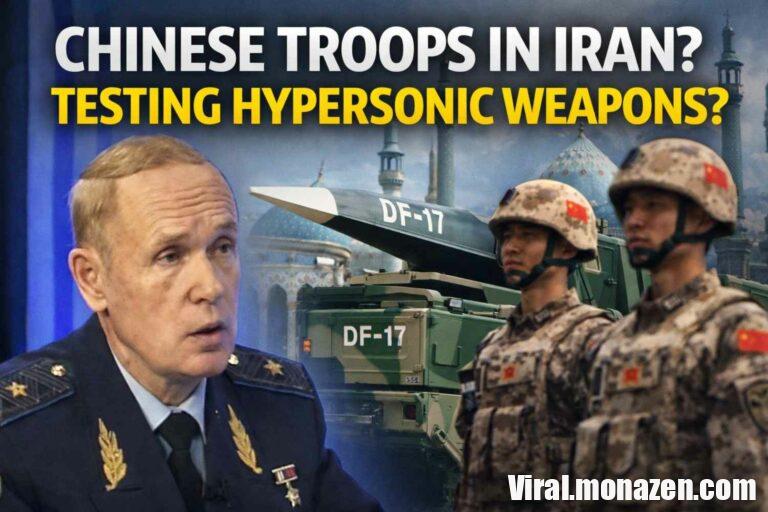
Recent remarks attributed to a retired Russian military officer have ignited renewed discussion among geopolitical observers about the possibility of deeper military cooperation between China and Iran. According to statements circulating in regional media, the officer suggested that Chinese military personnel could already be present in Iran, potentially participating in testing advanced weapons systems, including hypersonic technologies.
The comments, reportedly made by retired Russian Major General Vladimir Popov, have quickly drawn attention across political and security circles. While the claims have not been independently verified, they have fueled broader debates about the evolving strategic partnerships between major global powers and the role of emerging weapons technologies in modern conflicts.
The Rise of Hypersonic Weapons
Hypersonic weapons have become one of the most discussed developments in modern military technology. These systems travel at speeds greater than Mach 5, or five times the speed of sound, and are designed to evade traditional missile defense systems through their speed and maneuverability.
Unlike conventional ballistic missiles that follow predictable trajectories, hypersonic weapons can maneuver during flight, making them significantly more difficult to track and intercept.
Several countries are actively developing these systems, including:
- The United States
- China
- Russia
- India
- North Korea
Because of their potential strategic impact, hypersonic weapons are often viewed as part of the next generation of global military competition.
What the Russian General Allegedly Said
In comments widely shared on social media and some regional platforms, retired Russian General Vladimir Popov reportedly claimed that Chinese personnel could be operating within Iran to test advanced military technologies.
According to the statements attributed to him, Chinese specialists may be present not merely as advisors but as active participants in testing weapons systems.
The remarks suggested several possibilities:
- Iran could be hosting experimental weapons trials.
- Hypersonic missiles and advanced munitions might be tested under real operational conditions.
- China may be studying how its technologies perform in environments resembling real combat scenarios.
However, it is important to note that these claims have not been confirmed by independent sources or official government statements.
Iran’s Growing Military Capabilities
Over the past two decades, Iran has invested heavily in expanding its domestic defense capabilities.
Much of this development has focused on missile technology, drones, and asymmetric warfare strategies.
Iran’s missile program is widely considered one of the most advanced in the Middle East. The country has developed a range of ballistic and cruise missiles capable of reaching targets across the region.
Iranian officials have also publicly claimed progress in developing hypersonic missile technology, although outside experts remain cautious about assessing the true capabilities of such systems.
China’s Strategic Interests in the Region
China has steadily expanded its diplomatic, economic, and strategic relationships across the Middle East.
Iran occupies a particularly significant position in China’s long-term strategic vision due to several factors:
- Its geographic location along key trade routes
- Its energy resources
- Its role in regional security dynamics
In 2021, Iran and China signed a 25-year strategic cooperation agreement aimed at strengthening economic and political ties.
While the agreement primarily focuses on infrastructure, energy, and trade cooperation, some analysts believe it could also lead to deeper security collaboration.
Still, official Chinese policy emphasizes non-interference and diplomatic engagement, and Beijing rarely confirms involvement in foreign military activities.
Testing Grounds and Military Experiments
Throughout history, military powers have sometimes used foreign environments to test weapons technologies.
Conflict zones or allied territories can offer conditions that simulate operational realities more closely than controlled testing ranges.
However, such activities are often politically sensitive and rarely acknowledged publicly.
If a country were conducting weapons tests in another nation, it would typically involve complex diplomatic agreements and strict secrecy.
This is why many analysts remain cautious about accepting claims of foreign weapons testing without concrete evidence.
The Broader Geopolitical Context
The discussion surrounding these claims cannot be separated from the broader geopolitical competition unfolding among global powers.
In recent years, strategic rivalries between the United States, China, and Russia have intensified.
These tensions are visible in multiple arenas, including:
- Trade disputes
- Technology competition
- Military modernization
- Regional security alliances
Observers often interpret military cooperation among countries like China, Russia, and Iran through this wider lens of global strategic competition.
However, experts warn against drawing conclusions based solely on unverified statements or speculation.
Information Warfare and Strategic Narratives
In modern conflicts, information itself has become a powerful strategic tool.
Statements from military figures, political leaders, or commentators can influence perceptions even when the underlying facts remain uncertain.
Strategic narratives are often used to:
- Demonstrate strength
- Influence international opinion
- Shape domestic political discussions
Because of this, analysts often examine such statements carefully, separating rhetorical messaging from verifiable developments.
The Importance of Verification
One of the central challenges in analyzing claims like those attributed to General Popov is the absence of independently confirmed evidence.
No major international monitoring organizations or defense agencies have publicly verified the presence of Chinese military personnel conducting weapons tests in Iran.
Without corroboration, such statements remain part of a broader debate rather than established fact.
Responsible analysis requires distinguishing between confirmed developments and unverified claims circulating in political or media discussions.
How Experts Are Responding
Security analysts have offered mixed reactions to the reports.
Some believe that closer military cooperation between China and Iran is plausible given their expanding political ties.
Others argue that deploying Chinese personnel for weapons testing in Iran would represent a significant escalation that Beijing would likely avoid due to diplomatic risks.
Many experts emphasize that China tends to pursue influence through economic engagement rather than overt military deployments abroad.
As a result, claims of active Chinese weapons testing inside Iran remain subject to skepticism among many observers.
A Region Under Constant Scrutiny
The Middle East remains one of the most closely monitored regions in the world for military and geopolitical developments.
Any suggestion of new weapons testing or foreign military involvement can quickly attract global attention.
This is especially true when emerging technologies like hypersonic missiles are involved.
Because such weapons could potentially alter strategic balances, governments and analysts carefully watch for signs of new deployments or partnerships.
The Future of Hypersonic Competition
Regardless of the accuracy of the current claims, one fact remains clear: the global race to develop hypersonic weapons is accelerating.
Countries around the world are investing billions of dollars into research and development programs aimed at mastering these technologies.
Hypersonic systems are expected to reshape future military strategies by:
- Reducing response times in conflicts
- Challenging existing missile defense systems
- Increasing the importance of early-warning capabilities
As these technologies evolve, international discussions about arms control and strategic stability are likely to intensify.
Looking Ahead
For now, the claims attributed to the Russian general remain part of an ongoing discussion rather than a confirmed development.
While speculation about Chinese weapons testing in Iran continues to circulate, experts emphasize the need for reliable evidence before drawing definitive conclusions.
What the debate does reveal, however, is the growing complexity of global security dynamics.
As emerging technologies, shifting alliances, and geopolitical competition intersect, the world may increasingly see rumors and claims that reflect deeper anxieties about the balance of power.
Understanding these narratives — and verifying the facts behind them — will remain essential for policymakers, analysts, and the public alike.