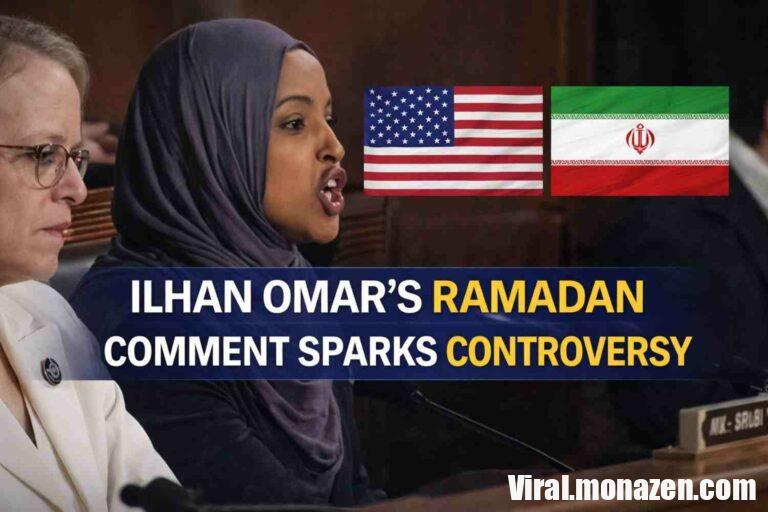
A recent social media post attributed to U.S. Representative Ilhan Omar has ignited renewed debate about American foreign policy in the Middle East, particularly regarding the timing of military actions during the Islamic holy month of Ramadan. The remarks, which circulated widely online alongside images from congressional hearings, have drawn strong reactions from supporters and critics alike, reflecting broader tensions in American political discourse about international conflicts, religion, and national security.
At the center of the controversy is a message in which Omar appeared to criticize what she described as a pattern of U.S. military operations occurring during Ramadan in Muslim-majority countries. The comment quickly spread across social media platforms, prompting discussions about whether the timing of military operations should take religious observances into account.
The episode illustrates how statements by prominent political figures can spark widespread discussion, particularly when they touch on sensitive intersections of faith, international policy, and military action.
The Context of the Remarks
Ilhan Omar, a Democratic representative from Minnesota, has long been a prominent voice in debates about U.S. foreign policy in the Middle East. As one of the first Muslim women elected to the United States Congress, her perspectives often attract attention both domestically and internationally.
The statement circulating online suggests that Omar expressed concern over U.S. military operations in Muslim-majority countries during Ramadan. Ramadan, observed by Muslims worldwide, is a month of fasting, prayer, and spiritual reflection.
Because of its significance in Islamic culture, events occurring during Ramadan can carry additional emotional and symbolic weight for Muslim communities.
Omar’s remarks appear to reflect this concern, raising questions about whether military actions conducted during the holy month may be perceived differently by those directly affected.
The Broader Debate Over Military Timing
While the timing of military operations is typically determined by strategic considerations rather than religious calendars, the issue is not entirely new.
Throughout history, conflicts have occasionally intersected with religious observances, leading to complex debates about cultural sensitivity and strategic necessity.
Military planners often prioritize operational objectives, intelligence assessments, and security considerations when determining when and where actions take place.
However, critics argue that cultural awareness—including religious holidays—can influence how military actions are perceived by local populations.
Supporters of Omar’s perspective say that recognizing such sensitivities could help reduce tensions and improve diplomatic relations in regions where religion plays a central role in daily life.
Others argue that military operations cannot realistically be scheduled around religious calendars when urgent security concerns are involved.
Political Reactions in Washington
Unsurprisingly, the comments attributed to Omar quickly triggered responses from political figures across the ideological spectrum.
Some lawmakers defended her right to raise concerns about the humanitarian and cultural implications of U.S. military actions.
Others criticized the statement, arguing that it oversimplifies complex geopolitical decisions and risks portraying American foreign policy in a misleading light.
These reactions reflect a familiar pattern in Washington politics, where debates about military strategy often intersect with broader ideological disagreements.
For some observers, the controversy highlights the difficulty of balancing security priorities with cultural and humanitarian considerations in foreign policy discussions.
The Role of Social Media in Political Debate
One reason the remarks spread so rapidly is the powerful role social media now plays in shaping political conversations.
Platforms like X (formerly Twitter), Facebook, and Instagram allow statements by public figures to reach millions of people almost instantly.
In many cases, posts are shared without full context, which can amplify controversy and contribute to misunderstandings about what was originally said.
Images of Omar speaking during congressional proceedings, paired with screenshots of the alleged post, helped fuel the viral spread of the story.
Within hours, the message had been widely discussed across political blogs, news forums, and social media communities.
Religion and Foreign Policy
The debate also touches on a broader question that has long shaped global politics: how religion influences international relations.
In regions such as the Middle East, religious identity often plays a significant role in social, political, and cultural life.
As a result, actions taken by foreign governments can sometimes be interpreted through religious or cultural lenses, even when they are primarily motivated by strategic considerations.
Scholars of international relations note that understanding these perspectives can be important for diplomatic engagement and conflict resolution.
At the same time, governments often emphasize that national security decisions must ultimately be based on practical considerations rather than symbolic timing.
Omar’s Political Profile
Ilhan Omar has been a frequent participant in debates about American involvement in international conflicts.
During her time in Congress, she has advocated for greater oversight of military operations abroad and has supported policies aimed at reducing civilian casualties and promoting diplomatic solutions.
Her positions have sometimes placed her at odds with political opponents who favor a more assertive military posture in certain regions.
As a result, statements from Omar about foreign policy often generate strong responses from both supporters and critics.
The latest controversy appears to follow this familiar pattern.
Public Response
Beyond Washington, the comments have sparked broader public discussion about the relationship between religion and international conflict.
Some observers say the remarks highlight the need for greater cultural awareness in foreign policy decisions.
Others believe that linking military operations to religious observances risks politicizing complex security issues.
The diversity of reactions underscores how deeply divided opinions can be when political debates intersect with matters of faith and national security.
A Continuing Conversation
Whether one agrees with Omar’s perspective or not, the episode illustrates the continuing influence of social media and public statements on foreign policy debates.
In today’s information environment, a single post can quickly evolve into a national conversation about broader issues.
For policymakers, analysts, and citizens alike, these discussions often reflect deeper questions about how nations navigate cultural differences while pursuing security objectives.
Looking Ahead
As geopolitical tensions persist in several parts of the world, debates about the ethical, cultural, and strategic dimensions of military actions are likely to continue.
For some, the conversation sparked by Omar’s remarks serves as a reminder that foreign policy decisions can carry symbolic meaning beyond their immediate objectives.
For others, it highlights the importance of maintaining focus on security priorities in a complex global landscape.
Regardless of perspective, the discussion demonstrates how interconnected modern political dialogue has become—where religion, diplomacy, military strategy, and digital communication all intersect.
And in that environment, even a single statement can prompt a far-reaching debate about how nations balance their values with their strategic interests.