
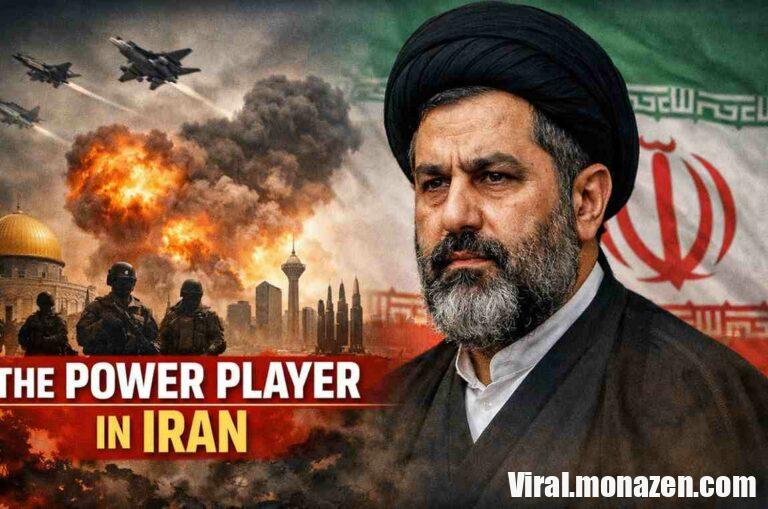
In the complex and often opaque world of Iranian politics, power rarely moves in straight lines. It shifts quietly behind closed doors, through networks of loyalty, ideology, and influence. In recent days, one name has resurfaced with renewed intensity across international headlines and political discussions: Mojtaba Khamenei, a cleric long rumored to wield significant influence behind the scenes in Tehran.
Speculation about his role has intensified amid rising tensions in the Middle East and renewed scrutiny of Iran’s internal power structure. While many reports circulating online contain dramatic claims, the reality is more nuanced. What remains undeniable, however, is that Mojtaba Khamenei occupies a unique position within Iran’s political and religious establishment—one that has made him a subject of fascination for analysts, journalists, and policymakers around the world.
A Political System Built on Layers of Authority
To understand why Mojtaba Khamenei’s name carries such weight, it is essential to understand the structure of power in the Islamic Republic of Iran.
At the top of the system stands the Supreme Leader, the country’s highest political and religious authority. The position oversees the armed forces, appoints key judicial and political figures, and ultimately shapes the strategic direction of the state.
Unlike a typical presidential system, Iran’s leadership operates through overlapping institutions: the presidency, parliament, religious bodies, and powerful security organizations such as the Islamic Revolutionary Guard Corps (IRGC).
Within this intricate network, influence is often as important as formal titles. Figures who hold no official office can still play decisive roles through connections, trusted networks, and proximity to power.
For years, analysts have suggested that Mojtaba Khamenei has been one such figure.
Mojtaba Khamenei: A Quiet but Influential Presence
Born in 1969 in Mashhad, Mojtaba Khamenei is one of the sons of Iran’s Supreme Leader Ayatollah Ali Khamenei. Unlike many political heirs in other systems, he has largely avoided the public spotlight.
He rarely appears in official speeches, media interviews, or public ceremonies. This deliberate absence from public life has only fueled speculation about the extent of his influence.
According to various international reports and academic studies, Mojtaba has spent years working within the inner circles of the Supreme Leader’s office, where strategic decisions involving security, intelligence, and political coordination often take shape.
Observers describe him as a “backroom strategist”—someone who operates through networks rather than formal authority.
Ties to Iran’s Security Establishment
One reason analysts pay close attention to Mojtaba Khamenei is his reported relationship with Iran’s security institutions.
The Islamic Revolutionary Guard Corps (IRGC) is one of the most powerful organizations in Iran. Originally formed after the 1979 revolution, the IRGC now plays roles far beyond the military. It influences politics, economic projects, regional strategy, and intelligence operations.
Several experts believe Mojtaba developed strong relationships within this institution during the late 1990s and early 2000s.
These connections matter.
In Iran’s political ecosystem, the alignment between clerical leadership and the IRGC can shape everything from domestic stability to foreign policy decisions.
Analysts who study Iran’s internal dynamics often argue that individuals trusted by both religious authorities and security leadership hold unique leverage.
Mojtaba Khamenei appears to fit that profile.
The “Shadow Influence” Narrative
The idea that Mojtaba acts as a behind-the-scenes power broker is not new.
For nearly two decades, political observers have debated whether he plays an informal role in coordinating strategy inside the Supreme Leader’s office.
During Iran’s disputed 2009 presidential election, for example, opposition figures accused Mojtaba of influencing political decisions in support of the ruling establishment. Iranian authorities rejected those claims, but the allegations contributed to his growing reputation as a hidden but powerful actor.
Because Iran’s leadership operates with limited transparency, much of the speculation surrounding Mojtaba’s influence remains difficult to verify conclusively.
However, what analysts generally agree on is that individuals close to the Supreme Leader’s family often gain access to political networks that are otherwise difficult to penetrate.
The Question of Succession
One reason Mojtaba Khamenei’s name frequently appears in geopolitical discussions is the long-standing question of who might eventually succeed Iran’s Supreme Leader.
Iran’s constitution states that the Supreme Leader is selected by the Assembly of Experts, a body of clerics elected by the public.
In theory, the process resembles a religious council choosing the most qualified scholar to lead the state.
In practice, however, political consensus among influential factions plays a major role.
Over the years, several potential successors have been mentioned by analysts: senior clerics, political figures, and individuals connected to the country’s security establishment.
Mojtaba Khamenei is occasionally included in these discussions—not because he holds an official position that automatically qualifies him for the role, but because of his proximity to power.
Still, many experts caution that predicting Iran’s leadership transitions is extremely difficult.
The country’s political history shows that succession decisions often emerge from complex negotiations among religious authorities, security leaders, and political institutions.
A Region Already on Edge
Speculation about leadership in Tehran comes at a time when the Middle East is experiencing heightened geopolitical tensions.
Conflicts and diplomatic standoffs involving regional powers, energy markets, and international alliances have increased global attention on Iran’s internal dynamics.
For many observers, leadership transitions in influential countries often carry wider implications.
Changes at the top can reshape diplomatic approaches, economic strategies, and military policies.
However, experienced analysts emphasize that national strategies rarely depend on a single individual alone. Iran’s policies are shaped by a broad network of institutions—including the presidency, parliament, military leadership, and powerful advisory bodies.
Even if leadership eventually changes, those institutions remain central to decision-making.
The International Dimension
Mojtaba Khamenei has also been mentioned in international policy discussions because of sanctions imposed by the United States.
In 2019, the U.S. Treasury included him in a sanctions list targeting individuals associated with Iran’s leadership network.
American officials argued that the sanctions were part of broader efforts to pressure Iran’s political establishment.
Iranian authorities rejected these measures, describing them as politically motivated and ineffective.
Sanctions often serve as diplomatic tools intended to signal pressure rather than produce immediate policy changes.
But they can contribute to the public visibility of individuals who might otherwise remain largely unknown outside their home country.
The Power of Perception
One of the most interesting aspects of Mojtaba Khamenei’s public image is how much of it is built on perception rather than confirmed information.
In political systems where decision-making is highly centralized and opaque, narratives about “shadow figures” often emerge.
Sometimes those narratives exaggerate influence; other times they reveal genuine informal power networks.
Journalists and researchers studying Iran frequently note that the line between rumor and reality can be difficult to draw.
Still, the persistence of Mojtaba’s name in discussions about Iran’s future reflects how closely global observers watch the country’s internal politics.
Why the World Is Watching
Iran remains one of the most strategically important countries in the Middle East.
Its geographic position, energy resources, regional alliances, and political influence ensure that developments inside the country often resonate far beyond its borders.
Whenever questions arise about leadership or political direction, analysts, governments, and international organizations closely monitor the situation.
Figures like Mojtaba Khamenei attract attention precisely because they exist at the intersection of religious authority, political networks, and security institutions.
Even without holding a formal government office, individuals in such positions can play meaningful roles in shaping conversations within elite circles.
A Story Still Unfolding
For now, much of the discussion surrounding Mojtaba Khamenei remains speculative.
Iran’s leadership structure has historically moved cautiously, often favoring stability and continuity over sudden change.
Whether Mojtaba ultimately becomes a central public figure in Iran’s political future—or remains a behind-the-scenes advisor—will depend on decisions made within Iran’s powerful institutions.
What is clear is that the world’s attention will remain fixed on Tehran’s political landscape.
In a region where geopolitical shifts can carry global consequences, understanding the individuals operating within those systems remains an essential part of interpreting the future.
And for now, Mojtaba Khamenei remains one of the most intriguing and closely watched figures within that landscape.