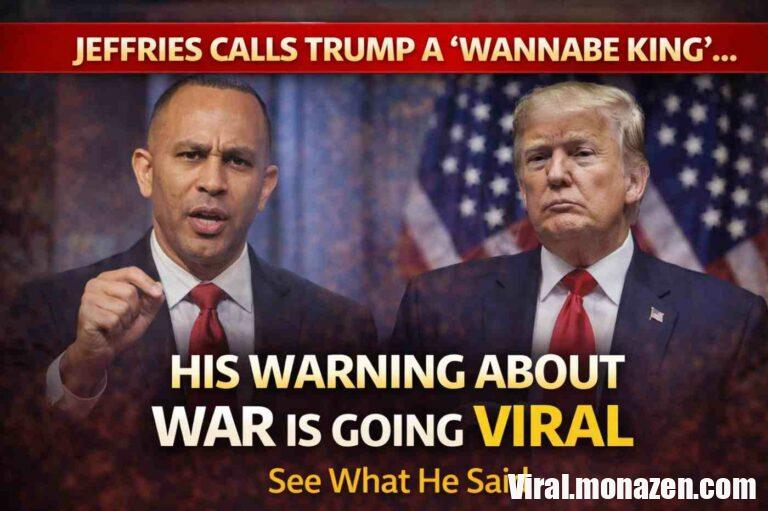
Political rhetoric in Washington rarely lacks intensity, but a recent remark by House Democratic leader Hakeem Jeffries has ignited a fresh wave of debate over U.S. foreign policy, domestic economic priorities, and the deep partisan divide shaping American politics.
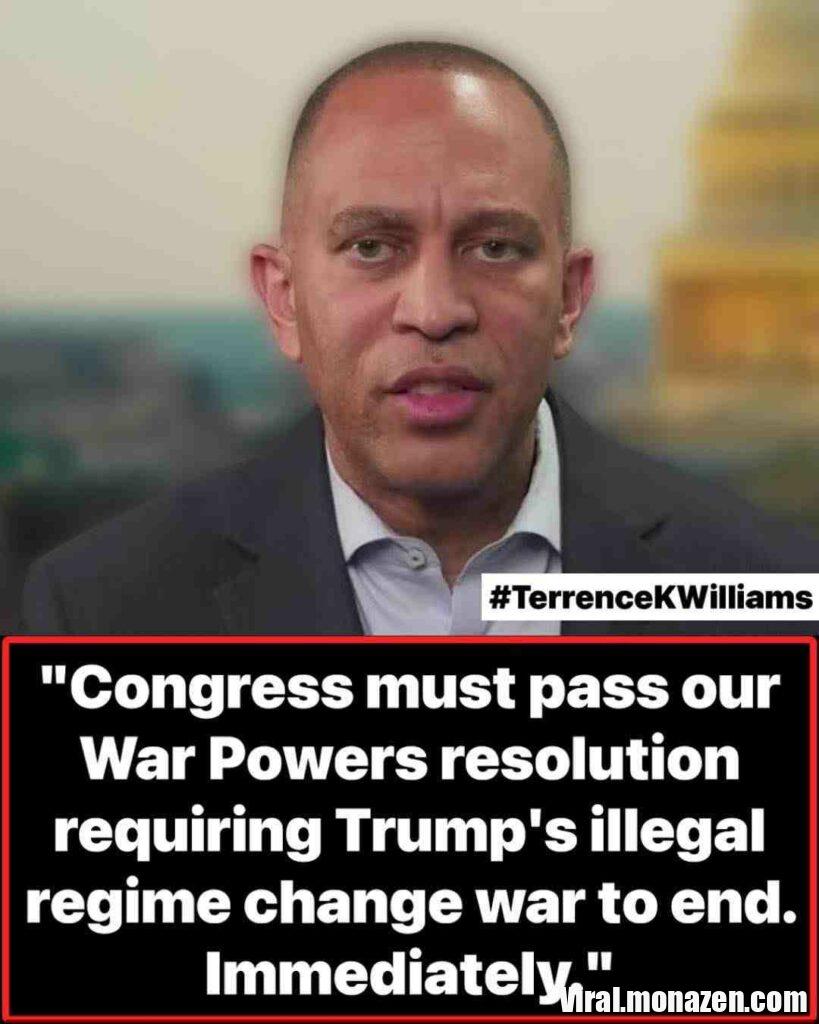
Jeffries’ statement, posted publicly on social media, criticized Republican leadership and warned against what he described as the risk of an “endless war in the Middle East.”
“We cannot allow a wannabe King to drag us into an endless war in the Middle East,” Jeffries wrote. “Republicans can find billions for bombs, but nothing to bring down your grocery bill or healthcare costs.”
The comment quickly spread across social media and political news outlets, drawing strong reactions from supporters and critics alike.
For Democrats, the statement underscored concerns about military escalation and the prioritization of domestic economic issues. For Republicans, the remark was seen as a partisan attack on former President Donald Trump and conservative foreign policy positions.
The Context Behind Jeffries’ Statement
Jeffries’ comments come at a moment when tensions in the Middle East have once again become a major focus of American political debate.
Military actions, regional alliances, and concerns about escalating conflicts have prompted lawmakers in Washington to revisit long-standing questions about the United States’ role in the region.
Some political leaders argue that strong military posture is necessary to deter threats and maintain stability.
Others warn that expanding military involvement could lead to prolonged conflicts similar to those that defined U.S. foreign policy in Iraq and Afghanistan.
Jeffries’ statement reflects the latter concern.
A Message Framed Around Domestic Priorities
Beyond the foreign policy implications, Jeffries’ message also linked international military spending to domestic economic pressures.
By contrasting “billions for bombs” with rising grocery and healthcare costs, the Democratic leader sought to highlight what he sees as a misalignment between federal spending priorities and everyday economic concerns facing American families.
Inflation, healthcare affordability, and cost-of-living challenges remain among the most frequently cited issues for voters across the political spectrum.
Political strategists often frame these topics in campaign messaging because they directly affect millions of households.
Jeffries’ remarks appear to connect those economic concerns with broader debates about government spending.
Republican Reaction and Criticism
Not surprisingly, the comments triggered a swift response from Republican figures and conservative commentators.
Critics accused Jeffries of exaggerating the risk of war and unfairly targeting Republican policy positions.
Some also argued that national security funding and domestic economic policy are separate issues that should not be framed as competing priorities.
Supporters of a strong defense policy maintain that maintaining military readiness is essential in an unpredictable global environment.
They also note that the federal budget includes funding for both defense and domestic programs.
The dispute reflects a broader ideological divide over how government resources should be allocated.
The Role of Political Language
Jeffries’ use of the phrase “wannabe King” became one of the most discussed elements of the statement.
In modern American politics, rhetorical flourishes often serve as shorthand for broader critiques.
Supporters of Jeffries interpreted the phrase as a warning about concentrated executive power.
Critics saw it as an unnecessary personal attack.
Political analysts say that such language can energize supporters but also deepen partisan tensions.
In the era of social media, even a single phrase can quickly become a headline.
The Larger Debate Over War Powers
Underlying the controversy is a long-standing constitutional debate: who should decide when the United States goes to war.
The U.S. Constitution grants Congress the authority to declare war, while the president serves as commander-in-chief of the armed forces.
Over the past several decades, presidents from both political parties have initiated military operations without formal declarations of war.
Some lawmakers have argued that Congress should play a stronger role in approving major military engagements.
Jeffries’ comments echo those concerns, emphasizing the need for congressional oversight in decisions that could lead to prolonged conflicts.
Domestic Economics vs. Global Security
The tension between domestic priorities and international security commitments is not new.
Throughout modern history, American leaders have struggled to balance investments in defense with spending on social programs.
Periods of major military engagement—such as the Cold War or the wars in Iraq and Afghanistan—often triggered debates about how resources should be distributed.
Jeffries’ statement taps into that historical pattern by framing military funding as competing with economic relief measures.
Whether that framing resonates with voters remains to be seen.
The Influence of Social Media in Political Messaging
One reason Jeffries’ comment gained such rapid attention is the role of social media in shaping modern political discourse.
Platforms like X (formerly Twitter), Facebook, and Instagram allow political leaders to communicate directly with millions of followers.
While this direct communication can help politicians share their views quickly, it can also amplify controversy.
A short post can quickly become the center of a national debate.
Jeffries’ remarks are a clear example of how a single message can spark widespread political discussion.
Support From Some Democrats
Within Democratic circles, some leaders and activists praised Jeffries for speaking out about the risk of military escalation.
They argue that the United States must remain cautious about entering new conflicts, especially after decades of military engagement in the Middle East.
Others emphasized the importance of focusing on economic issues such as healthcare affordability, housing costs, and inflation.
These concerns continue to rank among the top priorities for many voters.
A Reflection of America’s Political Divide
The controversy surrounding Jeffries’ statement ultimately reflects the broader polarization of American politics.
Foreign policy decisions that once enjoyed bipartisan support now often become flashpoints for partisan conflict.
Leaders from both parties frequently frame debates in ways that mobilize their supporters while criticizing their opponents.
As a result, statements like Jeffries’ can quickly become symbols of deeper political disagreements.
What Comes Next
It remains unclear whether Jeffries’ comments will influence upcoming policy discussions in Congress.
However, the debate they sparked highlights the ongoing tension between foreign policy strategy and domestic economic concerns.
With elections approaching and geopolitical tensions continuing to evolve, political leaders are likely to face increasing pressure to clarify their positions on both issues.
For voters, the question may ultimately come down to priorities: how should the United States balance its global responsibilities with the economic needs of its citizens?