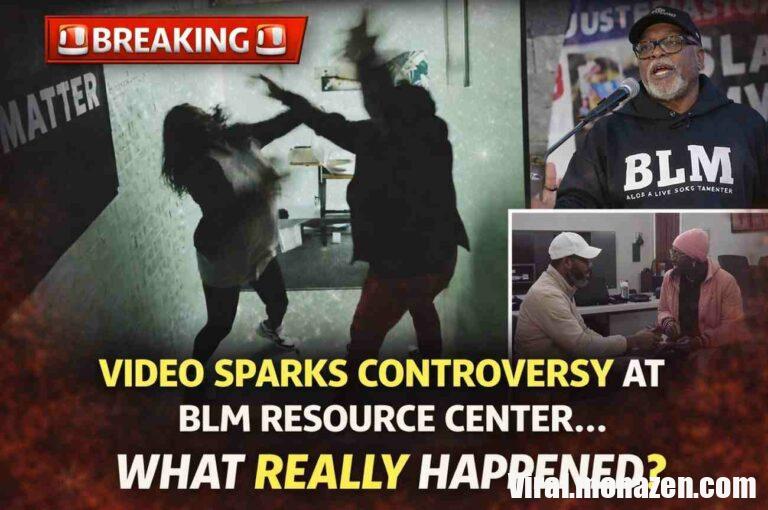
A video circulating widely on social media has ignited a fresh debate about leadership, transparency, and accountability within grassroots activist organizations after an altercation reportedly involving Clyde McLemore, founder of Black Lives Matter Lake County, and a female employee at the group’s community resource center in Waukegan, Illinois.
The incident, which police say resulted in minor injuries but no criminal charges, has sparked intense discussion online and renewed scrutiny of how nonprofit advocacy groups manage internal disputes and financial oversight.
As the footage spread across social platforms, reactions quickly split between those condemning the behavior shown in the video and others urging caution until all facts surrounding the confrontation are fully understood.
What began as a workplace dispute has now evolved into a broader conversation about leadership responsibility within organizations connected to high-profile social movements.
The Incident at the Resource Center
According to local reports, the altercation occurred inside the Black Lives Matter Lake County resource center, a space used for community outreach programs, organizing events, and social services.
Police confirmed that officers responded to reports of a physical confrontation between two individuals inside the building.
Authorities later identified the individuals involved as Clyde McLemore, the founder of the local chapter, and a female employee associated with the organization.
Witnesses told investigators that the dispute began as a verbal argument and escalated into a physical confrontation.
Both individuals reportedly suffered minor injuries, though neither required hospitalization.
Importantly, police confirmed that no arrests were made, and both parties declined to pursue charges.
What Reportedly Triggered the Argument
According to accounts cited in local coverage, the employee had questioned McLemore about how certain funds connected to the organization were being spent.
The disagreement reportedly intensified during that discussion.
Financial transparency is a sensitive topic for many nonprofit organizations, particularly those that rely on donations from supporters who expect accountability in how funds are used.
Advocacy groups often operate with limited administrative infrastructure, which can sometimes lead to disputes over budgeting, spending priorities, or financial management.
In this case, the disagreement appears to have escalated beyond a workplace argument.
The Role of Video in the Story
The controversy gained traction after a short video clip of the confrontation began circulating online.
Though the footage is brief and does not show the entire context of the argument, it quickly spread across social media platforms.
Clips shared on various accounts have accumulated thousands of views, fueling speculation and commentary.
Experts in media ethics often warn that short, edited videos can sometimes present only a partial picture of what occurred.
Without the full context leading up to the altercation, interpreting the situation accurately can be difficult.
Nonetheless, the visual nature of the footage has ensured that the story continues to draw attention.
Who Is Clyde McLemore?
Clyde McLemore is known locally in Illinois as a community activist who helped establish the Black Lives Matter Lake County chapter, which focuses on issues including racial justice, community policing, and social support programs.
Local chapters of the Black Lives Matter movement often operate independently from the national organization, focusing on community-specific initiatives.
McLemore has previously been involved in organizing protests, community outreach events, and educational programs aimed at addressing inequality.
Supporters say the organization has helped provide resources and advocacy for residents in the Waukegan area.
Critics, however, have pointed to the recent incident as evidence that leadership disputes and internal tensions may exist within the group.
The Broader Context of Nonprofit Accountability
The incident has also reignited a wider discussion about financial transparency in nonprofit organizations.
Across the nonprofit sector, organizations are expected to follow strict guidelines regarding how donations are collected, managed, and reported.
Many groups rely on volunteer leadership and small administrative teams, which can sometimes make oversight more complicated.
Experts note that transparency mechanisms—such as regular financial reports and independent audits—are crucial to maintaining public trust.
In recent years, several advocacy organizations across the political spectrum have faced scrutiny over financial management, underscoring the importance of clear governance structures.
Public Reaction and Political Debate
Because Black Lives Matter has been at the center of national political debates in the United States since 2020, the incident quickly became a topic of commentary among political activists and commentators.
Some critics of the movement seized on the story as evidence of broader leadership problems.
Supporters, meanwhile, argued that a single dispute within a local chapter should not be used to judge an entire movement that includes thousands of activists across the country.
Many observers also noted that workplace conflicts occur in organizations of all kinds, from corporations to nonprofits.
The challenge lies in how leadership responds and whether proper accountability processes are followed.
Police Response and Legal Outcome
Law enforcement officials confirmed that they investigated the incident after receiving reports of the confrontation.
However, because neither individual chose to file charges, the case did not move forward in the criminal justice system.
Situations like this are not uncommon in workplace disputes where both parties decide to resolve the matter privately rather than pursue legal action.
Police records indicate that officers documented the incident but did not identify evidence of a crime that would require further prosecution.
The Importance of Internal Resolution
For nonprofit organizations, incidents involving leadership disputes can present both reputational and operational challenges.
Organizations must often balance transparency with the need to resolve internal matters constructively.
Human resources experts say conflicts within mission-driven organizations can sometimes become especially intense because employees and volunteers often feel deeply invested in the cause they are supporting.
When disagreements arise, emotions can escalate quickly.
Successful organizations typically rely on clear conflict-resolution policies, including mediation, internal investigations, and governance oversight.
A Moment of Reflection for Activist Groups
The controversy has prompted some observers to call for stronger governance practices within grassroots activist organizations.
As advocacy groups grow and attract larger public attention, they often face increased expectations for professionalism and accountability.
Leadership training, financial transparency, and formal oversight structures are increasingly viewed as necessary for organizations seeking long-term credibility.
Many activists say that addressing internal challenges openly can actually strengthen movements by reinforcing their commitment to ethical leadership.
What Happens Next
It remains unclear whether the incident will lead to organizational changes within Black Lives Matter Lake County.
Neither McLemore nor representatives of the organization have released extensive public statements about the situation beyond confirming that an argument occurred.
For now, the episode serves as a reminder that movements built around social change must also navigate the everyday realities of leadership, conflict, and accountability.
As the story continues to circulate online, many observers are urging caution in drawing conclusions based on limited information.
What is certain, however, is that the incident has sparked a broader conversation about how community organizations handle disputes—and how transparency can shape public trust.