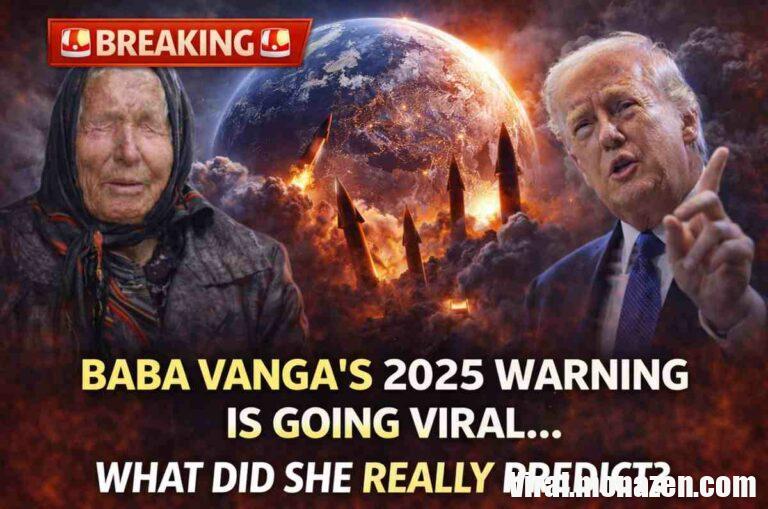
As geopolitical tensions intensify across the Middle East, an unexpected name has reappeared in online conversations around the world: Baba Vanga, the blind Bulgarian mystic whose alleged predictions have circulated for decades.
Social media platforms have recently been flooded with posts claiming that Baba Vanga predicted a major global conflict beginning around 2025, a prediction that many users are now linking to the escalating tensions involving the United States, Israel, and Iran.
For believers, the timing feels eerily coincidental. For skeptics, it represents yet another example of how vague prophecies can be interpreted to fit almost any major event.
Either way, the resurfacing of Baba Vanga’s predictions highlights something deeper about human nature: during uncertain times, people often search for meaning in the past to understand the future.
Who Was Baba Vanga?
Baba Vanga, whose real name was Vangeliya Pandeva Gushterova, was born in 1911 in what is now North Macedonia and spent most of her life in Bulgaria.
She reportedly lost her eyesight during a violent storm in her childhood. According to stories that later spread across Eastern Europe, the traumatic event marked the beginning of her alleged prophetic abilities.
Over the decades, Baba Vanga became a well-known figure in Bulgaria and neighboring countries. Visitors—including politicians, military officials, and ordinary citizens—reportedly traveled long distances to consult her.
Her supporters claimed she could predict global events, personal destinies, and political developments.
After her death in 1996 at the age of 85, stories about her predictions only grew more widespread.
The Prophecy That Keeps Returning
Among the many predictions attributed to Baba Vanga is a claim that a major global conflict would erupt in the mid-2020s, potentially transforming the geopolitical landscape.
The prediction itself has appeared in various forms online, with slightly different interpretations depending on the source.
Some versions suggest she predicted a devastating war that would begin in Eastern Europe. Others claim the conflict would start in the Middle East.
As tensions between regional powers have intensified in recent years, many people online have started linking current events to those predictions.
In particular, the ongoing military confrontations and diplomatic standoffs involving the United States, Israel, and Iran have revived interest in the prophecy.
Why the Prediction Is Going Viral Now
The resurgence of Baba Vanga’s prediction is closely tied to the current climate of global uncertainty.
International news has been dominated by reports of military strikes, strategic alliances, and growing tensions across multiple regions.
For many people following these developments, the idea that a decades-old prophecy might align with modern events creates a powerful narrative.
Social media platforms amplify these stories rapidly.
A single viral post referencing Baba Vanga’s prediction can spread across millions of users within hours, fueling debates about whether the prophecy is meaningful—or simply coincidence.
The Psychology Behind Prophecy
Experts who study human behavior say that prophecies often gain traction during periods of instability.
When people feel uncertain about the future, they naturally look for patterns or explanations that provide a sense of order.
Prophecies offer a narrative framework that helps people interpret complex events.
Dr. Daniel Kahneman, a Nobel Prize–winning psychologist known for his work on human decision-making, once described this tendency as “pattern-seeking behavior.”
Humans instinctively connect unrelated events to create stories that make sense of the world.
In the case of Baba Vanga, the broad and often ambiguous nature of the predictions makes them especially adaptable to new circumstances.
Predictions That Supporters Claim Came True
Supporters of Baba Vanga frequently cite several predictions they believe were accurate.
Among the most commonly mentioned are:
- The collapse of the Soviet Union
- The September 11 attacks in the United States
- Natural disasters such as major tsunamis
However, historians and researchers caution that many of these predictions were documented or interpreted only after the events occurred, making it difficult to verify their authenticity.
In many cases, the original statements attributed to Baba Vanga were never written down during her lifetime.
Instead, they were passed through word of mouth, later publications, or internet posts.
Skepticism From Scholars
Skeptics argue that Baba Vanga’s predictions are often so vague that they can be interpreted in countless ways.
For example, a prophecy referencing conflict or disaster could apply to almost any period in history.
Critics also note that the internet has played a major role in reshaping and expanding the list of predictions attributed to her.
Some statements circulating online may never have been spoken by Baba Vanga at all.
Scholars studying folklore and prophecy warn that over time, legends often grow more elaborate as stories are repeated and modified.
The Role of Social Media
In today’s digital world, rumors and speculation can travel faster than ever before.
Platforms like Facebook, X (formerly Twitter), TikTok, and Instagram allow millions of users to share content instantly.
When dramatic world events occur, posts referencing prophecies or conspiracy theories often gain attention quickly.
Algorithms designed to promote engaging content can amplify these stories even further.
As a result, predictions like Baba Vanga’s can suddenly become global talking points—sometimes overshadowing verified information.
A Symbol of Cultural Fascination
Regardless of whether one believes in her predictions, Baba Vanga has become a cultural phenomenon.
Her story reflects humanity’s long-standing fascination with prophets, mystics, and individuals who claim insight into the future.
From ancient oracles in Greece to Nostradamus in 16th-century France, societies across history have turned to prophetic figures during times of uncertainty.
Baba Vanga represents a modern continuation of that tradition.
Her legacy illustrates how mythology, history, and current events can merge in the public imagination.
Prophecy or Coincidence?
As tensions in global politics continue to evolve, the debate surrounding Baba Vanga’s prediction shows no signs of fading.
Some see her words as a warning that humanity should take seriously.
Others dismiss the entire phenomenon as viral speculation fueled by the internet.
The truth likely lies somewhere in between: a mixture of folklore, human curiosity, and the natural desire to understand an unpredictable world.
The Bigger Question
Whether or not Baba Vanga actually predicted future conflicts may ultimately be less important than why people continue to search for such predictions.
In moments of uncertainty, people often look backward—toward prophecies, history, or tradition—in hopes of finding clues about what lies ahead.
But the future, as history repeatedly shows, is rarely shaped by prophecy alone.
It is shaped by decisions, diplomacy, and the choices made by leaders and citizens alike.