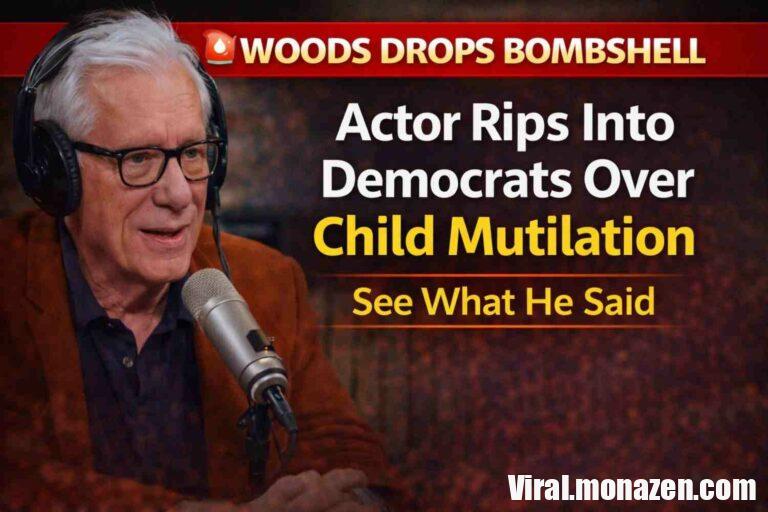
In the ever-intensifying intersection between politics, culture, and celebrity commentary, actor James Woods has once again ignited debate with a series of blunt remarks aimed at members of the Democratic Party and broader discussions surrounding gender identity and children.
Woods, a longtime Hollywood actor known for his roles in films such as Casino, Salvador, and Once Upon a Time in America, made the comments during a podcast appearance that quickly spread across social media platforms. The statement triggered a sharp reaction online, drawing support from some conservative commentators while prompting criticism from others who argue the remarks were inflammatory and misleading.
As with many high-profile political statements by celebrities, Woods’s comments highlight the increasingly blurred lines between entertainment, activism, and political discourse in the United States.
The Statement That Went Viral
During the interview, Woods delivered a strongly worded critique of what he described as progressive positions on gender identity, particularly policies related to minors.
The actor argued that he believes some political leaders and activists are supporting policies that allow or encourage children to transition genders at young ages. His comments were framed in stark language that quickly became the focal point of widespread debate.
Clips from the interview spread rapidly on social media, where supporters applauded Woods for speaking candidly while critics accused him of exaggerating or mischaracterizing complex medical and social issues.
Within hours, the discussion had moved beyond the original podcast appearance and into broader national conversations about parental rights, medical ethics, and the role of politics in cultural debates.
A Long History of Political Commentary
Although Woods built his reputation in Hollywood as an accomplished actor, he has become almost equally well known in recent years for his outspoken political views.
Over the past decade, he has used social media to express strong support for conservative policies and figures, including Donald Trump. His posts frequently address topics such as immigration, freedom of speech, media bias, and cultural trends in American society.
For supporters, Woods represents a rare conservative voice within an entertainment industry often perceived as politically liberal. Critics, however, argue that his posts often amplify partisan divisions and rely on controversial rhetoric.
Regardless of viewpoint, Woods has built a reputation for delivering commentary in an unusually direct style—something that again became evident in the podcast interview.
The Broader Debate Over Gender Policy
The controversy surrounding Woods’s remarks reflects an ongoing national debate about how governments, schools, and medical institutions should approach issues related to gender identity, particularly among minors.
In recent years, several states have passed laws restricting certain medical treatments for transgender youth, while others have moved to protect access to gender-affirming healthcare. The issue has become one of the most contentious cultural topics in American politics.
Supporters of gender-affirming care argue that it can be medically necessary for some individuals experiencing gender dysphoria. Major medical organizations in the United States—including the American Academy of Pediatrics and the American Medical Association—have supported the availability of certain treatments under careful medical supervision.
Critics, however, argue that such decisions should not involve irreversible medical interventions for minors and that more caution is needed when dealing with developing children.
These competing perspectives have turned gender policy into a central flashpoint in the nation’s broader cultural and political divisions.
Reaction From Supporters
Many commentators aligned with conservative viewpoints praised Woods’s willingness to speak openly about a topic they believe is often avoided in mainstream media or entertainment circles.
Supporters argued that the actor was raising concerns shared by many parents about the speed at which gender issues have entered public policy debates. Some praised him for challenging what they view as ideological pressure within the entertainment industry.
For them, Woods’s remarks represent an example of a public figure using his platform to question policies they believe deserve greater scrutiny.
Critics Push Back
At the same time, critics responded sharply to the actor’s comments.
Some accused Woods of using inflammatory language that misrepresents medical guidelines and stigmatizes transgender individuals. Others argued that the discussion should focus on nuanced policy analysis rather than emotional rhetoric.
Advocacy groups supporting LGBTQ rights emphasized that medical decisions related to gender identity typically involve extensive evaluation by healthcare professionals, parents, and mental health specialists.
For these critics, Woods’s remarks risk oversimplifying an issue that affects vulnerable individuals and families navigating difficult personal decisions.
The Role of Celebrity Voices in Political Debate
The episode also raises broader questions about the role of celebrities in political discourse.
Actors, musicians, athletes, and media personalities now wield enormous influence through social media platforms that allow them to communicate directly with millions of followers. As a result, statements made during interviews or podcasts can rapidly reach audiences far beyond traditional entertainment circles.
Some observers welcome this development, arguing that public figures have the same right to express political views as any other citizen. Others worry that celebrity commentary can overshadow expert analysis and reduce complicated policy debates to sound bites.
Woods’s remarks—and the strong reactions they generated—illustrate how celebrity voices can shape national conversations even when they originate outside traditional political institutions.
A Reflection of America’s Cultural Divide
The debate surrounding Woods’s comments ultimately reflects deeper cultural divisions in American society.
Questions about gender identity, parental authority, medical decision-making, and personal freedom intersect with broader political ideologies. These issues often become symbols in larger arguments about the direction of American culture and the balance between individual rights and social norms.
As a result, statements like Woods’s frequently resonate with audiences far beyond the entertainment world.
Media, Politics, and the Digital Age
The rapid spread of Woods’s remarks also highlights the powerful role of digital media in shaping modern political discourse.
In earlier decades, comments made during an interview might have remained within a limited audience. Today, however, clips can circulate across platforms within minutes, reaching millions of viewers and sparking immediate responses.
This environment tends to amplify provocative statements, as content that generates strong emotional reactions often spreads the fastest.
In the case of Woods’s interview, the combination of celebrity status, controversial subject matter, and blunt language created the perfect conditions for a viral political moment.
The Conversation Is Far From Over
Whether one agrees with Woods’s remarks or strongly disagrees with them, the reaction demonstrates how deeply emotional and politically charged discussions surrounding gender identity and cultural values have become.
For Woods, the episode reinforces his reputation as one of Hollywood’s most outspoken conservative voices. For critics and supporters alike, it serves as another reminder that debates once confined to legislative chambers or academic circles are now unfolding across podcasts, social media feeds, and celebrity interviews.
In an era when politics increasingly intersects with culture, entertainment, and online conversation, moments like this are likely to remain a defining feature of the public debate.
And as long as figures from Hollywood continue to speak openly about controversial issues, the lines between entertainment and political commentary will remain as blurred—and as powerful—as ever.