
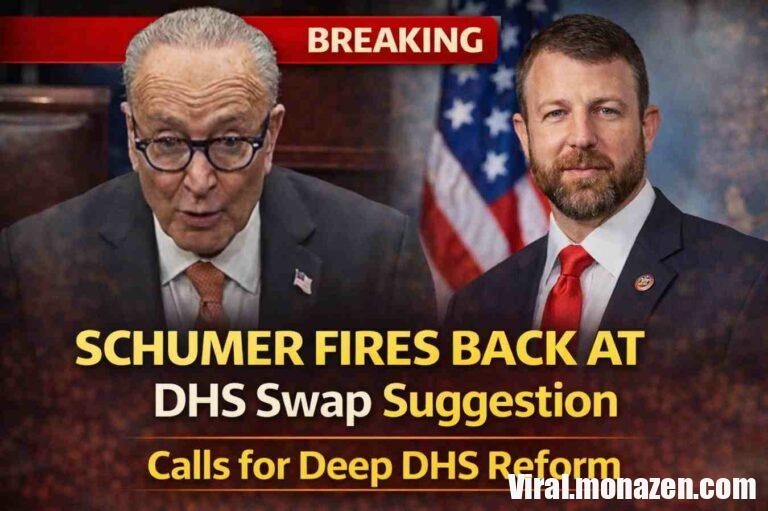
The debate over the future leadership of the U.S. Department of Homeland Security (DHS) has intensified after Senate Majority Leader Chuck Schumer publicly stated he would oppose Markwayne Mullin as a possible replacement for Kristi Noem.
Schumer’s comments, delivered during a discussion about the direction of federal immigration enforcement and national security agencies, signal a broader conflict within Washington over how DHS and its key enforcement arms—particularly Immigration and Customs Enforcement (ICE)—should be reformed. Rather than focusing on a single nominee, Schumer argued that the problems within the department are systemic and require structural changes before any leadership transition can be considered.
“The rot in DHS is deep—much deeper than any individual,” Schumer said, emphasizing that replacing a secretary without addressing broader policy and oversight issues would fail to solve the challenges facing the agency.
His remarks have sparked debate on Capitol Hill and beyond, raising questions about the future of DHS leadership, the role of Congress in shaping immigration enforcement, and the direction of national security policy.
A Controversial Nomination Debate
Although no official nomination has yet been finalized, speculation surrounding a potential leadership change at DHS has led to discussions about possible replacements for Secretary Kristi Noem. Among the names circulating in political circles is Senator Markwayne Mullin, a Republican from Oklahoma known for his outspoken positions on border security and immigration policy.
Mullin has built a reputation as a strong advocate for stricter border enforcement and expanded support for law enforcement agencies tasked with immigration control. Supporters argue that his background in business and politics could bring a more assertive approach to DHS operations.
However, Schumer’s rejection of Mullin as a potential nominee suggests that confirmation in the Senate would face serious political hurdles. With Democrats holding significant influence over the confirmation process, the path forward for any nominee could become a deeply partisan battle.
Schumer’s Call for Institutional Reform
Rather than focusing solely on the qualifications of any individual nominee, Schumer framed the issue as a broader institutional problem within the Department of Homeland Security.
According to the Senate leader, the agency has faced years of challenges related to oversight, accountability, and operational effectiveness. These concerns include disputes over immigration enforcement practices, detention policies, and coordination between federal agencies and local authorities.
Schumer argued that appointing a new leader without implementing reforms would simply perpetuate existing problems.
“The conversation shouldn’t start with who replaces whom,” Schumer suggested. “It should start with what needs to change inside the department.”
Among the reforms he has suggested are stronger congressional oversight mechanisms, clearer accountability structures for immigration enforcement agencies, and updated policies that address both border security and humanitarian concerns.
The Role of DHS in U.S. National Security
Established in the aftermath of the September 11 attacks, the Department of Homeland Security is one of the largest federal agencies in the United States government. It oversees a wide range of responsibilities, including border protection, immigration enforcement, cybersecurity, disaster response, and counterterrorism.
Within DHS, agencies such as U.S. Customs and Border Protection (CBP) and Immigration and Customs Enforcement (ICE) play central roles in enforcing immigration laws and managing the nation’s borders.
These responsibilities have placed DHS at the center of some of the most heated political debates in the United States, particularly as immigration continues to be a defining issue in national politics.
Critics of the department argue that its enforcement practices have sometimes raised civil liberties concerns, while supporters emphasize the need for strong security measures to protect the country’s borders.
Republican Response to Schumer’s Comments
Schumer’s rejection of Mullin has drawn criticism from some Republican lawmakers who argue that leadership changes could bring new energy and direction to the department.
Supporters of Mullin say his experience in both the private sector and government could provide valuable perspective in managing a large and complex agency. They also contend that Schumer’s focus on systemic reform risks delaying needed leadership decisions.
Some Republican voices have suggested that rejecting potential nominees before they are formally considered could politicize the confirmation process even further.
Others argue that DHS leadership should prioritize operational effectiveness and border security rather than becoming entangled in partisan battles.
Immigration Policy at the Center of the Debate
At the heart of the disagreement over DHS leadership lies the broader national debate over immigration policy.
For years, lawmakers from both parties have struggled to find consensus on how to address issues such as border security, asylum processing, immigration court backlogs, and the status of undocumented immigrants living in the United States.
These debates often influence how lawmakers view leadership choices for agencies like DHS.
For some policymakers, strong enforcement measures are the priority. For others, reforming immigration policies and improving humanitarian protections take precedence.
The disagreement between Schumer and Republican lawmakers reflects these deeper ideological differences.
Oversight and Accountability Concerns
Schumer’s call for stronger oversight reflects a growing conversation in Washington about how federal agencies should be monitored by Congress.
Over the years, DHS has faced scrutiny from both Democratic and Republican lawmakers over issues ranging from border management strategies to disaster response coordination.
Some lawmakers believe that enhanced oversight could help ensure transparency and accountability within the department. Others worry that excessive political scrutiny could hinder the agency’s ability to respond quickly to national security threats.
Balancing these concerns remains one of the most complex challenges facing Congress.
The Confirmation Process Ahead
If a leadership change at DHS were to occur, any nominee would need to be confirmed by the Senate—a process that can become highly contentious in politically divided times.
Confirmation hearings typically involve detailed questioning about policy priorities, management experience, and views on key issues such as immigration enforcement and national security.
Given the current political climate, any nominee would likely face intense scrutiny from lawmakers on both sides of the aisle.
Schumer’s early opposition to Mullin suggests that any potential nomination would be closely examined before moving forward.
A Broader Reflection of Political Divisions
The dispute over DHS leadership is emblematic of the broader divisions shaping American politics today.
Immigration, national security, and federal agency oversight remain among the most politically sensitive issues in Washington. As lawmakers debate these topics, leadership decisions within agencies like DHS often become symbolic battlegrounds for competing visions of policy and governance.
For observers of Washington politics, Schumer’s remarks highlight how deeply interconnected leadership decisions are with broader ideological debates.
Looking Ahead
As discussions about DHS leadership continue, the focus in Washington is likely to remain on both policy direction and institutional reform.
Whether the debate leads to significant structural changes within the department—or simply becomes another chapter in the ongoing partisan struggle over immigration and national security—remains to be seen.
For now, Schumer’s message is clear: before considering any new leadership at the Department of Homeland Security, Congress must first address what he sees as deeper systemic challenges within the agency itself.
And as the conversation unfolds, the future direction of one of America’s most important national security institutions hangs in the balance.