
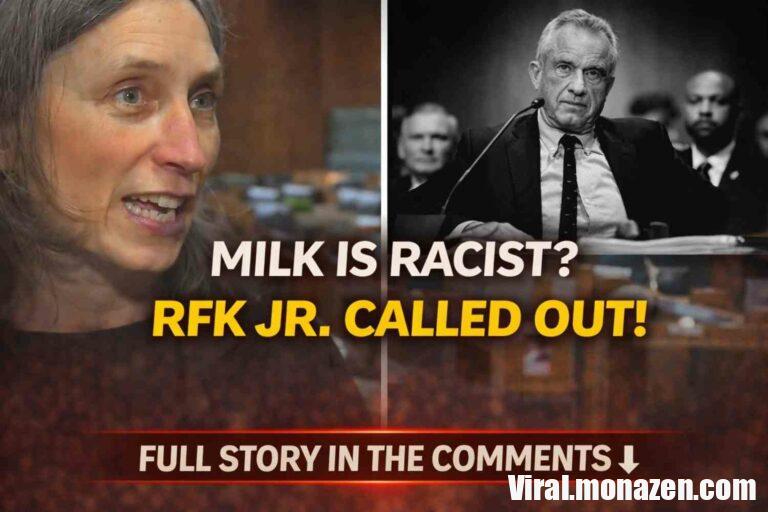
A heated debate has emerged at the intersection of nutrition, politics, and cultural symbolism after comments from Maxine Dexter criticizing Robert F. Kennedy Jr. for promoting whole milk triggered widespread reaction online.
Dexter’s remarks came during a broader discussion about nutrition policy and public health messaging. In her comments, she suggested that the political messaging around certain foods—particularly whole milk—has occasionally intersected with cultural and racial narratives in ways that deserve scrutiny.
Her remarks referenced what she described as “dog-whistling” language sometimes associated with online extremist communities, which have used images of milk consumption as a symbolic reference point in past internet campaigns.
The statement quickly ignited controversy, with critics accusing Dexter of politicizing food choices while supporters argued she was highlighting broader social dynamics surrounding nutrition, access, and inequality.
The episode illustrates how even seemingly simple dietary topics can become flashpoints in the United States’ increasingly polarized political landscape.
A Debate Over Nutrition Messaging
The controversy began after Kennedy, who has frequently spoken about health and nutrition issues, promoted whole milk as part of what he has described as a return to less processed and more traditional foods.
Kennedy has long argued that modern dietary guidelines should be reevaluated to focus more on natural food sources and less on heavily processed products.
Whole milk, which contains higher levels of natural fat compared to skim or low-fat varieties, has become part of a broader nutritional debate in recent years.
For decades, public health agencies encouraged reduced-fat dairy consumption to lower saturated fat intake. But some newer research has questioned whether the relationship between dairy fat and health risks is as straightforward as once believed.
This evolving scientific conversation has led some nutrition advocates to reconsider previous dietary guidelines.
Kennedy’s comments about whole milk were framed within that broader context.
Dexter’s Criticism
Dexter, a physician and first-term congresswoman, pushed back strongly against Kennedy’s messaging.
During a public exchange discussing nutrition policy, she argued that health recommendations should be guided by established scientific consensus rather than political messaging.
She also criticized what she described as a cultural framing of certain foods, suggesting that the symbolism surrounding milk has occasionally been appropriated in troubling ways online.
Her remarks specifically referenced extremist internet memes that have historically used milk imagery to promote racially charged narratives.
“Please ask for science-based regimens,” Dexter said during the exchange, emphasizing the importance of evidence-based health guidance.
Her comments quickly spread across social media, where they were interpreted in different ways depending on political perspectives.
The Internet’s Reaction
Within hours, the debate over Dexter’s remarks exploded across political commentary platforms.
Some critics mocked the idea that milk could be associated with racism, arguing that the claim stretched cultural analysis too far.
Others defended Dexter, noting that extremist groups have indeed used milk symbolism in certain internet campaigns over the past decade.
The disagreement reflects how online culture has increasingly blurred the line between genuine social analysis and political messaging.
In many cases, viral headlines and clipped quotes amplify controversy without fully explaining the context of statements.
Media analysts say the milk debate demonstrates how quickly complex discussions about nutrition, race, and symbolism can become oversimplified once they enter the viral news cycle.
A Long-Running Nutrition Debate
Beyond the political controversy, the discussion touches on an ongoing scientific debate about dairy consumption.
Whole milk contains higher levels of saturated fat compared to reduced-fat varieties, which historically led health authorities to recommend skim or low-fat options.
However, several recent studies have suggested that dairy fat may not have the same cardiovascular risks once assumed.
Some research has even found potential links between full-fat dairy consumption and lower risks of certain metabolic conditions.
Because of these mixed findings, nutrition experts increasingly emphasize overall dietary patterns rather than focusing on single foods.
Moderation, balance, and access to diverse foods remain central principles of most dietary guidelines.
The Access Argument
One part of Dexter’s remarks focused on disparities in food access across different communities.
Public health researchers have long documented the existence of “food deserts”—areas where residents have limited access to fresh and affordable food options.
These disparities can affect dietary choices and health outcomes in significant ways.
For example, communities with fewer grocery stores and higher food prices may have less access to fresh produce, high-quality dairy products, and other nutritious foods.
Dexter argued that discussions about ideal nutrition should consider those realities.
Her point reflects a broader public health perspective that health guidance must be practical and accessible for diverse populations.
The Politics of Food
Food has often played a surprising role in American political debates.
From school lunch programs to agricultural subsidies, nutrition policy has long been intertwined with economic, cultural, and ideological questions.
In recent years, debates about dietary guidelines have increasingly become part of wider cultural conversations.
Topics such as plant-based diets, food labeling, and agricultural practices have all become politically charged in different contexts.
The milk debate adds another example of how everyday food choices can become symbols within larger ideological disputes.
RFK Jr.’s Broader Health Advocacy
Kennedy has spent much of his public career advocating for changes to U.S. health and environmental policies.
He has frequently criticized federal health agencies and called for greater scrutiny of food additives, pesticides, and pharmaceutical practices.
His comments about whole milk are consistent with his broader argument that modern diets have become overly industrialized.
Supporters say his advocacy encourages Americans to rethink the quality and sourcing of their food.
Critics argue that some of his positions diverge from established scientific consensus.
The debate over milk therefore fits into a wider conversation about Kennedy’s health policy ideas.
What Experts Say
Nutrition experts say the most important takeaway from the debate is that dietary guidance should remain rooted in scientific evidence.
Most health organizations continue to recommend balanced diets that include fruits, vegetables, whole grains, lean proteins, and dairy products in moderation.
Whether individuals choose whole milk, low-fat milk, or plant-based alternatives often depends on personal health needs, cultural preferences, and access to food options.
Experts caution that political debates should not overshadow the core goal of promoting healthy and sustainable eating habits.
Looking Ahead
As the controversy fades from the headlines, the underlying questions remain.
How should public health guidance evolve as new research emerges?
How can policymakers address disparities in food access across different communities?
And how should political leaders communicate about nutrition without turning dietary choices into ideological battlegrounds?
The debate sparked by Dexter’s comments highlights the challenge of navigating these questions in an era when even everyday foods can become symbols in larger cultural arguments.
For many observers, the lesson may be simple: food policy is rarely just about food.
It is also about science, economics, culture, and the complex ways they intersect in modern society.