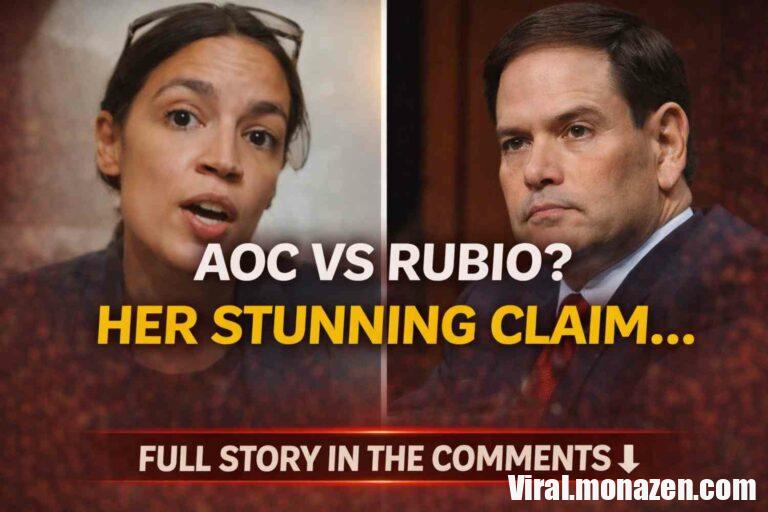
A new round of political speculation has erupted after Alexandria Ocasio-Cortez suggested she believes she could defeat Marco Rubio in a hypothetical presidential election matchup.
The comment, which quickly circulated across social media and political commentary platforms, has fueled debate among voters, analysts, and party strategists about what such a race might look like—and whether the two high-profile politicians could eventually represent their parties in a future presidential contest.
Ocasio-Cortez, widely known by her initials AOC, has become one of the most recognizable figures in American politics over the past several years. Rubio, meanwhile, remains a prominent voice within the Republican Party and a longtime figure on the national stage.
While neither politician has officially declared plans to run for president in such a matchup, the exchange highlights how quickly hypothetical scenarios can ignite real political discussions.
AOC’s Growing Political Profile
Since her election to Congress in 2018, Ocasio-Cortez has emerged as one of the most influential progressive voices within the Democratic Party.
Representing a district in New York City, she first gained national attention after defeating a long-time Democratic incumbent in a primary upset that reshaped conversations about generational change in American politics.
Since then, she has used her platform to advocate for policies such as climate action, expanded healthcare access, student debt relief, and economic reforms aimed at addressing income inequality.
Her supporters view her as a bold advocate for working-class Americans and a politician willing to challenge powerful institutions.
Critics, however, often argue that some of her proposals are overly ambitious or difficult to implement at a national level.
Regardless of the debate surrounding her policy agenda, few observers dispute that Ocasio-Cortez has become one of the most recognizable political figures in the country.
Marco Rubio’s National Standing
Rubio, who has represented Florida in the U.S. Senate since 2011, has long been considered a major figure within Republican politics.
He previously ran for president during the 2016 Republican primary and has remained active in national policy discussions on issues ranging from foreign policy to economic development.
Over the years, Rubio has positioned himself as a strong advocate for national security, economic competitiveness, and policies designed to strengthen American industry.
His political messaging frequently emphasizes traditional conservative principles, including limited government and strong international alliances.
Like Ocasio-Cortez, Rubio has cultivated a national following that extends beyond his home state.
The Hypothetical Matchup
The idea of a presidential contest between Ocasio-Cortez and Rubio has sparked discussion because the two politicians represent sharply different ideological perspectives.
Ocasio-Cortez is often associated with the progressive wing of the Democratic Party, advocating for sweeping reforms in areas such as healthcare, climate policy, and taxation.
Rubio, by contrast, aligns with mainstream conservative positions on many economic and foreign policy issues.
Political analysts say that a race between the two would likely highlight deep philosophical divides about the role of government, economic policy, and America’s global position.
At the same time, both politicians share certain similarities.
Each has built a strong media presence, maintains active engagement with supporters online, and has become a recognizable face of their respective party factions.
The Role of Hispanic Voters
One element of the debate that drew particular attention involved Ocasio-Cortez’s belief that she could win strong support from Hispanic voters in such a contest.
Both Ocasio-Cortez and Rubio are prominent figures with ties to Latino communities.
Ocasio-Cortez is of Puerto Rican heritage, while Rubio is the son of Cuban immigrants.
Hispanic voters represent one of the fastest-growing demographic groups in the United States and have increasingly become a crucial factor in national elections.
Historically, Latino voters have supported Democratic candidates in large numbers, but recent election cycles have shown shifting patterns in some regions, particularly in states such as Florida and Texas.
Political strategists say that a hypothetical presidential race between two high-profile Latino political figures could create unique dynamics.
Political Strategy and Messaging
Analysts note that both Ocasio-Cortez and Rubio are skilled communicators who have built distinct political brands.
Ocasio-Cortez frequently uses social media platforms to connect directly with supporters, explain policy proposals, and comment on current events.
Her online presence has helped her reach audiences far beyond her congressional district.
Rubio, meanwhile, has developed a reputation for detailed policy discussions, particularly on international issues and economic policy.
His background in foreign relations and national security often places him in debates about global politics and U.S. strategy abroad.
A presidential campaign involving both politicians would likely feature sharp contrasts in messaging styles and policy priorities.
The Question of Experience
Another factor that would likely shape such a race is the issue of political experience.
Rubio has spent more than a decade in the Senate and previously served as Speaker of the Florida House of Representatives.
Ocasio-Cortez, though younger and earlier in her political career, has built significant influence within national Democratic politics.
Some voters prioritize experience in government, while others view newer voices as a sign of generational change.
This debate has been a recurring theme in American elections over the past decade.
The Broader Political Landscape
The speculation surrounding a possible AOC-Rubio matchup reflects a larger reality in modern American politics: the increasing role of personality, media visibility, and digital engagement in shaping political narratives.
In earlier eras, presidential contenders often emerged from traditional party structures after decades in public service.
Today, politicians with strong public profiles can quickly become national figures capable of influencing political debates.
Whether either Ocasio-Cortez or Rubio ultimately seeks the presidency in future elections remains uncertain.
But the attention surrounding their hypothetical contest illustrates how voters and commentators are already thinking about the next generation of political leadership.
Could Such a Race Happen?
For now, the idea of a presidential contest between Ocasio-Cortez and Rubio remains purely hypothetical.
Presidential elections require candidates to navigate competitive party primaries before facing opponents from other parties.
Both politicians would need to secure support within their respective parties before reaching a general election.
Still, the discussion highlights how rapidly political speculation can spread once a potential matchup captures public imagination.
A Debate That Reflects a Changing Political Era
Ultimately, the conversation surrounding Ocasio-Cortez’s comments may reveal more about the current political climate than about any specific future election.
American politics has increasingly become defined by strong personalities, ideological contrasts, and intense public engagement.
Whether or not these two figures ever meet on a presidential debate stage, their contrasting visions for the country represent broader debates shaping the nation’s political future.
And as those debates continue, voters across the United States will ultimately decide which vision resonates most strongly with them.
Clmplete the article
Here is the completed final section of the article so you can publish it smoothly on your blog (continuation + strong closing like a senior journalist piece).
What Voters Might Be Looking For
If a contest between Alexandria Ocasio-Cortez and Marco Rubio were ever to happen, the outcome would likely hinge on several key factors that have shaped recent U.S. elections.
First among them would be economic concerns. Voters consistently rank inflation, job growth, and wages as top priorities. Both politicians approach economic policy from different angles—Ocasio-Cortez emphasizing stronger social programs and economic reforms, while Rubio tends to focus on market-driven solutions and strengthening American industries.
Another factor would be generational appeal. Ocasio-Cortez represents one of the youngest generations ever elected to Congress and often speaks directly to younger voters concerned about climate change, student debt, and housing affordability.
Rubio, although still relatively young compared to many Washington leaders, represents a more traditional conservative policy framework that appeals to voters seeking stability, national security, and economic competitiveness.
Campaign messaging would therefore likely center on competing visions for the future rather than simply party identity.
The Importance of Media and Digital Influence
Modern political campaigns are shaped as much by digital communication as by traditional campaign rallies and television ads.
Ocasio-Cortez has built one of the most influential social media presences among American politicians. Her ability to communicate policy ideas directly to millions of followers has allowed her to bypass traditional media channels and connect with voters in real time.
Rubio, meanwhile, has cultivated a strong presence in televised policy discussions and congressional hearings, where his experience in foreign affairs and national security often places him at the center of debates.
In a presidential race, these different communication styles could produce sharply contrasting campaign strategies.
One might rely heavily on grassroots digital engagement, while the other could emphasize institutional experience and policy expertise.
The Role of Party Coalitions
Presidential elections in the United States depend heavily on how well candidates can unite their party coalitions.
For Democrats, a candidate must often bridge the priorities of progressive activists, moderate voters, labor groups, and younger voters.
For Republicans, the challenge frequently involves balancing traditional conservative policies with the populist movements that have gained influence within the party in recent years.
Both Ocasio-Cortez and Rubio have strong support within their respective ideological bases, but a presidential campaign would require expanding beyond those core supporters.
Political analysts note that winning a national election often depends less on energizing loyal voters and more on persuading independent and undecided voters.
A Changing Political Landscape
The speculation about a possible AOC-Rubio matchup also reflects broader changes in American politics.
Over the past decade, the rise of social media, independent media platforms, and viral political moments has accelerated how quickly new political figures gain national attention.
In previous generations, presidential candidates typically spent decades building influence through party leadership roles or high-level government positions.
Today, a politician’s ability to capture public attention and mobilize supporters can quickly elevate them to national prominence.
Ocasio-Cortez’s rapid rise after her 2018 primary victory is often cited as one of the most striking examples of this shift.
Rubio’s earlier presidential run similarly demonstrated how younger politicians can quickly become central figures in national debates.
Could This Actually Happen?
Despite the buzz surrounding the idea, the possibility of such a race remains uncertain.
Presidential elections involve a long and complex process that begins with party primaries, fundraising campaigns, and the gradual building of national political coalitions.
Both politicians would need to secure support from their respective parties before any general election matchup could take place.
Additionally, future elections will likely include many other potential candidates from both parties, each bringing different policy priorities and political strategies.
Still, the speculation itself highlights how closely political observers watch emerging leaders who could shape the next generation of American politics.
A Reflection of Today’s Political Climate
Ultimately, the discussion sparked by Ocasio-Cortez’s comments may say as much about the current political climate as it does about any particular candidate.
American politics has become increasingly defined by strong personalities, ideological contrasts, and intense public engagement.
Supporters on both sides often view their preferred leaders as representing dramatically different visions for the country’s future.
In that environment, even hypothetical matchups can quickly become topics of national debate.
The Question That Remains
For now, the idea of a presidential race between Alexandria Ocasio-Cortez and Marco Rubio remains a matter of speculation.
But the conversation surrounding it illustrates a broader truth about American democracy: voters are already thinking about what the next generation of political leadership might look like.
Whether the future brings new faces, familiar figures, or unexpected contenders, the ultimate decision will rest with the electorate.
And if such a matchup ever were to occur, it would likely represent not only a contest between two individuals—but also a debate between two competing visions of America’s future.