
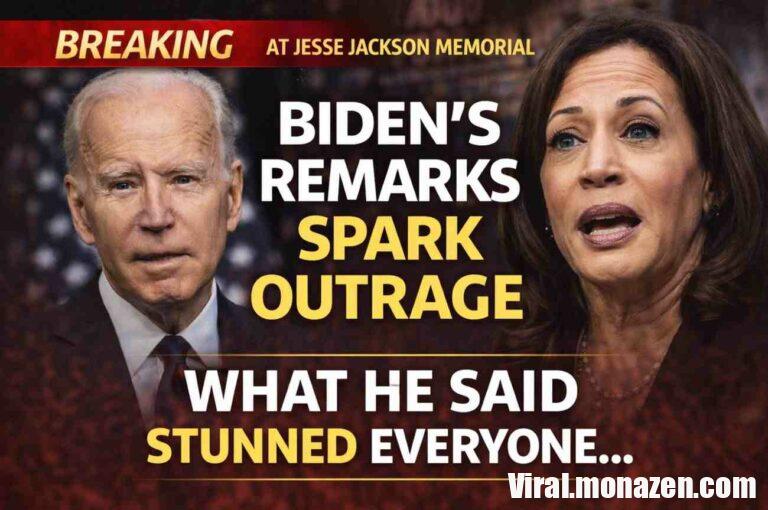
Former U.S. President Joe Biden’s appearance at a memorial service honoring civil rights leader Rev. Jesse Jackson has sparked renewed debate across social media and political circles, after a quote attributed to Biden began circulating online. The viral post claims that during the service Biden told attendees, “I am a hell of a lot smarter than most of you,” a statement that quickly fueled criticism, memes, and political commentary.
However, as with many viral moments in the modern digital media environment, the story has evolved into a broader conversation not only about what was said but also about how political narratives spread online, how speeches are interpreted, and how partisan reactions shape public understanding of major public events.
The memorial service itself was intended to honor one of the most influential figures in modern American civil rights history. Yet in the hours following the event, much of the online discussion shifted from the legacy of Jesse Jackson to the comments attributed to Biden and reactions to remarks by Vice President Kamala Harris.
The Context: Honoring a Civil Rights Leader
Rev. Jesse Jackson has long been recognized as a central figure in the civil rights movement. A close ally of Dr. Martin Luther King Jr., Jackson spent decades advocating for racial equality, voting rights, economic justice, and political participation for marginalized communities.
Throughout his career, Jackson founded the Rainbow/PUSH Coalition and ran for president twice in the 1980s, campaigns that helped expand the political influence of minority voters within the Democratic Party.
The memorial service, attended by political leaders, civil rights advocates, and public figures from across the country, was intended as a reflection on Jackson’s legacy and the continuing struggle for social justice in the United States.
Speakers at the event included current and former political leaders who shared stories about Jackson’s activism and his influence on American politics.
The Viral Quote
The controversy began when a social media post circulated claiming that Biden had told the audience during the service that he was “a hell of a lot smarter than most of you.”
The claim spread rapidly on platforms such as Instagram, Facebook, and X (formerly Twitter), where users debated whether the statement had been taken out of context or misrepresented.
Political commentators quickly weighed in, with critics portraying the remark as arrogant or dismissive, while supporters suggested that the quote may have been misinterpreted or extracted from a longer portion of the speech.
In the age of viral content, even a brief sentence—real or alleged—can rapidly become the focal point of political discussion.
Media analysts note that viral posts often amplify specific moments from speeches while ignoring the broader context in which they were delivered.
Kamala Harris and Political Style
The same viral post also referenced Vice President Kamala Harris, suggesting that she used what the author described as a “fake accent” during her remarks.
Criticism of political speech patterns is not new in American politics. Public figures often face scrutiny over their tone, phrasing, and speaking style, particularly when addressing diverse audiences.
Supporters of Harris argue that accusations about her speaking style are frequently exaggerated or politically motivated. They point out that many politicians naturally shift their tone or cadence depending on the setting, audience, or emotional tone of an event.
Critics, however, have repeatedly accused Harris of adjusting her speaking style in ways they believe appear inauthentic.
The debate over political communication reflects a broader cultural dynamic in which public figures are evaluated not only on their policies but also on how they present themselves in public settings.
Social Media and the Politics of Perception
One of the most significant aspects of the controversy surrounding Biden’s alleged remark is how quickly it spread across social media.
In the digital age, a single post—especially one paired with an image or short video clip—can reach millions of viewers within hours. The speed of online sharing means that political narratives can form before traditional news organizations have time to verify or contextualize the claims.
Media scholars describe this phenomenon as “information acceleration,” where public reaction often precedes careful analysis.
Political strategist Daniel Herrera notes that viral content can shape public perception even when the full story is more complicated.
“Once a quote or clip starts circulating online, people often form opinions immediately,” Herrera said. “By the time context or clarification arrives, the narrative has already taken hold.”
The Role of Partisan Commentary
Reactions to the viral post have largely followed predictable partisan lines.
Some critics of Biden seized on the quote as evidence that the former president is disconnected from ordinary Americans or overly confident in his own judgment.
Supporters, meanwhile, questioned the accuracy of the claim and argued that the controversy reflects the tendency of social media to amplify politically charged interpretations.
The debate illustrates how modern political discourse often centers not just on policy decisions but also on symbolic moments that can be interpreted in dramatically different ways depending on one’s political perspective.
A Broader Reflection on Political Discourse
Beyond the specific controversy, the episode highlights a broader issue in contemporary politics: the growing tension between viral communication and traditional journalism.
In previous decades, major political speeches were primarily interpreted through television broadcasts and newspaper coverage, which generally provided extended excerpts and contextual analysis.
Today, however, many voters encounter political events first through short clips, memes, or social media posts that emphasize emotional reactions rather than detailed reporting.
This shift has fundamentally changed how political narratives develop.
The Legacy of Jesse Jackson
Lost amid the online controversy was the central purpose of the memorial event itself: honoring the life and legacy of Jesse Jackson.
For decades, Jackson worked to expand opportunities for minority communities and to build coalitions across racial and economic lines.
His presidential campaigns in 1984 and 1988 helped bring issues of economic inequality, education access, and voting rights into the national political conversation.
Many speakers at the memorial emphasized that Jackson’s activism helped pave the way for future generations of leaders, including the election of Barack Obama as the first Black president.
The Continuing Conversation
As the debate over Biden’s alleged remark continues online, it serves as another example of how political communication has evolved in the digital era.
Public speeches, once evaluated primarily through traditional news coverage, now unfold simultaneously across social media platforms where clips, quotes, and commentary circulate instantly.
For voters and observers, the challenge lies in distinguishing between viral claims, partisan interpretations, and verified reporting.
What began as a memorial service honoring a historic civil rights leader has therefore become part of a much larger conversation about political speech, media dynamics, and the role of digital platforms in shaping public opinion.
And in today’s political climate, that conversation is unlikely to end anytime soon.