
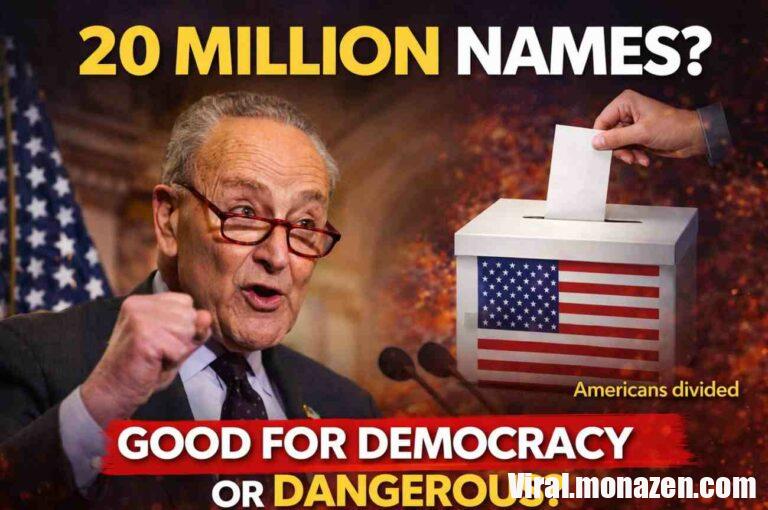
A growing political debate has emerged in Washington over the proposed Safeguard American Voter Eligibility (SAVE) Act, legislation that supporters say would strengthen election security but critics argue could potentially affect millions of eligible voters. The proposal has sparked a national conversation about voter identification requirements, election integrity, and the balance between access to voting and safeguards against fraud.
At the center of the controversy is a claim frequently raised in political discussions: that stricter verification requirements could lead to the removal of millions of names from voter registration rolls. Supporters view this as a necessary step to ensure only eligible citizens vote in federal elections. Opponents warn that the process could inadvertently affect legitimate voters who lack immediate access to documentation.
The debate illustrates one of the most contentious policy questions in modern American politics: how to ensure elections are both secure and accessible.
What the SAVE Act Proposes
The SAVE Act focuses primarily on requiring proof of U.S. citizenship when registering to vote in federal elections. Under the proposal, individuals would need to provide documentation—such as a birth certificate, passport, or other official proof—confirming they are U.S. citizens before being added to voter rolls.
Supporters argue that this measure would close loopholes that rely on self-attestation, where voters affirm their eligibility on registration forms without presenting documentation at the time of registration.
Proponents say the goal is straightforward: ensure that federal elections are conducted with a clear verification process confirming that only eligible citizens cast ballots.
They contend that requiring documentation is already common in many aspects of daily life, including obtaining employment, boarding commercial flights, or applying for financial services.
From their perspective, voting—arguably the most important civic act in a democracy—should be subject to similarly clear identity standards.
Supporters Emphasize Election Integrity
Backers of the legislation frame the SAVE Act as a safeguard for democratic institutions.
They argue that maintaining accurate voter rolls is essential for public confidence in election outcomes. If voter rolls contain outdated or inaccurate entries, they say, it can create vulnerabilities that undermine trust in the electoral system.
Election integrity advocates also note that voter roll maintenance is already required under federal law. States regularly remove names from registration lists when voters die, move to another state, or otherwise become ineligible.
Supporters say the SAVE Act would simply add an additional verification step at the beginning of the process—ensuring eligibility is confirmed before someone is added to the rolls.
They believe such measures could strengthen confidence in elections, particularly in an era when public trust in institutions has been declining.
Critics Warn of Potential Barriers
Opponents of the SAVE Act, including many Democratic lawmakers and voting rights organizations, argue that requiring proof of citizenship could create barriers for legitimate voters.
They point out that millions of Americans do not readily have access to documents like birth certificates or passports. For some individuals—especially elderly voters, rural residents, and people who have moved frequently—obtaining documentation may involve time, expense, or bureaucratic hurdles.
Voting rights advocates say such requirements could disproportionately affect certain groups, including lower-income citizens and historically marginalized communities.
Critics also emphasize that federal law already prohibits non-citizens from voting in federal elections. They argue that instances of non-citizen voting are extremely rare and that existing safeguards already protect election integrity.
From their perspective, the focus should instead be on expanding access to voting rather than adding additional requirements.
The Political Divide
The SAVE Act has become a flashpoint in the broader political divide between Republicans and Democrats over election policy.
Republican lawmakers often emphasize election security and verification measures. Many argue that requiring proof of citizenship is a reasonable step that aligns with the importance of protecting the integrity of elections.
Democratic lawmakers generally focus on protecting voter access and ensuring that eligible citizens are not unintentionally excluded from the electoral process.
This divide has grown sharper in recent years as election procedures—from mail-in ballots to voter identification laws—have become central issues in political campaigns and legislative debates.
Public Opinion Remains Mixed
Public attitudes toward voter identification laws vary widely depending on how questions are framed.
Some polls show strong public support for requiring identification at polling places. Many Americans see voter ID laws as a common-sense measure to prevent potential fraud.
However, when discussions shift to documentation requirements for voter registration, opinions often become more divided.
Surveys frequently reveal a balancing act among voters: strong support for election security measures paired with concerns about ensuring all eligible citizens can participate in the democratic process.
Election Administration Challenges
Election officials across the country face the complex task of maintaining voter rolls that are both accurate and inclusive.
Federal law requires states to regularly update registration lists by removing individuals who have died or moved away. However, these processes must also ensure that legitimate voters are not mistakenly removed.
Past voter roll maintenance efforts have sometimes generated controversy when individuals were incorrectly removed from voter lists due to clerical errors or outdated data.
Election administrators often emphasize that maintaining accurate voter rolls is a continuous process that requires careful coordination between state agencies, local governments, and federal databases.
Broader Questions About Election Reform
The debate surrounding the SAVE Act is part of a larger conversation about election reform in the United States.
In recent years, policymakers have proposed a wide range of changes to election procedures, including expanding early voting, improving voter registration systems, strengthening cybersecurity protections, and updating outdated voting infrastructure.
Many experts argue that comprehensive election reform must address both access and security simultaneously.
Ensuring elections are secure without limiting participation remains one of the most complex policy challenges facing lawmakers.
The Road Ahead
Whether the SAVE Act ultimately becomes law remains uncertain. Like many election-related proposals, it faces significant political hurdles in Congress.
Legislation affecting voting procedures often requires bipartisan cooperation, which has been difficult to achieve in a highly polarized political environment.
Nevertheless, the debate itself highlights the continued importance Americans place on elections and the democratic process.
Both supporters and critics of the SAVE Act claim they are defending democracy—albeit in different ways.
A Continuing National Conversation
The controversy surrounding the SAVE Act underscores how deeply Americans care about the integrity and fairness of elections.
For some, stronger verification requirements represent a necessary safeguard against potential abuse of the system.
For others, ensuring that every eligible citizen can vote without unnecessary barriers remains the highest priority.
As the discussion continues in Congress and across the country, the challenge for policymakers will be finding solutions that preserve both principles: security and access.
In the end, the strength of American democracy may depend on how successfully those two goals can be balanced.