
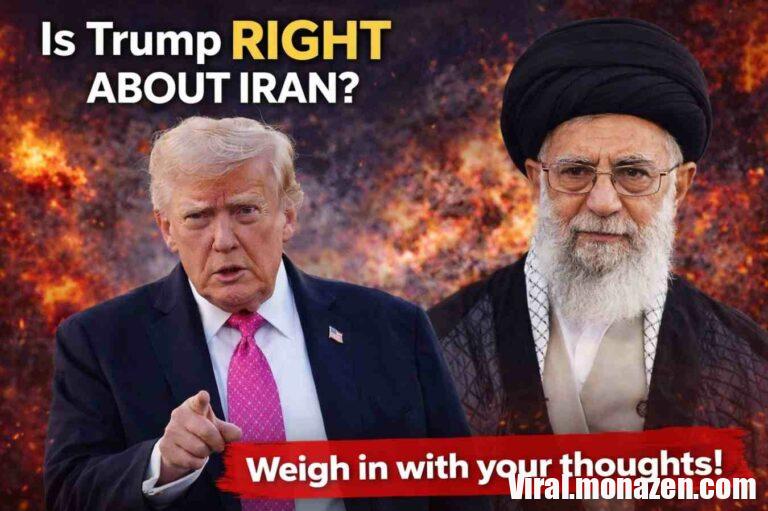
Former U.S. President Donald Trump has once again stirred international debate with a blunt characterization of Iran’s ruling government, describing the removal of the Islamic Republic as comparable to eliminating “a major cancer from the face of the Earth.” The remark, which quickly circulated across political media and social platforms, reflects the continued intensity surrounding U.S.–Iran relations and highlights the enduring divide over how Washington should confront Tehran.
Trump’s statement comes amid renewed geopolitical tensions across the Middle East and ongoing discussions about Iran’s nuclear ambitions, regional influence, and long-standing confrontation with the United States and its allies.
A Longstanding Rivalry
The conflict between the United States and Iran stretches back more than four decades, beginning with the 1979 Iranian Revolution, when the country’s Western-backed monarchy was overthrown and replaced by the Islamic Republic.
Relations deteriorated rapidly following the seizure of the U.S. Embassy in Tehran and the hostage crisis that held American diplomats captive for 444 days. Since then, the two nations have remained adversaries, with periods of confrontation alternating with brief attempts at diplomacy.
Trump’s presidency was marked by some of the most dramatic escalations in that rivalry in recent years.
The “Maximum Pressure” Strategy
During his time in office, Trump implemented what became known as the “maximum pressure” campaign against Iran. The strategy centered on sweeping economic sanctions aimed at crippling the Iranian economy and forcing the government to renegotiate its nuclear program and regional activities.
In 2018, the Trump administration withdrew the United States from the Joint Comprehensive Plan of Action (JCPOA)—the international agreement designed to limit Iran’s nuclear development in exchange for sanctions relief.
Trump argued the agreement was flawed and failed to address Iran’s ballistic missile program and support for armed groups across the Middle East.
Following the withdrawal, Washington reinstated heavy sanctions targeting Iran’s oil exports, banking system, and key industries.
The sanctions significantly weakened Iran’s economy, triggering inflation, currency instability, and widespread financial pressure inside the country.
Iran’s Regional Network
Trump and many of his supporters have long argued that Iran plays a destabilizing role across the Middle East.
Tehran has developed alliances with several armed groups and political movements throughout the region. These include Hezbollah in Lebanon, Hamas in Gaza, and the Houthi movement in Yemen, as well as militia networks in Iraq and Syria.
U.S. officials have frequently accused Iran of using these alliances to expand its influence and challenge American interests and allies in the region.
Iranian leaders, however, describe their regional activities as part of a broader strategy to resist foreign intervention and defend their national security.
Nuclear Concerns Remain Central
At the center of the dispute is Iran’s nuclear program.
Western governments have long feared that Iran could eventually develop nuclear weapons capability, a claim Tehran consistently denies. Iranian officials maintain that their nuclear program is intended solely for civilian energy purposes.
Despite these assurances, international watchdogs and intelligence agencies have repeatedly raised concerns about the scale and transparency of Iran’s nuclear activities.
Trump’s administration argued that the original nuclear deal failed to permanently block Iran’s path to nuclear weapons and only delayed potential development.
Since the U.S. withdrawal from the agreement, Iran has gradually expanded aspects of its nuclear program, including uranium enrichment levels beyond limits set under the JCPOA.
The Language of Confrontation
Trump’s recent description of Iran’s leadership as a “cancer” reflects the harsh rhetoric that has often characterized U.S.–Iran exchanges.
Supporters of Trump’s approach argue that blunt language and firm policies are necessary to deter what they view as an aggressive regime.
They say strong rhetoric sends a clear signal that Washington will not tolerate threats to American citizens, allies, or regional stability.
Critics, however, warn that inflammatory language can increase tensions and make diplomatic solutions more difficult to achieve.
Foreign policy experts often emphasize that rhetoric between rival nations can influence political decisions, military planning, and public perception.
The Risk of Escalation
The relationship between Washington and Tehran has come close to open conflict several times in recent years.
One of the most dramatic moments occurred in January 2020, when a U.S. drone strike killed Iranian General Qassem Soleimani in Baghdad. The strike was ordered by Trump and triggered immediate retaliation from Iran, which launched ballistic missiles at U.S. military bases in Iraq.
Although the confrontation stopped short of full-scale war, it illustrated how quickly tensions between the two countries can escalate.
Security analysts say the Middle East remains one of the world’s most fragile geopolitical regions, where even small incidents can have far-reaching consequences.
Domestic Politics and Foreign Policy
Trump’s comments also reflect the role that foreign policy plays in American domestic politics.
Many Republican voters support a hardline approach toward Iran, viewing the country’s government as a major threat to global security.
Democrats and foreign policy moderates often favor a combination of diplomatic engagement and economic pressure, arguing that negotiations can reduce the risk of military conflict.
The debate over Iran policy has therefore become a recurring theme in U.S. political discourse.
Each administration tends to pursue a different strategy depending on its broader foreign policy philosophy.
Iran’s Internal Dynamics
Inside Iran, the government faces its own internal challenges.
Economic sanctions, inflation, and political restrictions have led to periodic protests among Iranian citizens. Some demonstrations have criticized government policies, while others have focused on economic hardships.
Analysts note that Iran’s political system is complex, with power divided between elected officials and religious authorities led by the Supreme Leader.
While the Islamic Republic maintains a strong security apparatus, internal pressures continue to shape its political landscape.
A Debate That Shows No Signs of Ending
Trump’s comments about Iran have reignited a familiar debate: whether the United States should seek regime change, pursue diplomatic engagement, or maintain a long-term strategy of containment.
Foreign policy experts remain divided.
Some argue that strong pressure can weaken Iran’s regional ambitions and force meaningful negotiations.
Others believe that confrontation risks pushing the region toward wider conflict while strengthening hardline factions within Iran.
What remains clear is that the relationship between the United States and Iran will continue to influence global politics for years to come.
As tensions rise and political rhetoric intensifies, policymakers around the world are watching closely to see how the next chapter in this long-running rivalry will unfold.
For now, Trump’s stark warning has once again placed Iran at the center of the global political conversation—reminding observers that the question of how to deal with Tehran remains one of the most complex challenges in international diplomacy.