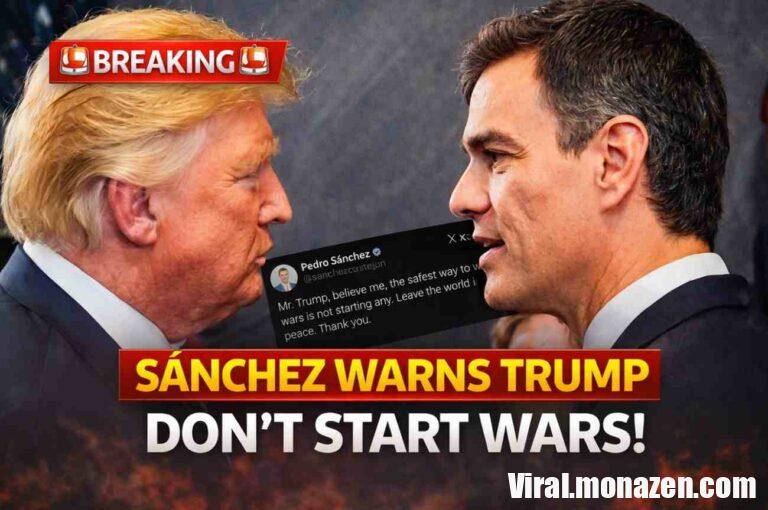
In an era marked by rising geopolitical tensions, the language used by world leaders carries significant weight. A single statement can shape public debate, influence diplomatic relationships, and even impact global markets. Recently, Spanish Prime Minister Pedro Sánchez sparked widespread discussion after a message directed toward former U.S. President Donald Trump circulated widely on social media platforms.
The message, attributed to Sánchez in a widely shared post, emphasized a simple but powerful principle: the best way to win a war is to avoid starting one at all. Whether interpreted as a broader philosophical position or as commentary on specific international tensions, the remark quickly ignited conversations about diplomacy, military strategy, and the role of global leadership in preventing conflict.
While the authenticity and context of viral political posts are often debated, the broader issue raised by the message reflects a real and enduring question in international relations: How can major powers prevent conflicts from escalating into global crises?
A World on Edge
The past decade has seen a noticeable increase in geopolitical uncertainty. Conflicts in Eastern Europe, tensions in the Middle East, and strategic rivalries among global powers have contributed to a climate where the possibility of military confrontation is never far from the headlines.
Governments around the world are balancing competing priorities—national security, economic stability, and diplomatic alliances—while attempting to navigate an increasingly complex international landscape.
Against this backdrop, calls for restraint and diplomatic engagement have become a recurring theme among some world leaders. The message attributed to Sánchez reflects a viewpoint held by many policymakers: that preventing war is often more valuable than winning one.
Spain’s Role in International Diplomacy
Spain has historically positioned itself as a supporter of multilateral diplomacy and international cooperation. As a member of the European Union and NATO, the country participates in collective security frameworks while also advocating for diplomatic solutions to global disputes.
Under Sánchez’s leadership, Spain has emphasized dialogue, humanitarian assistance, and international law as key components of its foreign policy approach.
Spanish officials have repeatedly stressed that military power alone cannot resolve many of the complex conflicts shaping today’s geopolitical environment. Instead, they argue that long-term stability depends on negotiation, cooperation, and economic development.
The sentiment expressed in the viral message aligns with this broader diplomatic philosophy.
Trump and the Politics of Strength
Donald Trump, during his presidency and in subsequent political commentary, has often emphasized a different approach to international relations—one focused heavily on military strength, economic leverage, and assertive negotiations.
Supporters of Trump argue that demonstrating strength and unpredictability can deter adversaries and protect national interests. They frequently point to actions such as increased defense spending, pressure on NATO allies to contribute more to collective security, and aggressive sanctions policies as examples of this strategy in practice.
Critics, however, argue that such approaches risk escalating tensions and undermining diplomatic institutions designed to prevent conflict.
The contrast between these perspectives—assertive deterrence versus diplomatic restraint—represents one of the central debates shaping modern foreign policy discussions.
The Power of Political Messaging
In the age of social media, political messaging travels faster and reaches wider audiences than ever before. Statements that once might have appeared in a diplomatic briefing or newspaper interview can now circulate globally within minutes.
This environment amplifies both the influence and the risk of political communication.
For leaders like Sánchez, a message emphasizing peace and diplomacy can resonate with audiences concerned about the dangers of global conflict. For others, such statements may be interpreted as criticism of more confrontational foreign policy strategies.
Regardless of interpretation, viral political messages highlight how digital platforms have become an integral part of modern diplomacy.
Preventing War: Lessons from History
The idea that avoiding war represents the greatest victory is not new. Throughout history, many influential thinkers and leaders have emphasized the importance of diplomacy and conflict prevention.
Following the devastation of the two world wars in the twentieth century, international institutions such as the United Nations were established with the explicit goal of reducing the likelihood of global conflict.
While these institutions have not eliminated war entirely, they have created mechanisms for negotiation, peacekeeping, and conflict resolution that have helped prevent many regional disputes from escalating.
The debate between military deterrence and diplomatic engagement remains central to international relations today.
Europe’s Perspective on Global Stability
European governments, including Spain’s, often emphasize diplomacy partly because of the continent’s historical experiences with war.
The European Union itself emerged from efforts to ensure that devastating conflicts between major European powers would never occur again.
As a result, European leaders frequently advocate for multilateral dialogue, economic cooperation, and collective security arrangements as tools for maintaining stability.
This perspective sometimes leads to differences in tone and strategy between European policymakers and leaders in other regions, including the United States.
The Challenge of Balancing Peace and Security
Despite the appeal of diplomatic solutions, governments must also address legitimate security concerns.
Military deterrence remains an important component of international stability. Many analysts argue that strong defense capabilities can discourage potential aggressors from initiating conflicts in the first place.
For policymakers, the challenge lies in finding the right balance between maintaining credible security measures and avoiding actions that could unnecessarily escalate tensions.
Statements like the one attributed to Sánchez highlight this delicate balance—reminding audiences that while defense preparedness is essential, the ultimate goal of international leadership should be preserving peace.
A Conversation Beyond Two Leaders
Although the viral message frames the discussion as a direct exchange between Sánchez and Trump, the underlying issue extends far beyond any individual political figures.
The broader question concerns how global leaders approach conflict in an era of rapid technological change, nuclear deterrence, and interconnected economies.
With modern weapons capable of causing unprecedented destruction, the stakes of geopolitical miscalculation are higher than ever.
For many policymakers and citizens alike, the idea that preventing war represents the most meaningful victory continues to resonate strongly.
The Future of Global Diplomacy
As international tensions continue to evolve, debates about military strategy, diplomatic engagement, and global leadership are likely to intensify.
Some leaders will continue advocating for strong deterrence policies, while others will emphasize dialogue and conflict prevention.
In reality, effective foreign policy often requires elements of both approaches.
Whether through formal negotiations, international institutions, or public messaging, the global community faces the ongoing challenge of maintaining stability in an increasingly complex world.
A Simple Idea with Global Implications
The message attributed to Spain’s prime minister may be brief, but it reflects a profound idea: that true leadership is measured not only by the ability to fight wars, but by the ability to prevent them.
In a world where geopolitical tensions can escalate quickly, the reminder that peace remains the ultimate objective carries enduring significance.
As international leaders continue to debate strategy, diplomacy, and security, the conversation sparked by that simple statement underscores a timeless truth—sometimes the greatest victory is ensuring that conflict never begins at all.