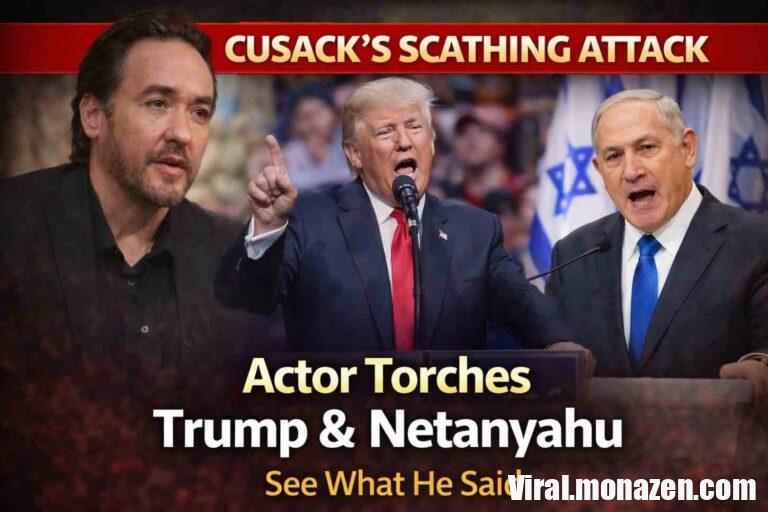
In an era when political debates unfold as much on social media as they do in government chambers, actors and entertainers increasingly find themselves shaping the public conversation. One of the latest examples comes from outspoken Hollywood actor John Cusack, whose recent remarks criticizing both Donald Trump and Benjamin Netanyahu ignited a new wave of debate across political and media circles.
Cusack’s comments, posted online amid escalating tensions involving Iran and growing geopolitical uncertainty, drew both praise and condemnation. For supporters, his words reflected frustration with global leadership and the direction of modern politics. For critics, they were yet another example of celebrities inserting themselves into complex international issues.
The reaction illustrates a broader trend in American public life: the increasing role of cultural figures in political discourse.
A Viral Statement in a Heated Moment
The controversy began when Cusack posted a message describing the United States as no longer functioning as a constitutional republic. In the statement, he argued that powerful political figures and wealthy elites have transformed the political system into something dominated by greed, influence, and unchecked power.
Cusack’s language was blunt and provocative. He described global leadership as increasingly controlled by what he called “gangsters and madmen,” referencing both Trump and Netanyahu directly.
The post spread rapidly across social media platforms, gaining attention from political commentators, journalists, and supporters on both sides of the political spectrum. Within hours, screenshots of the statement were circulating widely, triggering heated discussion about the role of celebrity voices in politics.
For many observers, the speed of the reaction highlighted the deep divisions that define contemporary political dialogue.
John Cusack: Actor Turned Political Commentator
Although Cusack is best known for films such as Say Anything, High Fidelity, and Grosse Pointe Blank, he has increasingly become known for his outspoken political views.
Over the past decade, he has used his social media platforms to comment on topics ranging from economic inequality to foreign policy and climate change. His posts frequently criticize corporate influence in government, the concentration of wealth among elites, and what he sees as the erosion of democratic institutions.
Supporters say his activism reflects a long tradition of artists speaking out on political issues. Critics argue that celebrity commentary can oversimplify complex geopolitical problems.
Regardless of perspective, Cusack’s remarks rarely go unnoticed.
The Trump Factor
The inclusion of Donald Trump in Cusack’s comments immediately amplified the reaction.
Trump remains one of the most polarizing figures in American politics. His supporters view him as a disruptive force who challenged entrenched political elites and reshaped the Republican Party. Critics see him as a symbol of political instability and deep division.
Since leaving the White House, Trump has continued to dominate headlines, with ongoing legal battles, campaign activity, and his influence over the Republican base keeping him at the center of national debate.
Cusack’s remarks tapped directly into that ongoing political divide, ensuring the discussion quickly expanded beyond Hollywood commentary into broader ideological territory.
Netanyahu and the International Dimension
Cusack’s criticism also extended to Benjamin Netanyahu, Israel’s long-serving prime minister and one of the most influential leaders in modern Middle Eastern politics.
Netanyahu has played a central role in shaping Israel’s security strategy and its relationships with the United States and other global powers. Supporters credit him with strengthening Israel’s security and international alliances. Critics argue his policies have contributed to regional tensions and political polarization within Israel itself.
The inclusion of Netanyahu in Cusack’s critique reflects how global conflicts — particularly those involving Iran and the broader Middle East — have become deeply intertwined with domestic political debates in the United States.
Celebrity Voices in Political Debate
Cusack’s comments are part of a larger pattern: the growing influence of celebrities in shaping political conversations.
Actors, musicians, athletes, and media personalities now frequently use social platforms to speak directly to millions of followers, bypassing traditional media channels.
Supporters of this trend argue that public figures have the same right to express political opinions as anyone else. Critics worry that celebrity influence can blur the line between entertainment and informed policy discussion.
Yet the phenomenon is hardly new. Throughout American history, artists and cultural figures have used their platforms to advocate for political causes — from civil rights and anti-war movements to environmental activism.
What has changed is the speed and scale of the conversation.
The Role of Social Media
The viral spread of Cusack’s remarks underscores the powerful role social media plays in shaping modern political discourse.
Platforms allow statements to reach millions within minutes, often without the filtering or contextual framing that traditional journalism provides. As a result, brief comments can quickly become flashpoints in national debates.
This dynamic often amplifies the most provocative language, as posts that spark strong emotional reactions tend to spread the fastest.
In Cusack’s case, the stark wording of his statement virtually guaranteed a rapid and intense response.
Supporters Applaud the Criticism
Some commentators and activists praised Cusack for speaking out, arguing that his message reflects widespread frustration with global leadership and the concentration of power among political and economic elites.
Supporters say outspoken voices — whether from Hollywood or elsewhere — can help draw attention to issues that might otherwise remain outside the spotlight.
They argue that public criticism of powerful leaders is a fundamental component of democratic societies.
Critics Push Back
Others strongly disagreed with Cusack’s remarks, accusing him of using inflammatory language that contributes to political division.
Some critics argued that comparing political leaders to criminals or extremists oversimplifies complex geopolitical realities. Others suggested that celebrity commentary often lacks the nuance required to understand international diplomacy and security challenges.
For them, Cusack’s post represents a broader trend of politicized rhetoric that fuels polarization rather than constructive dialogue.
A Reflection of a Divided Political Climate
The intensity of the reaction to Cusack’s statement reveals how deeply polarized political discourse has become.
Even brief comments from public figures can ignite major controversies when they touch on sensitive topics such as international conflict, national leadership, and the future of democratic institutions.
In many ways, the debate surrounding Cusack’s remarks mirrors the broader tensions shaping modern politics: disagreements over leadership, the role of elites, and the direction of global power.
The Conversation Continues
Whether praised or criticized, Cusack’s comments have succeeded in one respect: they have sparked conversation.
In a digital age where public figures can reach audiences instantly, the intersection of celebrity culture and political commentary shows no signs of fading. Statements that once might have passed quietly now travel across the world within minutes.
For observers of modern politics, the episode serves as another reminder that today’s debates are no longer confined to government chambers or news studios. They unfold everywhere — including Hollywood, social media, and the smartphones of millions of readers.
And as global tensions continue to rise, voices from every corner of public life are likely to remain part of the conversation.