
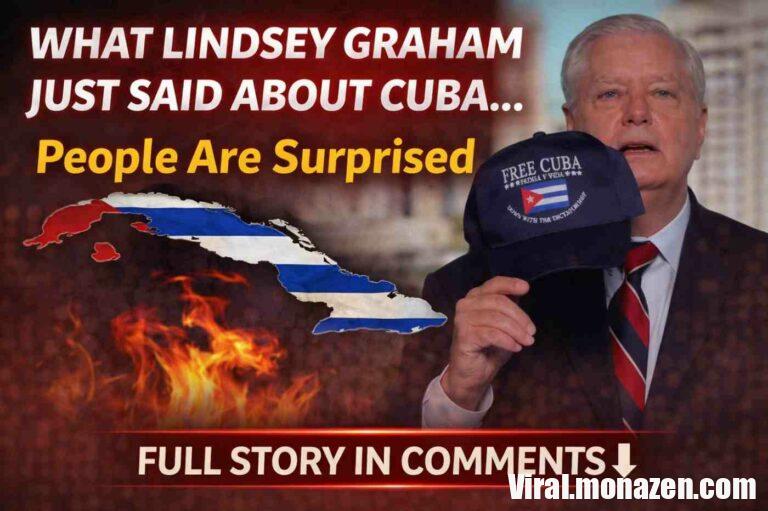
Senator Lindsey Graham’s recent remarks suggesting that “Cuba is next” in the global struggle against authoritarian regimes have ignited a new round of debate about U.S. foreign policy toward the Caribbean nation. Speaking during a television appearance in Miami while holding a cap emblazoned with the words “Free Cuba,” the South Carolina Republican framed his comments as part of a broader call to confront governments that Washington views as hostile or oppressive.
“If we get in a fight, I want to win it quick,” Graham said during the interview. “You see this hat? ‘Free Cuba.’ Stay tuned. The liberation of Cuba is upon us. We’re marching through the world. We’re clearing out the bad guys. Cuba is next.”
While supporters of the senator interpret the comments as rhetorical support for democratic change in Cuba, critics argue that the remarks raise concerns about escalating tensions and reviving long-standing geopolitical conflicts in the Western Hemisphere.
The discussion has drawn attention not only because of Graham’s high-profile role in Washington but also because of the long and complicated history between the United States and Cuba.
A Long and Complicated Relationship
Relations between Washington and Havana have been strained for more than six decades. Following the Cuban Revolution in 1959, which brought Fidel Castro to power, the United States imposed sweeping economic sanctions on the island nation.
Those sanctions—commonly referred to as the U.S. embargo—remain one of the central pillars of American policy toward Cuba today. The embargo restricts trade, financial transactions, and investment, though certain humanitarian and agricultural exceptions exist.
Over the years, U.S. administrations have taken varying approaches to the policy.
During the Cold War, Cuba’s close alliance with the Soviet Union made it a focal point of geopolitical tension. The 1962 Cuban Missile Crisis, triggered by the discovery of Soviet nuclear missiles stationed on the island, brought the world to the brink of nuclear conflict.
Since then, American leaders have generally pursued strategies aimed at isolating the Cuban government economically while supporting democratic reforms on the island.
A Political Flashpoint in Florida
Graham’s comments came during a visit to Miami, a city that holds enormous political significance when it comes to U.S. policy toward Cuba.
South Florida is home to one of the largest Cuban exile communities in the world. Many residents fled the island after the revolution and have remained strong critics of the Cuban government.
For decades, Cuban American voters have played a powerful role in shaping U.S. political debate on the issue.
Politicians from both major parties frequently travel to Miami to discuss their positions on Cuba policy, often emphasizing support for democracy and human rights on the island.
In recent years, however, the debate has broadened beyond the traditional exile community to include younger Cuban Americans who sometimes hold more varied perspectives on engagement and reform.
Supporters Applaud the Message
Supporters of Graham’s remarks argue that his comments reflect growing frustration among U.S. policymakers over the Cuban government’s human rights record.
In particular, protests that erupted across Cuba in 2021 brought renewed international attention to political freedoms on the island.
Thousands of Cubans took to the streets calling for economic reforms and greater civil liberties. Cuban authorities responded with arrests and restrictions on communication, actions that drew criticism from human rights organizations and foreign governments.
Advocates for stronger U.S. action argue that American leaders should continue to pressure Havana to implement democratic reforms.
“Statements like this highlight the urgency of standing with the Cuban people,” said one policy analyst who focuses on Latin American affairs. “Many believe the international community should continue pushing for meaningful change.”
Critics Warn Against Escalation
However, critics say Graham’s language risks fueling unnecessary tension between Washington and Havana.
Some foreign policy experts caution that dramatic rhetoric can complicate diplomatic efforts and reinforce the Cuban government’s narrative that the United States seeks to interfere in the country’s internal affairs.
Others note that decades of sanctions and political pressure have not yet produced the democratic transformation many U.S. policymakers hoped for.
“History shows that policy toward Cuba is extremely complex,” said a professor of international relations who studies the region. “Any suggestion of direct confrontation or intervention raises serious questions about regional stability.”
Critics also emphasize that many Latin American countries favor diplomatic engagement and gradual reform rather than confrontational approaches.
The Role of Symbolism in Politics
The “Free Cuba” hat Graham displayed during the interview carries symbolic significance within the broader political conversation.
For many Cuban Americans, the phrase represents a longstanding aspiration for political change and democratic governance on the island.
At the same time, the slogan reflects decades of ideological struggle that have shaped U.S.–Cuba relations.
Political messaging often relies heavily on symbols and slogans to communicate complex policy positions in simple terms.
In this case, the phrase “Free Cuba” has been used by activists, politicians, and advocacy groups across multiple generations.
A Changing Geopolitical Landscape
The debate surrounding Graham’s comments also reflects broader shifts in global politics.
In recent years, tensions between the United States and rival powers such as Russia and China have influenced foreign policy discussions in multiple regions.
Some analysts argue that Cuba’s strategic location in the Caribbean—just 90 miles from the U.S. mainland—continues to give the island geopolitical importance.
Others note that economic challenges inside Cuba, including inflation and shortages of basic goods, have created pressure for reform.
However, predicting the future direction of Cuba’s political system remains difficult.
Diplomatic Efforts and Future Possibilities
Despite decades of tension, there have been moments when Washington and Havana moved toward improved relations.
One of the most notable occurred during the Obama administration, when diplomatic ties were restored and travel restrictions were partially eased.
Although those policies were later scaled back, they demonstrated that significant shifts in U.S.–Cuba relations are possible.
Today, policymakers remain divided over the best approach moving forward.
Some advocate maintaining strong pressure through sanctions, while others argue that engagement and economic cooperation could encourage long-term reforms.
The Broader Debate Continues
Senator Graham’s comments have once again brought attention to one of the most enduring foreign policy questions facing the United States.
Should Washington continue its longstanding strategy of isolation and pressure, or should it pursue new diplomatic avenues to influence change on the island?
For now, the debate remains unresolved.
What is clear, however, is that Cuba continues to occupy a unique place in American political discourse—a country whose history, geography, and politics ensure that it remains a central topic whenever discussions turn to democracy, sovereignty, and global strategy.
As the conversation continues, policymakers, analysts, and citizens alike will be watching closely to see how the next chapter in U.S.–Cuba relations unfolds.