
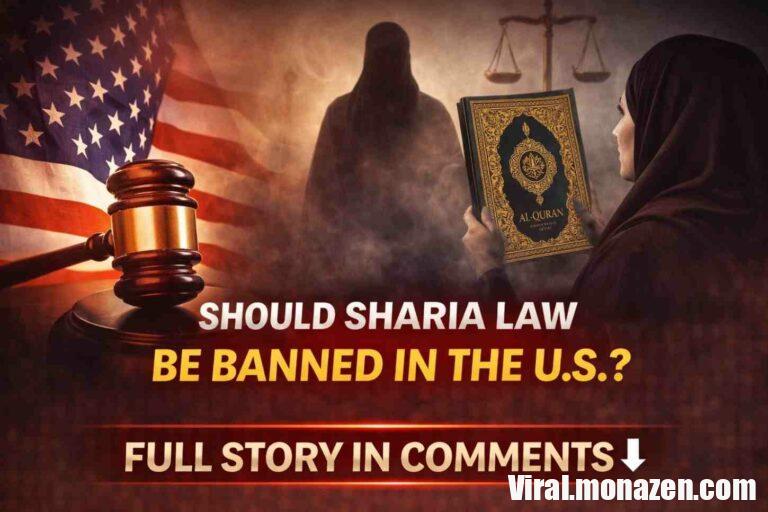
In recent years, a growing number of conservative lawmakers in the United States have pushed legislation aimed at restricting or banning the use of Sharia law in American courts. The effort has sparked a national debate touching on constitutional law, religious freedom, national security, and the broader cultural tensions shaping American politics.
Supporters argue that such laws are necessary to protect the U.S. Constitution as the supreme legal authority in the country. Critics counter that the legislation is unnecessary and risks stigmatizing Muslim communities while raising serious concerns about religious liberty.
The controversy reflects deeper questions about how religious traditions interact with American legal institutions—and whether those traditions pose any realistic challenge to the U.S. legal system.
What Is Sharia Law?
The term “Sharia” is commonly translated as Islamic law, but scholars note that it is more accurately understood as a broad framework of moral and legal principles derived from Islamic religious texts and traditions.
In practice, Sharia can cover a wide range of matters—from personal religious observance to family law questions such as marriage, inheritance, and divorce.
In many Muslim-majority countries, certain aspects of Sharia are incorporated into national legal systems. However, in Western democracies like the United States, religious law cannot replace or override constitutional law.
American courts are bound by the Constitution, federal law, and state law—meaning that any religious practice must operate within those legal boundaries.
The Rise of “Anti-Sharia” Legislation
Efforts to restrict the influence of Sharia law in the United States date back more than a decade. Since around 2010, lawmakers in dozens of states have introduced bills aimed at preventing courts from considering foreign or religious legal systems.
Some of these measures have passed.
States including Alabama, Arizona, Kansas, Louisiana, North Carolina, South Dakota, and Tennessee have adopted laws or constitutional amendments that prohibit courts from applying foreign or religious law if it conflicts with constitutional protections.
Often, the laws are written broadly, referring not specifically to Islam but to “foreign law” or “international law.” Supporters say this wording ensures neutrality while reinforcing that American law must remain supreme.
Yet critics say the legislative efforts are clearly aimed at Muslim communities, even when the language of the law avoids explicitly mentioning Islam.
Federal Efforts to Ban Sharia Law
The debate has also reached Congress.
In 2025, Republican lawmakers introduced legislation known as the “No Sharia Act,” designed to prevent American courts from enforcing any foreign legal rulings that violate constitutional rights.
The proposed law would prevent courts from enforcing contracts, judgments, or family-law decisions based on foreign legal codes if those codes conflict with constitutional protections such as equal rights or due process.
Supporters of the bill argue that it protects American values and ensures that religious legal systems cannot undermine the Constitution.
One sponsor of the legislation stated that while religious freedom is protected in the United States, foreign legal systems should never supersede the Constitution.
However, the proposal has sparked criticism from civil liberties advocates and legal scholars.
Critics Say the Laws Address a “Non-Problem”
Many legal experts argue that anti-Sharia legislation is unnecessary because U.S. courts already cannot enforce laws that violate constitutional rights.
In other words, the Constitution already prevents any religious legal system—including Sharia—from replacing American law.
Critics therefore describe many of the proposed laws as symbolic political gestures rather than practical legal reforms.
Research groups tracking state legislation say hundreds of bills targeting Sharia or “foreign law” have been introduced across the country, often without evidence that Islamic law is actually being imposed in U.S. courts.
Some legal scholars also warn that such laws could inadvertently affect other religious communities.
For example, Jewish arbitration courts known as “beth din” and Christian mediation systems sometimes resolve disputes within their communities, but their decisions must still comply with American law.
Broad bans on religious legal principles could complicate these longstanding practices.
Political and Cultural Context
The issue has become closely linked to broader debates about immigration, national identity, and national security.
Some conservative politicians argue that Western countries must guard against what they describe as “creeping Sharia”—a belief that Islamic legal systems could gradually influence Western institutions.
Others frame the issue as part of a larger confrontation with extremist ideologies.
Several Republican lawmakers have described Sharia law as fundamentally incompatible with American values, arguing that legislation is needed to prevent its expansion.
For example, one senator supporting federal legislation argued that the United States must protect its constitutional system from foreign ideological influences.
Critics respond that such rhetoric risks conflating Islam—a religion practiced by millions of Americans—with extremism.
Civil rights organizations warn that framing Muslim religious practices as a threat could encourage discrimination and social division.
The Constitutional Question
At the heart of the debate lies the First Amendment, which protects both religious freedom and the separation of church and state.
American courts have long held that individuals have the right to practice their religion freely, as long as those practices do not violate public laws or the rights of others.
For example, religious arbitration—where two parties voluntarily agree to resolve a dispute through religious mediation—is permitted under U.S. law as long as the outcome complies with constitutional protections.
Legal scholars therefore argue that the Constitution already provides a robust framework for balancing religious freedom and the rule of law.
Public Opinion and Political Strategy
Some analysts believe the issue resonates strongly with certain voters because it connects to broader cultural concerns about globalization, immigration, and national identity.
Ballot initiatives and legislative proposals targeting Sharia law have sometimes generated significant public support.
In Oklahoma, for example, a 2010 ballot measure banning courts from considering Sharia law passed with overwhelming voter approval.
Political strategists say such measures can energize conservative voters who see them as defending traditional American values.
However, opponents argue that these campaigns often rely on fear of unfamiliar cultural practices rather than evidence of actual legal threats.
A Debate That Reflects Larger Questions
The ongoing debate over banning Sharia law reveals deeper tensions within American society.
For some, the legislation represents a proactive defense of constitutional principles.
For others, it raises concerns about religious freedom, minority rights, and the politicization of cultural differences.
Despite the heated rhetoric surrounding the issue, most legal experts agree on one key point: the U.S. Constitution remains the ultimate authority in American courts.
Whether additional legislation is necessary—or merely symbolic—remains a question that continues to divide lawmakers, legal scholars, and the public.
What is clear is that the conversation about Sharia law has become part of a larger national discussion about how America balances religious diversity with the rule of law.
As that debate continues, it is likely to remain a powerful—and controversial—topic in American politics.