
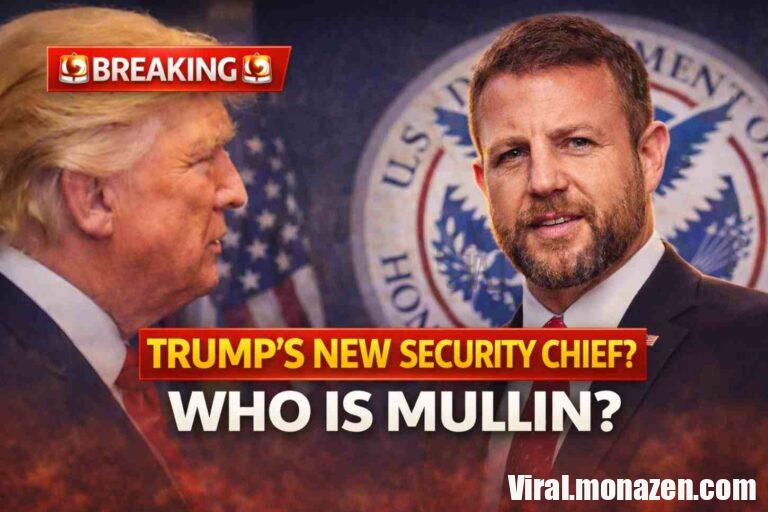
In a move that signals both political loyalty and a continuation of tough immigration policies, U.S. President Donald Trump has nominated Oklahoma Senator Markwayne Mullin to serve as the next Secretary of Homeland Security. The announcement came amid mounting pressure on the Department of Homeland Security (DHS), which has faced political controversy, operational challenges, and heightened scrutiny in recent months.
If confirmed by the Senate, Mullin would replace Kristi Noem, the embattled former head of the department whose tenure was marked by policy disputes and growing criticism over immigration enforcement operations. Mullin’s nomination reflects the president’s effort to place a trusted ally in charge of one of the federal government’s most powerful and politically sensitive agencies.
The Department of Homeland Security plays a central role in national security, overseeing immigration enforcement, border protection, counterterrorism operations, and disaster response. As such, the selection of its leader carries significant implications for both domestic policy and international relations.
From Mixed Martial Arts to the Senate
Markwayne Mullin’s rise to national prominence has been anything but conventional.
Before entering politics, Mullin built a reputation in Oklahoma as a successful businessman and former mixed martial arts fighter. Born and raised in the state, he spent much of his early career working in his family’s plumbing business. Over the years, Mullin and his wife expanded the company into a thriving enterprise, employing dozens of workers and serving communities across the region.
His business background became a cornerstone of his political identity. Mullin often presented himself as an outsider to Washington politics, emphasizing his experience as a small-business owner rather than a career politician.
That narrative helped him win election to the U.S. House of Representatives in 2012, where he served for more than a decade before successfully running for the U.S. Senate in 2022. He was officially sworn in as a senator in early 2023.
Throughout his time in Congress, Mullin has cultivated a reputation for direct, sometimes confrontational political style—a characteristic that has both energized supporters and drawn criticism from opponents.
A Loyal Ally of Donald Trump
Mullin’s political trajectory has been closely linked to his support for former President Trump.
Since arriving in Washington, he has consistently aligned himself with Trump’s policy priorities, particularly on issues such as immigration enforcement, border security, and federal law enforcement authority.
In recent years, Mullin has emerged as one of the Republican Party’s most outspoken defenders of Trump’s immigration policies. He has frequently argued that stronger enforcement measures are necessary to address what many conservatives see as a crisis at the U.S. southern border.
This ideological alignment likely played a key role in Trump’s decision to nominate him to lead DHS.
The agency is central to implementing many of the administration’s most controversial policies, including expanded detention programs, stricter asylum regulations, and increased support for Immigration and Customs Enforcement (ICE) operations.
A Department Under Intense Scrutiny
Should Mullin be confirmed, he will inherit leadership of a department facing multiple political and operational challenges.
DHS has come under heavy criticism in recent months following several high-profile incidents involving immigration enforcement operations.
One of the most controversial cases occurred in Minnesota, where two U.S. citizens were reportedly killed during encounters with federal immigration agents. The incident sparked protests, congressional inquiries, and renewed debate about the scope of federal enforcement authority.
Civil rights organizations and some Democratic lawmakers have called for greater oversight of DHS operations, arguing that aggressive immigration enforcement can sometimes lead to tragic consequences.
Supporters of the agency, however, insist that federal officers are performing a difficult job under dangerous conditions.
Mullin himself has defended immigration agents strongly. Following the death of Alex Pretti, who was shot by immigration officers in Minneapolis, Mullin took to social media to express support for law enforcement personnel.
“Obstructing federal law enforcement is a felony,” he wrote, emphasizing that many Americans comply with ICE instructions without hesitation. He also highlighted what he described as a dramatic increase in threats against federal agents, suggesting that enforcement officers face significant personal risks while carrying out their duties.
The Government Shutdown Debate
Mullin has also been vocal about the political battles surrounding federal funding for DHS.
The department recently found itself at the center of a partial government shutdown, triggered by congressional disagreements over immigration policy and budget allocations.
Republican lawmakers have accused Democrats of engaging in political theatrics by allowing funding for DHS to lapse, while Democrats argue that oversight and reform are necessary before expanding enforcement operations.
During a recent television appearance, Mullin criticized the shutdown sharply.
“What is actually happening right now with the Democrat Party by this political theatre… by shutting down DHS for something that you even admitted yourself can’t be done,” he said in an interview with CNN.
According to Mullin, the funding dispute does little to stop immigration enforcement operations while potentially undermining national security.
Leadership Style: Combative and Direct
Mullin’s nomination has also attracted attention because of his personality.
Unlike many traditional Washington politicians, Mullin is known for his combative style and willingness to engage in direct confrontation.
One widely publicized moment occurred during a Senate hearing in 2023 when Mullin challenged a labor union leader to a physical fight during a heated exchange. The incident quickly went viral and reinforced his reputation as a politician unafraid of confrontation.
Supporters view his approach as evidence that he is willing to challenge political norms and stand up for his beliefs.
Critics argue that such behavior raises questions about his temperament for leading a major federal agency responsible for national security.
What Confirmation Could Mean
Before Mullin can assume the role of Homeland Security secretary, his nomination must be confirmed by the U.S. Senate.
Although Republicans currently hold significant influence in the chamber, confirmation hearings are expected to include intense questioning from Democratic lawmakers concerned about immigration policy, civil liberties, and DHS oversight.
If confirmed, Mullin would become the second Homeland Security chief in Trump’s current administration.
His appointment could signal a continuation—and possibly an expansion—of the administration’s immigration enforcement strategy.
Analysts believe his leadership may prioritize strengthening cooperation between federal immigration authorities and local law enforcement, expanding detention programs, and accelerating deportation procedures.
A Defining Role in American Security
The Department of Homeland Security was created after the September 11 attacks in 2001 to coordinate federal efforts against terrorism and protect U.S. infrastructure.
Today, it is one of the largest federal agencies, employing more than 250,000 people across numerous divisions, including:
- Customs and Border Protection (CBP)
- Immigration and Customs Enforcement (ICE)
- The Federal Emergency Management Agency (FEMA)
- The Transportation Security Administration (TSA)
- The U.S. Secret Service
Leading such a complex organization requires navigating not only national security threats but also political controversies surrounding immigration and civil liberties.
The Road Ahead
As the confirmation process begins, Mullin’s nomination is likely to deepen the ongoing national debate about immigration policy and the role of federal enforcement agencies.
For supporters of the Trump administration, his appointment represents a commitment to strengthening border security and empowering law enforcement.
For critics, it raises concerns about the future direction of the Department of Homeland Security and the balance between security and civil rights.
Regardless of the outcome, the selection of Markwayne Mullin highlights the broader political struggle over immigration and national security—issues that continue to shape American politics in profound ways.