In the age of social media diplomacy, a single message can ripple far beyond the platform where it first appears. That reality became strikingly clear after a brief exchange involving tech billionaire Elon Musk and Iran’s Supreme Leader Ali Khamenei ignited intense debate online and triggered fresh speculation among financial traders.
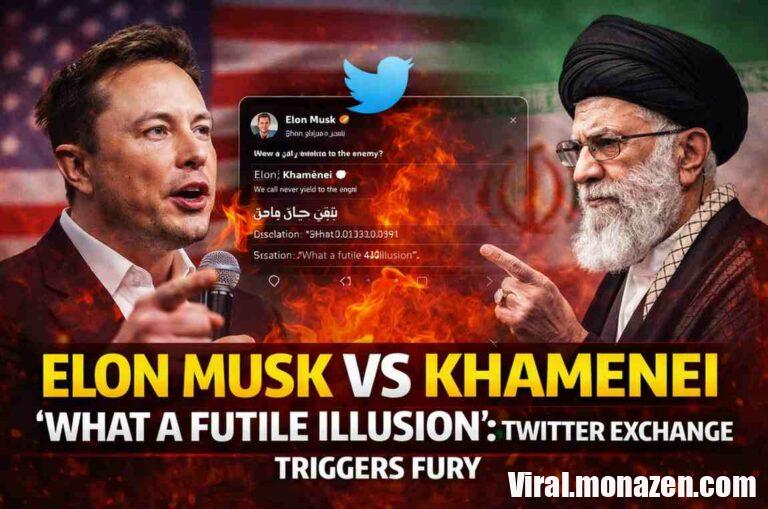
The controversy began when Khamenei reiterated a familiar message of defiance toward Western pressure. In a statement circulated widely on social media, he declared that Iran would “never yield to the enemy.” Such rhetoric has been a staple of Iranian political messaging for decades, especially during moments of heightened regional tension.
But what happened next captured the internet’s attention.
Musk responded — not in English, but in Persian — with a short phrase: “زهی خیال باطل” (Zahi khiyal-e batel).
The phrase roughly translates to “what a futile illusion” or “wishful thinking.”
Within hours, the post spread rapidly across the platform Musk owns, X. The reply accumulated hundreds of thousands of reactions and millions of views, while translations and interpretations circulated across multiple languages.
The reaction was immediate, polarizing, and global.
A Digital Exchange That Captured the Internet
The brevity of Musk’s response contrasted sharply with the complex geopolitical tensions surrounding Iran and the West. Yet its simplicity may have been precisely what propelled it across social media.
Users from across the Middle East, Europe, and North America quickly amplified the message. In Iran, some online commentators interpreted the exchange as a symbolic challenge to the country’s leadership. Others criticized Musk for inserting himself into sensitive political discourse.
For Musk, the response fits a long-established pattern. The billionaire has frequently used social media to weigh in on political debates, technological developments, and economic trends.
But rarely has a single sentence in a foreign language drawn such immediate international attention.
Part of the fascination came from the fact that Musk chose Persian — a language not typically associated with his public commentary.
Whether written personally or with assistance, the phrase’s cultural nuance sparked curiosity. Linguists noted that “زهی خیال باطل” carries a tone of dismissive irony — a rhetorical way of saying an idea is completely unrealistic.
The Social Media Multiplier
The episode illustrates how modern geopolitics increasingly unfolds in real time on digital platforms. Messages once confined to diplomatic statements now circulate instantly through networks reaching billions of users.
Under Musk’s ownership, X has positioned itself as a central hub for political and economic conversation. Leaders, journalists, investors, and activists all use the platform to shape narratives and respond to unfolding events.
The Musk-Khamenei exchange quickly became one of the most widely discussed posts of the day.
Within hours, analysts noted that the discussion was trending across multiple regions, including Europe, the Middle East, and the United States.
For many observers, the exchange was less about the literal words than about what they symbolized: the intersection of technology, politics, and global influence.
Why Markets Pay Attention
While the conversation unfolded online, another audience was watching closely — financial traders.
Markets often react sharply to geopolitical developments, particularly those involving energy-producing regions like the Middle East. Even rhetorical tensions can influence investor sentiment.
In this case, traders were already monitoring regional developments, including tensions in shipping lanes and ongoing diplomatic disputes. Musk’s comment, amplified by millions of viewers, added another layer of uncertainty to an already volatile environment.
Some market analysts argue that influential figures with massive online followings can unintentionally influence investor psychology.
A widely shared message from a high-profile figure can quickly shape narratives, amplify speculation, or shift attention toward certain sectors.
In today’s hyperconnected financial system, perception itself can move markets.
Oil, Gold, and Digital Assets
Whenever Middle Eastern tensions rise, traders often look first at oil markets.
The region remains one of the world’s most critical energy hubs, and any suggestion of conflict can influence expectations about supply and transport routes.
Gold markets sometimes react as well, since the metal is often viewed as a safe-haven asset during periods of uncertainty.
More recently, digital assets have entered the picture. Cryptocurrency traders frequently monitor geopolitical headlines because sudden shifts in global sentiment can drive rapid price movements.
While Musk’s comment alone is unlikely to determine long-term trends, the massive online attention surrounding it illustrates how quickly market narratives can emerge.
For short-term traders, perception can matter almost as much as policy.
The Power of Online Influence
Few individuals wield as much digital influence as Elon Musk.
With hundreds of millions of followers and direct control over the platform hosting the conversation, Musk occupies a unique position in the global information ecosystem.
His posts about technology, artificial intelligence, and even memes regularly generate worldwide discussion.
At times, his commentary has also intersected with markets. Past posts about cryptocurrencies, for example, have coincided with rapid price swings.
Because of this history, investors tend to pay close attention whenever Musk enters a geopolitical conversation.
Even when his statements are brief or ambiguous, they can spark waves of speculation.
Reactions Across the Political Spectrum
The Musk-Khamenei exchange drew mixed responses from political observers.
Some commentators saw it as an example of how private individuals can challenge traditional political messaging in the digital age.
Others criticized the exchange, arguing that geopolitical conflicts require careful diplomatic handling rather than social media responses.
Supporters of Musk praised the use of Persian as a symbolic gesture aimed at communicating directly with Iranian audiences.
Critics, meanwhile, warned that high-profile interventions by influential figures can complicate already delicate international relationships.
The debate reflects a broader question about the role of technology leaders in political discourse.
Protest Narratives and Online Interpretation
Reports circulating online suggested that some protesters in Iran began referencing the phrase Musk used in their demonstrations.
However, independent confirmation of such claims remains difficult due to limited access for journalists and restrictions on reporting inside the country.
Nevertheless, the narrative itself gained traction on social media, further amplifying the viral nature of the exchange.
In the digital age, perception often spreads faster than verified information.
And once a narrative takes hold online, it can shape discussions even before facts are fully established.
A New Era of Geopolitical Communication
The episode highlights how dramatically the landscape of international communication has changed.
In earlier decades, geopolitical statements typically passed through official diplomatic channels or traditional media outlets.
Today, a single social media reply can reach tens of millions of people within minutes.
The speed of this communication can intensify tensions but also create unexpected opportunities for dialogue and debate.
For analysts studying global politics, the Musk-Khamenei exchange is another example of how technology platforms now function as arenas for geopolitical messaging.
The Bottom Line
Whether viewed as a provocative comment, a linguistic curiosity, or a symbol of the digital age’s influence on politics, Elon Musk’s Persian reply captured worldwide attention.
The exchange demonstrates how quickly online conversations can spill into broader geopolitical narratives — and even attract the scrutiny of financial markets.
In a world where social media, global politics, and economic systems are increasingly interconnected, even a single line of text can reverberate far beyond the screen where it first appears.
For investors, policymakers, and ordinary users alike, the episode is a reminder of a new reality:
In the digital era, influence travels at the speed of a tweet — and sometimes, the entire world is watching.