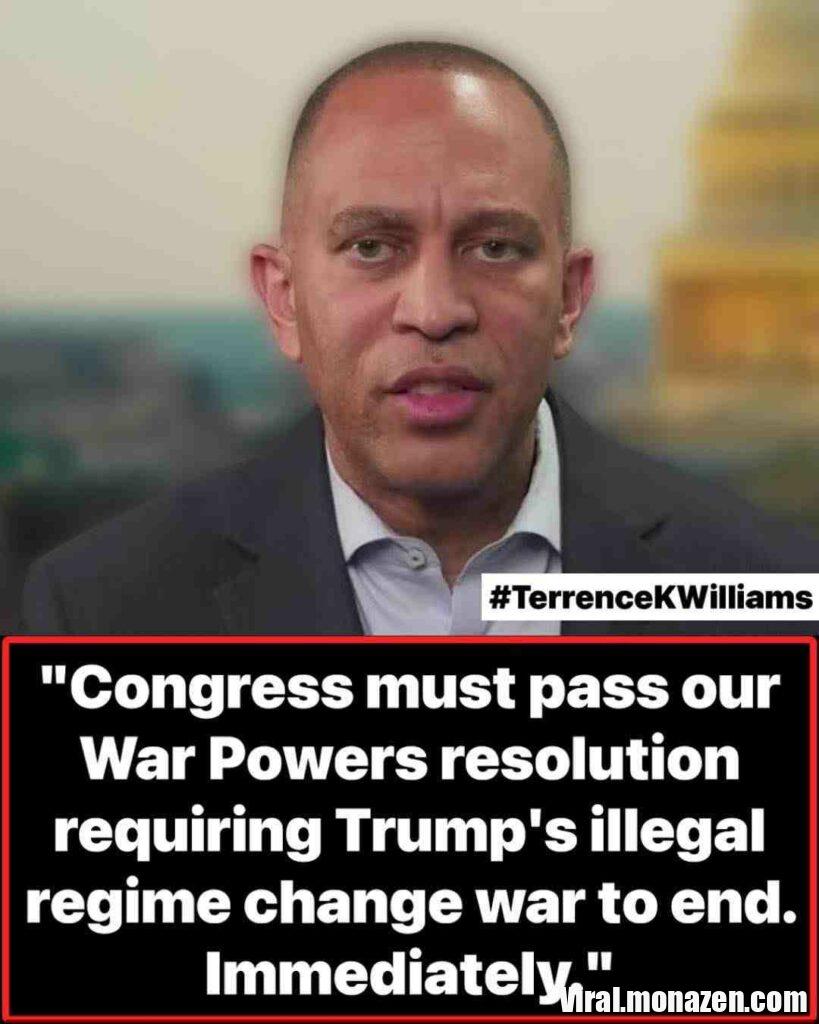
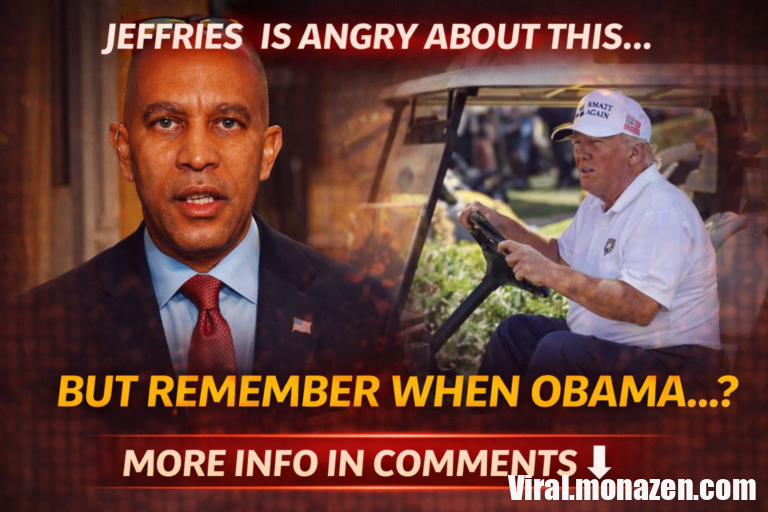
A fresh political dispute has erupted in Washington after House Democratic Leader Hakeem Jeffries publicly criticized former President Donald Trump for spending time on the golf course while the United States faces escalating global tensions.
Jeffries’ remarks, delivered through a social media post that quickly circulated across political platforms, sparked an intense debate about presidential conduct during international crises—and about whether similar scrutiny has been applied consistently across different administrations.
The controversy highlights a familiar pattern in American politics: how symbolic moments, such as a president playing golf or taking personal time during periods of conflict, can quickly become powerful political talking points.
The Comment That Sparked the Debate
The controversy began after Jeffries posted a message on social media criticizing the former president.
In the message, Jeffries suggested that the United States was facing serious national challenges while government workers, including some federal employees, were experiencing disruptions or uncertainty. He contrasted that situation with images of Trump playing golf, implying that the activity reflected poorly on presidential leadership during difficult times.
Jeffries also sharply criticized Republican lawmakers who continue to support Trump, describing them with a term that suggested unquestioning loyalty.
The comment quickly attracted attention across social media platforms and political commentary shows.
Supporters of Jeffries argued that the message highlighted a broader issue about presidential priorities and leadership during times of national stress.
Critics, however, accused the Democratic leader of political hypocrisy.
The “Presidential Leisure” Debate
At the center of the controversy is a longstanding political question: how much personal time should presidents take during periods of international conflict or domestic crisis?
Presidents of the United States maintain extremely demanding schedules, often working around the clock with national security briefings, diplomatic meetings, and legislative negotiations.
However, even during wartime, presidents historically have taken time for recreation or personal activities.
Golf, in particular, has long been associated with the presidency.
Several modern presidents—including Dwight Eisenhower, George W. Bush, Barack Obama, and Donald Trump—have all been known to play golf while in office.
The issue has repeatedly surfaced in political debates, often depending on which party controls the White House.
Critics Point to Past Presidents
Following Jeffries’ criticism, some commentators pointed out that previous presidents also engaged in leisure activities during periods of military engagement.
One example frequently cited in recent discussions is Barack Obama, who served as president from 2009 to 2017.
During Obama’s administration, the United States was involved in several overseas military operations, including campaigns in Afghanistan, Iraq, Libya, and Syria.
Despite these conflicts, Obama—like many presidents before him—occasionally played golf or participated in recreational activities during his time in office.
At the time, political critics sometimes used those moments to question his focus or priorities.
Supporters countered that the presidency is a continuous job, and that leaders remain connected to military and intelligence operations regardless of where they are physically located.
This broader context has led many analysts to view the current debate as part of a recurring political pattern rather than a unique controversy.
The Role of Symbolism in Politics
Political communication experts say the power of such controversies often lies in symbolism rather than substance.
Images of presidents golfing, vacationing, or relaxing can be interpreted differently depending on the viewer’s political perspective.
For supporters of a president, these activities may appear normal—evidence that the leader maintains balance despite the pressures of the office.
For critics, the same images can be framed as signs of detachment from serious national issues.
This dynamic illustrates how political messaging frequently relies on imagery and narrative as much as policy debates.
A Highly Polarized Environment
The latest dispute also reflects the increasingly polarized nature of American politics.
In the modern media environment, statements from political leaders can spread across the internet within minutes, generating intense reactions from supporters and critics alike.
Cable news programs, podcasts, and social media platforms often amplify these exchanges, turning individual comments into nationwide political conversations.
As a result, disagreements that might once have remained within congressional debates now quickly become part of the broader national political dialogue.
Leadership During Times of Conflict
Beyond the partisan exchange, the controversy raises deeper questions about how Americans expect their leaders to behave during periods of international tension.
Presidential leadership during war or crisis has long been a defining element of political reputation.
Some presidents have chosen to emphasize public displays of seriousness and constant engagement.
Others have maintained that maintaining normal routines—even recreational ones—can demonstrate confidence and stability.
Military historians note that presidents often remain connected to real-time intelligence regardless of their location.
Modern technology allows commanders-in-chief to receive classified briefings, issue orders, and communicate with military leaders from almost anywhere.
The Politics of Double Standards
The accusation of a “double standard” has become a recurring theme in American political debate.
Both major parties have frequently accused the other of applying different expectations depending on who holds power.
For example, political analysts have documented how media coverage of presidential vacations, leisure activities, or travel expenses often varies dramatically depending on the political climate and the administration involved.
This phenomenon reflects broader challenges within political communication, where narratives can shift quickly based on partisan loyalties.
A Familiar Pattern in American Politics
In many ways, the dispute between Jeffries and Trump supporters fits into a long tradition of political messaging in the United States.
Moments of symbolism—whether a president’s speech, a photograph, or a casual activity—can become powerful tools for shaping public perception.
These narratives often resonate because they connect complex policy debates to simple visual images.
A photograph of a president golfing, for instance, can evoke strong emotional reactions, even if the underlying policy decisions are far more complicated.
What Happens Next?
While the controversy may dominate political headlines for a short period, analysts say it is unlikely to produce immediate policy consequences.
Instead, it serves as another example of how political leaders and commentators attempt to frame narratives around leadership, responsibility, and accountability.
As global tensions continue to evolve and domestic political campaigns intensify, similar disputes are likely to emerge again.
In the modern political era, where social media can transform a single comment into a national debate within hours, such exchanges have become a routine part of American public life.
A Reflection of the National Conversation
Ultimately, the debate sparked by Jeffries’ remarks highlights the broader divisions shaping American political discourse.
For some voters, the controversy reinforces concerns about leadership priorities.
For others, it illustrates the partisan nature of modern political criticism.
What remains clear is that symbolic moments—whether a golf outing, a social media post, or a public remark—continue to play an outsized role in shaping the national conversation.
And as the United States navigates both domestic political battles and complex international challenges, those moments will likely remain part of the ongoing debate about what Americans expect from their leaders.