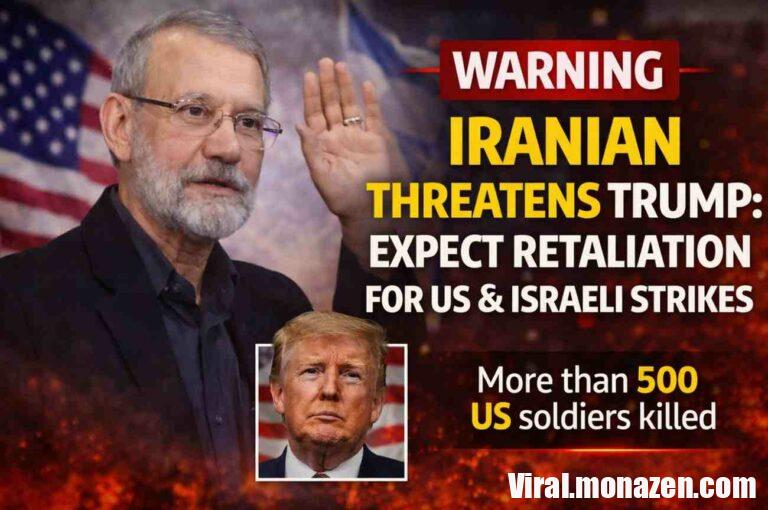
As tensions in the Middle East continue to dominate international headlines, a recent statement attributed to prominent Iranian political figure Ali Larijani has stirred renewed debate about the direction of regional politics and the potential consequences of escalating military confrontation.
In remarks circulating through regional media outlets, Larijani reportedly warned that U.S. President Donald Trump should reconsider his strategic calculations if Washington intends to pursue policies framed around the slogan “America First” while simultaneously supporting actions that could deepen conflict in the Middle East.
The comments come at a time when the region is experiencing heightened military alert, diplomatic strain, and uncertainty about the next steps in an already volatile geopolitical landscape.
Who Is Ali Larijani?
Ali Larijani is one of the most recognizable figures in Iranian politics. Over the years, he has held several influential positions within the country’s political system.
Larijani previously served as Speaker of the Iranian Parliament (Majlis) for more than a decade, becoming one of the most prominent lawmakers in the Islamic Republic. His political career has also included roles as Iran’s chief nuclear negotiator and as an advisor within the country’s strategic policy circles.
Known for his pragmatic political style compared with some hardline figures, Larijani has often positioned himself as a voice capable of navigating between ideological commitments and practical diplomacy.
Even when not holding formal office, statements from figures like Larijani are closely watched by analysts because they can signal broader currents within Iran’s political establishment.
The Context of the Statement
The comments attributed to Larijani appear to reference ongoing tensions between Iran, the United States, and Israel.
For years, relations between these actors have been shaped by disagreements over nuclear policy, regional security alliances, and military activities across the Middle East.
In his remarks, Larijani reportedly suggested that Washington should reassess its priorities, particularly if it seeks to balance domestic political messaging with international security commitments.
The statement raises questions about the consistency of strategic narratives, especially when slogans such as “America First” are used alongside active involvement in regional conflicts.
Political slogans, analysts say, can sometimes clash with the realities of global security commitments.
Strategic Messaging in Times of Conflict
Statements from senior political figures often serve purposes beyond simply conveying information. In many cases, they function as strategic messages directed at multiple audiences.
For domestic audiences, they may reinforce political unity or demonstrate defiance against external pressure.
For international observers, such remarks can signal a country’s stance on key issues or attempt to influence diplomatic negotiations.
In the case of Larijani’s statement, analysts suggest that the message may be aimed at highlighting what Iranian officials view as contradictions in U.S. policy.
By questioning whether American leaders prioritize national interests or foreign alliances, Iranian figures may be attempting to shape global narratives surrounding the conflict.
The “America First” Debate
The phrase “America First” became one of the defining political slogans of Donald Trump’s presidency. The concept emphasizes prioritizing U.S. domestic interests in economic policy, immigration, and international relations.
However, critics have frequently questioned how that philosophy aligns with the United States’ long-standing network of global alliances and military commitments.
Larijani’s remarks appear to tap directly into that debate.
By raising the question of whether Washington’s actions align with its stated priorities, Iranian officials may be attempting to highlight perceived inconsistencies in American foreign policy.
Supporters of the slogan, on the other hand, argue that maintaining strong alliances and deterring adversaries ultimately serves American interests as well.
The Role of Military Escalation
One of the most concerning aspects of rising tensions in the region is the possibility that rhetorical exchanges could contribute to military escalation.
The Middle East already hosts a dense network of military forces, including U.S. bases, regional defense alliances, and competing security partnerships.
Incidents involving missile launches, airstrikes, or maritime confrontations have occurred periodically over the past several years.
In such an environment, statements by political leaders can sometimes amplify fears that a broader confrontation could emerge.
At the same time, analysts caution that political rhetoric does not always translate into immediate military action.
Instead, it often forms part of a broader strategic communication effort.
The Impact on Regional Stability
The Middle East remains one of the most strategically significant regions in the world.
Its importance stems from several factors, including:
- Global energy production
- Key maritime shipping routes
- Long-standing political and religious conflicts
- The presence of multiple major powers
When tensions rise between influential actors like Iran and the United States, the effects can ripple across the entire region.
Neighboring countries often find themselves navigating complex diplomatic choices as they attempt to maintain stability while protecting their own national interests.
For many governments, avoiding escalation has become a top priority.
International Reactions
International reactions to statements like Larijani’s tend to vary widely depending on geopolitical perspectives.
Some analysts interpret such comments as part of Iran’s effort to frame the narrative of regional conflicts in a way that highlights Western involvement.
Others view the remarks primarily as domestic political messaging aimed at strengthening internal unity during periods of external pressure.
Meanwhile, Western governments often respond cautiously to rhetorical statements, focusing instead on concrete developments such as military movements, diplomatic initiatives, or economic sanctions.
This difference in emphasis reflects the complex nature of modern international relations, where public messaging and actual policy decisions do not always align perfectly.
Diplomacy and the Path Forward
Despite the heated rhetoric that occasionally dominates headlines, diplomatic channels between global powers and regional actors have not completely disappeared.
Throughout recent decades, negotiations involving Iran and international partners have repeatedly attempted to address disputes over nuclear activities, sanctions, and regional security.
Although progress has often been uneven, diplomacy remains one of the few mechanisms capable of reducing tensions without resorting to military confrontation.
Many experts argue that sustained dialogue, even when difficult, is essential for preventing misunderstandings that could escalate into conflict.
A Region Under the Global Spotlight
The Middle East’s strategic importance ensures that political statements from influential figures rarely remain confined to domestic audiences.
When leaders such as Ali Larijani comment on U.S. policy or regional security dynamics, their words quickly circulate across international media.
This widespread attention reflects the region’s role as a focal point of global geopolitics.
Energy markets, military alliances, and diplomatic negotiations are all closely tied to developments in this part of the world.
As a result, even rhetorical exchanges between political leaders can influence perceptions far beyond the immediate region.
The Power of Political Narratives
Ultimately, statements like Larijani’s highlight the importance of political narratives in shaping global discussions.
In modern geopolitics, the battle for influence is not fought only through military strength or economic pressure. It also unfolds through competing interpretations of events, policy priorities, and national interests.
Each side seeks to frame the conversation in a way that strengthens its position both domestically and internationally.
For observers, understanding these narratives is essential to interpreting the broader strategic environment.
Looking Ahead
As tensions in the Middle East continue to evolve, the comments attributed to Ali Larijani represent just one piece of a much larger geopolitical puzzle.
Whether the region moves toward increased confrontation or renewed diplomatic engagement will depend on decisions made by leaders across multiple countries.
For now, the situation remains fluid.
Political rhetoric continues to circulate, military forces remain on alert, and international observers are closely watching each development.
In such a complex landscape, even a single statement can become a focal point for broader debates about strategy, alliances, and the future of regional stability.