
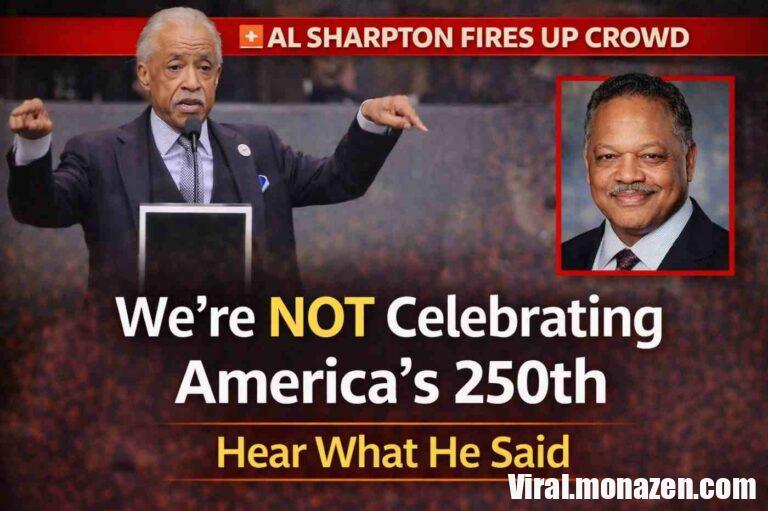
During a memorial service honoring civil rights icon Jesse Jackson, longtime activist Al Sharpton delivered a passionate speech that quickly reverberated across political and social media circles. Speaking before a packed audience in Chicago, Sharpton reflected on the legacy of the civil rights movement, the unfinished struggle for racial justice, and the historical experience of Black Americans in the United States.
But one portion of his speech, in particular, drew national attention. Sharpton addressed the upcoming 250th anniversary of the United States, questioning whether all Americans view the milestone in the same way.
“We’re not celebrating America’s 250th birthday,” Sharpton said, arguing that the nation’s founding moment in 1776 did not represent freedom for everyone living in the country at the time.
The comments quickly sparked debate, touching on long-standing discussions about American history, slavery, and how the nation interprets its past while looking toward the future.
A Speech Rooted in History
Sharpton delivered the remarks while paying tribute to the life and influence of Jesse Jackson, one of the most prominent figures in the modern civil rights movement. Jackson, who rose to prominence in the 1960s alongside Martin Luther King Jr., spent decades advocating for racial equality, voting rights, and economic justice.
For Sharpton, the memorial service provided an opportunity not only to honor Jackson’s contributions but also to reflect on the broader history that shaped the civil rights struggle.
In his speech, Sharpton referred to the year 1619—the date when enslaved Africans first arrived in English colonies in North America. He argued that the story of America cannot be told solely through the lens of the country’s founding in 1776, because millions of people were still enslaved at that time.
“We got here in 1619,” Sharpton told the audience. “We worked 246 years and never got paid, but we are still here.”
The statement echoed a perspective shared by many historians who emphasize that the legacy of slavery and segregation continues to shape American society.
The Historical Context
Sharpton’s remarks draw attention to a central historical reality: when the United States declared independence from Britain in 1776, slavery remained legal in many parts of the country.
The contradiction between the ideals expressed in the Declaration of Independence—particularly the phrase “all men are created equal”—and the continued existence of slavery has long been a subject of scholarly discussion.
For decades, historians, educators, and activists have debated how the nation should interpret that contradiction. Some emphasize the founding principles of liberty and democracy as a framework that later generations used to expand civil rights. Others argue that the nation must confront the darker aspects of its past in order to fully understand its development.
Sharpton’s speech reflects the latter viewpoint, highlighting the experience of those who were excluded from the rights promised at the nation’s founding.
Linking Past and Present
Sharpton also connected historical struggles with modern political debates.
In one moment that drew particular attention, he told the audience that the civil rights movement had overcome powerful opponents in the past.
“We’ve beat people bigger than Trump,” Sharpton said, referencing Donald Trump.
The statement was repeated several times, drawing applause from some members of the audience.
Sharpton’s comments suggested that the civil rights movement’s legacy provides confidence for activists facing contemporary political challenges.
Reactions Across the Political Spectrum
The remarks sparked strong reactions across the political spectrum.
Supporters of Sharpton praised the speech as a powerful reminder of the long struggle for equality in the United States. Many argued that acknowledging historical injustices does not diminish the country’s achievements but instead strengthens the nation by encouraging reflection and progress.
For them, Sharpton’s comments reflected an honest reckoning with history and the ongoing work needed to address racial disparities.
Critics, however, argued that framing the nation’s 250th anniversary in negative terms risks overshadowing the progress that has been made since the founding era.
Some commentators suggested that national celebrations should emphasize unity and shared accomplishments rather than focusing primarily on historical grievances.
The differing reactions highlight the broader cultural debate over how Americans interpret their past.
The Legacy of Jesse Jackson
The setting of the speech—Jesse Jackson’s memorial service—added another layer of significance to Sharpton’s remarks.
Jackson’s career spanned more than half a century, during which he worked alongside some of the most influential figures in the civil rights movement. He founded organizations such as Operation PUSH and the Rainbow Coalition, which sought to bring together diverse communities to advocate for social and economic justice.
Jackson also ran for president twice in the 1980s, becoming one of the first major African American candidates to mount a serious campaign for the nation’s highest office.
For many activists, Jackson’s life symbolizes both the achievements and the unfinished work of the civil rights era.
Sharpton’s speech emphasized that legacy, portraying the current moment as part of a longer historical journey.
America at 250
The United States is preparing to mark its 250th anniversary in 2026, an event expected to include nationwide celebrations, educational initiatives, and reflections on the country’s history.
For many Americans, the milestone represents an opportunity to celebrate the endurance of democratic institutions and the nation’s global influence.
At the same time, some historians and activists view the anniversary as a chance to examine the full complexity of American history—including the struggles that shaped its development.
Sharpton’s remarks suggest that these two perspectives will likely coexist in the coming years.
A Continuing Conversation
Speeches like Sharpton’s illustrate how discussions about history remain deeply connected to contemporary political and social issues.
Questions about how the United States should interpret its founding, acknowledge historical injustices, and move forward as a diverse society continue to shape public debate.
For some, emphasizing the nation’s ideals and progress provides inspiration for the future. For others, confronting historical inequities is essential for building a more inclusive society.
As the country approaches its 250th anniversary, those conversations are likely to intensify.
The Power of Public Memory
Ultimately, Sharpton’s speech underscores the powerful role that public memory plays in shaping national identity.
Memorial services, anniversaries, and historical commemorations often become moments when societies reflect on where they have been and where they hope to go.
By linking the legacy of Jesse Jackson to broader questions about American history, Sharpton reminded listeners that the story of the United States is still being written.
Whether one agrees with his interpretation or not, the speech highlights an enduring truth: the meaning of America’s past—and its future—remains a subject of ongoing dialogue.
And as the nation approaches one of the most significant milestones in its history, that dialogue is certain to continue.