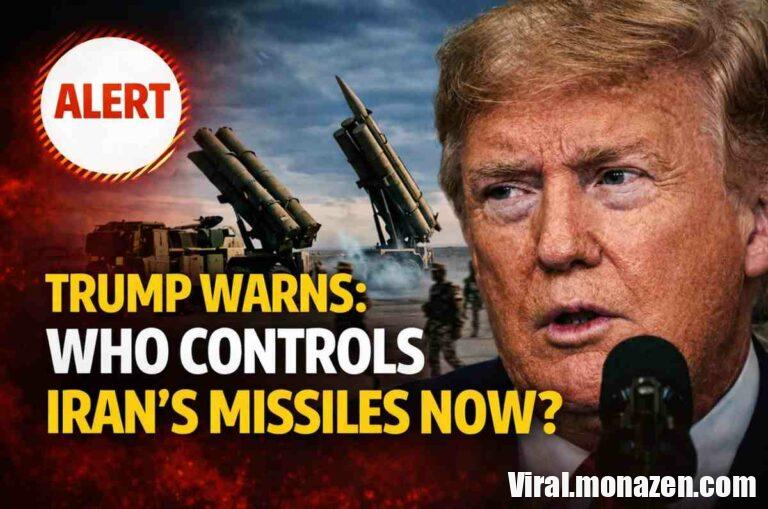
Washington — In remarks that have drawn widespread international attention, former U.S. President Donald Trump warned that Iran’s military command structure may have been severely disrupted following a series of intense military developments in the region. According to Trump, the rapid disappearance or absence of several senior Iranian figures has created a potentially dangerous situation in which it is unclear who currently controls parts of the country’s strategic missile arsenal.
The comments, delivered during a discussion about ongoing tensions in the Middle East, reflect growing uncertainty among policymakers and analysts about the stability of command structures surrounding Iran’s ballistic missile forces.
While officials have not confirmed the full extent of leadership changes inside Iran, Trump described the situation as a sudden collapse of the visible chain of command — using the striking phrase that Iran’s leadership had “evaporated” faster than expected.
His remarks have intensified debate among international observers about the risks posed by advanced missile systems in moments of political or military instability.
Concerns Over Strategic Missile Control
At the center of Trump’s warning is a critical question: who currently has operational control over Iran’s missile platforms?
Iran possesses one of the most extensive ballistic missile programs in the Middle East. These systems, which include short-range and medium-range missiles, have long been viewed as a central pillar of Iran’s defense strategy.
For years, Iran has argued that its missile program serves purely defensive purposes. However, Western governments and regional rivals have often expressed concern that these weapons could threaten military bases, energy infrastructure, or cities if tensions escalate.
Trump suggested that the uncertainty surrounding Iran’s leadership could create a dangerous environment in which control over these weapons may not be clearly defined.
“If the command structure disappears suddenly, the biggest question becomes who is holding the trigger,” one security analyst in Washington explained following the remarks.
This uncertainty has prompted new discussions within defense and intelligence circles about the stability of strategic weapons management in volatile political environments.
The Importance of Chain of Command
Modern military systems — particularly missile forces — rely heavily on a structured and centralized chain of command.
In most countries, strict protocols govern how such weapons can be deployed. Orders typically pass through several layers of authorization designed to prevent accidental or unauthorized use.
If leadership disruptions occur, however, those systems may face temporary confusion until authority is clearly reestablished.
Experts emphasize that the issue is not simply the existence of weapons themselves but rather who controls the command structure behind them.
A former defense official noted that situations involving unclear leadership are among the scenarios military planners take most seriously.
“When leadership is stable, there is accountability and clear communication,” the analyst said. “But when leadership becomes uncertain, the risk calculations become more complicated.”
Iran’s Missile Program: A Strategic Pillar
Iran’s ballistic missile program has developed steadily over the past several decades.
The country began investing heavily in missile technology during the Iran-Iraq War in the 1980s, when both sides used long-range rockets against major cities.
Since then, Iran has expanded its missile capabilities significantly, developing a range of systems capable of reaching targets across the Middle East.
Iranian officials have repeatedly described these weapons as essential for deterrence, particularly given the country’s limited access to modern air forces compared with some regional rivals.
From Tehran’s perspective, missiles serve as a tool to balance regional military power.
However, critics argue that the program also contributes to regional tensions and arms competition.
International Concerns About Proliferation
One of the central fears expressed by Trump in his remarks involves the possibility that advanced missile systems could fall under the influence of unpredictable actors.
In his comments, he warned that if Iran’s command structure is weakened or fragmented, there could be uncertainty over who ultimately directs the country’s strategic arsenal.
Such concerns are not unique to Iran.
Throughout modern history, international security experts have worried about what might happen to powerful weapons in times of political instability or leadership transition.
These concerns are often discussed in the context of nuclear or missile-capable states, where the stakes are significantly higher.
However, analysts caution that there is currently no confirmed evidence that Iran’s missile systems are outside official control.
Instead, the discussion reflects a broader strategic concern about maintaining stability during periods of political upheaval.
Regional Military Tensions
Trump’s comments come amid an already tense regional environment.
Over the past several years, tensions between Iran, the United States, and Israel have intensified across multiple fronts.
These tensions have included:
- Maritime incidents in the Persian Gulf
- Cybersecurity confrontations
- Airstrikes targeting military facilities in neighboring countries
- Diplomatic disputes surrounding nuclear agreements
Each of these issues has contributed to a fragile geopolitical landscape in which small developments can rapidly gain global attention.
The latest discussion about missile control adds another layer to that complex security picture.
The Role of Intelligence Gathering
One of the most challenging aspects of monitoring military developments in closed political systems is the difficulty of obtaining accurate information.
Trump acknowledged that the United States currently lacks complete intelligence clarity regarding the exact status of Iran’s internal command structure.
This is not unusual.
Intelligence assessments often rely on a combination of satellite imagery, intercepted communications, diplomatic sources, and regional monitoring.
Even with sophisticated surveillance capabilities, gaps in information can remain — particularly during rapidly evolving situations.
Because of this, policymakers must often make decisions based on incomplete data while waiting for further confirmation.
The Strategic Message Behind the Statement
Observers say Trump’s remarks may also serve a strategic purpose beyond simply describing intelligence concerns.
Political leaders often use public statements to signal priorities, influence diplomatic negotiations, or reinforce deterrence.
By emphasizing the risks associated with unclear missile control, Trump may be seeking to highlight the importance of maintaining pressure on Iran’s strategic capabilities.
His comments also underline the continuing role of the United States as a key actor in monitoring security developments across the Middle East.
At the same time, analysts note that strong public warnings can sometimes increase tensions if they are interpreted as signals of potential military escalation.
A Region Watching Closely
Countries throughout the Middle East are carefully monitoring developments related to Iran’s military structure.
Many regional governments view Iran’s missile program as a central factor shaping the region’s balance of power.
Meanwhile, European governments have also expressed interest in maintaining stability and preventing further escalation that could affect global energy markets or international security.
Because the Middle East remains a crucial hub for oil production and shipping routes, any uncertainty regarding military developments tends to attract worldwide attention.
The Challenge of Stability in a Complex Region
The situation described in Trump’s remarks illustrates a broader challenge facing policymakers around the world.
Modern security environments are often shaped not only by the presence of powerful weapons but also by the stability of political institutions responsible for controlling them.
When leadership structures are strong and clearly defined, systems of command and accountability help prevent miscalculations.
But when uncertainty emerges — whether through conflict, political transition, or internal disruptions — the international community becomes increasingly concerned about how strategic assets are managed.
For this reason, analysts often emphasize the importance of communication, transparency, and diplomatic engagement even during periods of tension.
Looking Ahead
At present, it remains unclear how the situation inside Iran’s military command structure will evolve.
Iranian authorities have not confirmed the details referenced in Trump’s remarks, and official statements from Tehran continue to emphasize that the country’s defense institutions remain operational.
Nevertheless, the discussion sparked by the former president’s comments highlights the ongoing geopolitical importance of Iran’s missile program and the broader strategic dynamics shaping the Middle East.
As governments, intelligence agencies, and international observers continue monitoring the situation, one reality remains clear:
in a region where security balances are delicate and strategic weapons are central to national defense policies, clarity of command is as important as the weapons themselves.
For now, policymakers across the world will be watching closely to determine whether the concerns raised signal a temporary period of uncertainty — or the beginning of a new chapter in the region’s already complex security landscape.