
In the long and turbulent history of American politics, few figures have faced legal scrutiny on the scale now confronting former U.S. President Donald Trump. What began as scattered investigations across multiple jurisdictions has gradually evolved into a series of court cases that have produced some of the most consequential legal findings ever applied to a modern political leader.
Over the past several years, prosecutors, judges, and juries have examined a range of allegations involving business practices, campaign conduct, and attempts to influence electoral outcomes. While Trump and his allies continue to dispute the legitimacy of these cases, several rulings have already produced a permanent judicial record—one that legal experts say cannot simply be erased by political messaging or social media narratives.
The implications extend far beyond the courtroom. They reach into the heart of American political life, raising complex questions about accountability, the rule of law, and how the legal system interacts with the nation’s deeply polarized political climate.
The Historic 34-Count Conviction
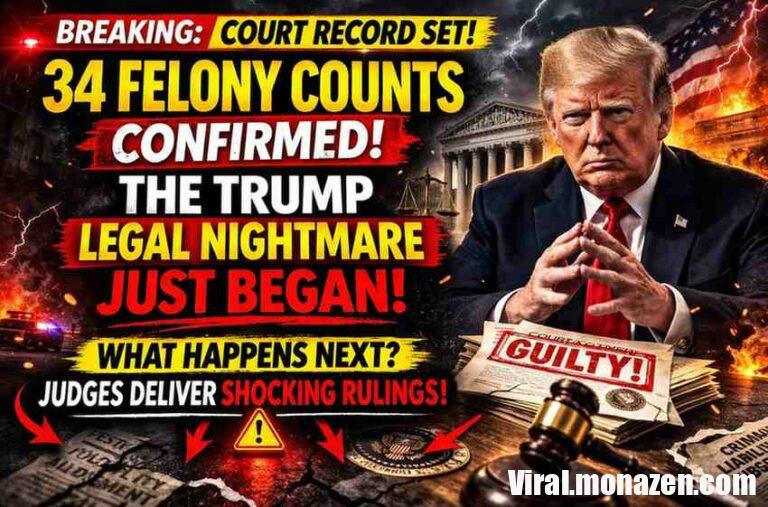
The most widely discussed ruling came when a New York jury convicted Trump on 34 felony counts related to falsifying business records. Prosecutors argued that the records were manipulated to conceal payments tied to the 2016 presidential campaign.
During the trial, the prosecution presented documents, witness testimony, and financial records intended to demonstrate a coordinated effort to misrepresent business transactions. The jury ultimately concluded that the records had indeed been falsified and that the actions violated New York law.
Trump has repeatedly criticized the case, calling it politically motivated and pledging to appeal. His legal team argues that the prosecution stretched legal theory and that the case should never have been brought to trial. Appeals are expected to move through the courts over time, potentially shaping future interpretations of campaign finance and record-keeping laws.
For legal scholars, however, the verdict marked a watershed moment: a former U.S. president found guilty of felony charges in a criminal court.
Civil Liability and Financial Judgments
The criminal case is only one part of the broader legal picture. Trump has also faced major civil rulings related to business conduct.
In one of the most significant cases, a New York court found Trump liable for fraudulent financial practices connected to the valuation of assets used in loan applications and financial statements. The court determined that key financial representations were inaccurate and imposed financial penalties along with restrictions on business operations.
Civil rulings do not carry criminal penalties such as imprisonment, but they can still have major consequences. In this case, the judgment included substantial monetary penalties and oversight provisions affecting Trump’s business entities.
Legal analysts note that civil findings often rely on a lower burden of proof than criminal cases, but the evidence presented must still satisfy a judge or jury that wrongdoing occurred under the relevant legal standards.
A Complex Web of Investigations
Beyond the cases already decided, several other legal proceedings involving Trump have unfolded in both state and federal courts.
Some investigations focus on the events surrounding the 2020 presidential election, including efforts to challenge or overturn the results in key states. Prosecutors in those cases have examined phone calls, internal communications, and public statements made during the weeks following the election.
Other cases involve the handling of government records after Trump left office. These investigations have examined whether classified or sensitive documents were improperly retained or stored.
Each of these matters follows its own legal timeline. Some have moved quickly toward trial, while others have experienced delays due to appeals, motions, and procedural disputes.
Trump’s Response: Politics and Legal Strategy
Trump has responded to the legal challenges with a two-pronged approach: a vigorous courtroom defense combined with an aggressive public campaign criticizing the investigations.
In speeches and social media posts, he has repeatedly argued that the cases represent political “witch hunts” designed to undermine his influence and derail his political ambitions. Many of his supporters echo that claim, viewing the prosecutions as part of a broader struggle between political factions in Washington.
At the same time, Trump’s legal team has pursued traditional defense strategies inside the courtroom. These include motions to dismiss charges, challenges to the jurisdiction of courts, and appeals to higher courts seeking to overturn or narrow previous rulings.
Legal observers say this combination of political messaging and procedural litigation reflects the unusual circumstances of prosecuting a former president who remains deeply involved in national politics.
The Rule of Law Debate
For many Americans, the central issue raised by these cases is not simply the fate of one political figure but the broader principle of legal accountability.
Supporters of the prosecutions argue that the legal system must apply the same standards to everyone, regardless of wealth or political status. They say failing to pursue credible allegations against powerful figures would undermine public trust in democratic institutions.
Critics, however, warn that prosecuting political leaders risks intensifying partisan divisions and could set precedents that future administrations might exploit against political rivals.
The debate has become a defining feature of contemporary American politics, with legal developments frequently dominating headlines and campaign speeches alike.
A Nation Watching the Courts
One of the most striking aspects of Trump’s legal battles is the level of public attention they have attracted. Court hearings, legal filings, and judicial rulings have become major news events, often generating intense discussion across television networks, newspapers, and online platforms.
Polls show that Americans remain sharply divided over how to interpret the cases. Some view them as evidence that the justice system is functioning properly. Others believe the prosecutions reflect political bias.
Regardless of perspective, few observers deny that the proceedings represent one of the most unusual intersections of law and politics in modern U.S. history.
What Happens Next?
Legal experts say the final outcome of Trump’s cases could take years to fully resolve. Appeals, additional trials, and new rulings may reshape the legal landscape multiple times before the process concludes.
Even after verdicts are issued, higher courts—including potentially the U.S. Supreme Court—could be asked to review key constitutional questions raised during the proceedings.
In the meantime, the cases continue to unfold alongside an ongoing political environment in which Trump remains a central figure.
A Defining Moment for American Institutions
For historians and constitutional scholars, the significance of this period may extend far beyond any single courtroom decision.
The United States has long prided itself on the idea that no individual stands above the law. At the same time, the nation has rarely tested that principle in circumstances involving a former president with a vast political following.
Whether the legal process ultimately strengthens or further strains public confidence in American institutions remains an open question.
What is clear, however, is that the intersection of law, politics, and public opinion surrounding Donald Trump has already produced a chapter in American history unlike any other.
As appeals move forward and new cases emerge, the country—and much of the world—continues to watch closely.
The final verdict on the broader implications of these legal battles may not come from a single court ruling but from how the American system of justice and democracy ultimately absorbs the shock of this unprecedented moment.