
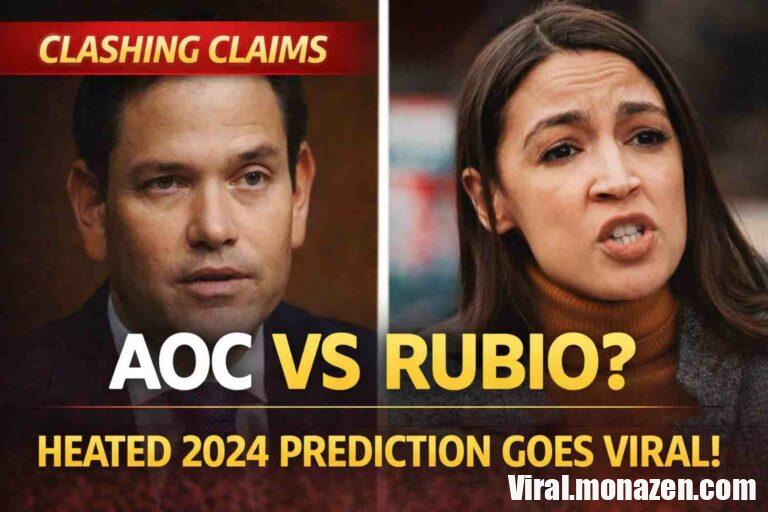
Representative Alexandria Ocasio-Cortez has never been a stranger to bold political statements. Since her surprise victory in a New York congressional primary in 2018, the progressive Democrat has built a reputation for challenging political norms, energizing younger voters, and positioning herself as one of the most recognizable figures on the American left.
Now, comments suggesting that she believes she could defeat Senator Marco Rubio in a hypothetical presidential race have sparked fresh debate about the future direction of U.S. politics, the growing influence of Latino voters, and the deep ideological divide shaping the country’s two major parties.
While the remarks were made in the context of political discussion rather than an official campaign announcement, they have nonetheless generated widespread reaction among political analysts, party strategists, and voters across the country.
A Hypothetical Matchup
The idea of a potential presidential contest between Ocasio-Cortez and Rubio reflects more than just a theoretical political scenario. Both figures represent different wings of American politics and symbolize contrasting visions for the nation’s future.
Ocasio-Cortez, often referred to as AOC, rose to prominence as a progressive voice advocating for sweeping policy proposals such as expanded social programs, climate action, and economic reforms designed to address inequality. She has become one of the most visible leaders among younger Democrats and progressive activists.
Rubio, meanwhile, has spent more than a decade as a prominent Republican figure. First elected to the U.S. Senate in 2010, he has positioned himself as a strong voice on foreign policy, economic growth, and national security. Rubio also ran for president during the 2016 Republican primary, where he emerged as one of the party’s leading contenders before ultimately losing the nomination.
A contest between the two would therefore represent not just a generational shift but a stark ideological clash.
The Hispanic Vote and Political Strategy
Central to Ocasio-Cortez’s comments was the idea that she believes she could win strong support among Hispanic voters, a demographic that continues to grow in influence across the United States.
According to U.S. Census data, Hispanic Americans represent one of the fastest-growing voting blocs in the country. Their political preferences vary widely by region, age, and economic background, making them a key focus for both major parties.
Ocasio-Cortez has long emphasized issues she believes resonate strongly within many Latino communities, including immigration reform, workers’ rights, and expanded access to healthcare and education. As the daughter of Puerto Rican parents, she often speaks about her cultural background and how it shapes her political perspective.
Rubio, however, also has deep connections to Hispanic voters. The Florida senator is the son of Cuban immigrants and has frequently highlighted his own family’s story as part of the broader American narrative of opportunity and upward mobility.
Political strategists note that the diversity within the Hispanic electorate means that no single candidate can assume automatic support from the entire group.
“In reality, Latino voters are not a monolithic bloc,” said one political analyst. “They have different priorities depending on where they live, their economic circumstances, and their cultural backgrounds.”
A Changing Democratic Party
Ocasio-Cortez’s comments also highlight the evolving nature of the Democratic Party. Over the past decade, progressive voices have gained increasing influence within the party, pushing leaders to consider more ambitious policy proposals on issues such as climate change, student debt, and economic inequality.
Supporters of the progressive movement argue that younger voters want bold solutions to complex problems and that traditional political approaches no longer reflect the urgency of today’s challenges.
Critics within the party, however, sometimes worry that such proposals could alienate moderate voters in competitive states.
The debate reflects a broader question facing Democrats: how to balance progressive energy with broader electoral appeal.
Rubio’s Political Position
On the Republican side, Rubio has continued to play an important role in shaping the party’s approach to both domestic and international issues.
Over the years, he has focused heavily on foreign policy, particularly regarding Latin America, China, and global security concerns. He has also supported policies aimed at strengthening economic competitiveness and reducing government regulation.
Rubio’s supporters argue that his experience in the Senate and his policy expertise would make him a formidable national candidate should he choose to pursue another presidential bid.
“Rubio has spent years building a record on major policy issues,” one Republican strategist noted. “That kind of experience carries weight in national campaigns.”
The Politics of Confidence
Political observers say statements like the one attributed to Ocasio-Cortez are not unusual in modern politics.
Candidates and potential candidates often project confidence when discussing hypothetical contests, particularly when addressing supporters or speaking about political strategy.
Confidence can be an important part of political messaging, signaling strength and determination to voters. At the same time, such remarks can quickly become headline-generating moments in a media environment that thrives on bold statements and sharp contrasts.
A Nation Divided
The reactions to Ocasio-Cortez’s comments have reflected the broader polarization of American politics.
Supporters praised the congresswoman’s confidence and argued that progressive policies could resonate with voters seeking change.
Critics, meanwhile, dismissed the claim as unrealistic and argued that a national election would involve far more complex dynamics than a simple ideological contest.
The exchange illustrates how quickly political speculation can turn into a larger debate about the country’s direction.
The Long Road to a Presidential Race
Despite the attention surrounding hypothetical matchups, any actual presidential contest remains years away and would involve a complicated political process.
Potential candidates must first navigate primary elections within their own parties before reaching a general election stage. That process often includes intense scrutiny, policy debates, fundraising challenges, and months—sometimes years—of campaigning.
For now, neither Ocasio-Cortez nor Rubio has formally announced plans for a presidential run against the other.
Still, the conversation surrounding their potential rivalry reflects a deeper truth about modern American politics: the next generation of political leadership is already taking shape.
A Glimpse of Future Battles
Whether or not a contest between Alexandria Ocasio-Cortez and Marco Rubio ever materializes, the discussion itself highlights the shifting political landscape of the United States.
New leaders are emerging, demographic changes are reshaping the electorate, and ideological debates within both parties are redefining what national campaigns might look like in the years ahead.
For voters, analysts, and political strategists alike, these early signals provide a glimpse into the future battles that may define the next era of American politics.
And if such a matchup ever does occur, it would almost certainly become one of the most closely watched political contests in modern history.