As geopolitical tensions continue to dominate global headlines, analysts and defense experts have increasingly turned their attention to one critical question: what would a full-scale military conflict with Iran actually cost?
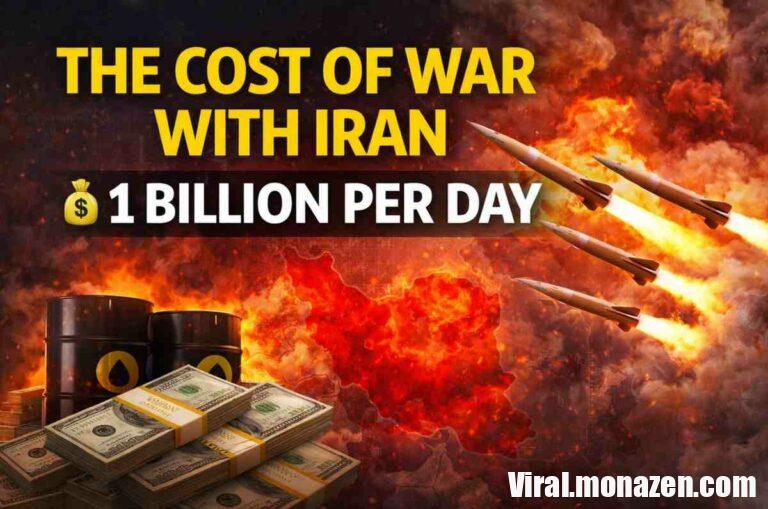
According to estimates frequently cited by military analysts and economic researchers, a major war involving the United States and Iran could cost around $1 billion per day, or potentially even more depending on the scale and duration of operations.
While such numbers can sound abstract, they reflect the immense financial, logistical, and strategic commitments required to sustain modern warfare. Beyond the immediate military expenses, the broader economic consequences could ripple through global markets, energy supplies, and international trade.
Understanding these potential costs helps illustrate why policymakers often approach such scenarios with extreme caution.
The Financial Reality of Modern Warfare
Military conflicts in the 21st century are extraordinarily expensive. Modern warfare relies on advanced technologies, precision weapons, satellite surveillance, cyber operations, and massive logistical support networks.
Every element—from aircraft carriers to missile defense systems—requires continuous funding to operate.
In the case of a potential conflict with Iran, analysts say the United States would likely need to deploy significant naval and air forces to the region. These operations alone would require large daily expenditures.
For example, the cost of operating a single aircraft carrier strike group can run several million dollars per day when accounting for fuel, personnel, maintenance, and combat operations.
Multiply that across multiple fleets, air bases, and support units, and the expenses quickly climb into the hundreds of millions—or even billions—each day.
The Strategic Importance of the Middle East
Any major conflict involving Iran would take place in a region of enormous strategic significance.
The Middle East sits at the center of global energy production, with key shipping routes passing through narrow maritime corridors such as the Strait of Hormuz.
This waterway alone carries roughly one-fifth of the world’s oil supply, making it one of the most important chokepoints in international trade.
If hostilities disrupted traffic through the strait, oil prices could rise sharply across global markets. Such a scenario would affect not only energy companies but also industries ranging from transportation to manufacturing.
For this reason, economic analysts often stress that the financial impact of war in the region would extend far beyond the immediate military spending.
Lessons From Past Conflicts
Historical experience provides some insight into how costly prolonged conflicts can become.
The wars in Iraq and Afghanistan, for example, lasted nearly two decades and cost the United States trillions of dollars when long-term expenses such as veteran care, reconstruction, and interest on borrowed funds are included.
Although a conflict with Iran would likely take a different form, experts believe it could still generate enormous financial commitments.
Iran has a large population, a well-developed defense network, and a strategic geography that includes mountains, deserts, and coastal areas—all of which could complicate military operations.
Because of these factors, defense analysts often describe any large-scale confrontation with Iran as a complex and potentially lengthy undertaking.
Military Infrastructure and Operational Costs
One reason conflicts are so expensive is the scale of infrastructure required to support military operations.
In addition to combat forces, wars involve:
- Transportation of troops and equipment
- Maintenance of aircraft and vehicles
- Intelligence and surveillance systems
- Satellite communications
- Cybersecurity operations
- Medical support and evacuation services
Each of these components requires specialized personnel and advanced equipment.
In a conflict scenario, military planners must ensure that supply chains remain functional across thousands of miles. This includes delivering fuel, ammunition, spare parts, and food to deployed forces.
Such logistical operations alone can cost billions over the course of a prolonged campaign.
The Hidden Costs of War
Direct military spending is only one part of the total financial impact.
Wars often create long-term economic consequences that extend far beyond the battlefield.
These may include:
- Reconstruction of damaged infrastructure
- Support programs for veterans and injured service members
- Increased national debt
- Economic disruptions in global trade
In addition, geopolitical instability can trigger fluctuations in financial markets, affecting investment patterns and currency values.
Because of these ripple effects, economists sometimes describe the cost of war as far greater than the initial defense budgets suggest.
Energy Markets and Global Economic Impact
Another factor that could amplify the financial consequences of conflict is the global energy market.
Iran is one of the largest oil producers in the region, and the surrounding Gulf states also play a major role in global supply.
If hostilities disrupted production or shipping routes, oil prices could rise dramatically.
Higher energy prices typically affect nearly every sector of the global economy. Transportation costs increase, manufacturing becomes more expensive, and consumers face higher prices for everyday goods.
In this way, even countries far from the conflict zone could feel the economic impact.
Military Strategy and Deterrence
Because of the enormous financial and strategic costs involved, military conflicts between major regional powers are often shaped by deterrence strategies.
Deterrence refers to the effort to prevent conflict by demonstrating that the consequences would be too costly for any side to pursue.
In the case of Iran, both the United States and its regional allies have invested heavily in military capabilities designed to discourage escalation.
These include missile defense systems, naval patrols, intelligence networks, and diplomatic efforts aimed at reducing misunderstandings.
Such strategies are intended to maintain stability while avoiding the enormous costs associated with direct confrontation.
Diplomatic Efforts and International Dialogue
Despite periods of tension, diplomatic channels between Iran and global powers have remained active over the years.
International negotiations regarding Iran’s nuclear program have been one of the most prominent examples of these efforts.
The 2015 nuclear agreement, known as the Joint Comprehensive Plan of Action (JCPOA), was designed to limit Iran’s nuclear activities in exchange for sanctions relief.
Although the agreement has faced challenges and partial collapse in recent years, it demonstrated that diplomacy can play a role in reducing the risk of conflict.
Many analysts believe that sustained diplomatic engagement remains one of the most effective ways to prevent costly military confrontations.
Public Debate and Policy Decisions
The financial implications of war are often a central factor in political debates.
Government leaders must weigh the costs of military action against strategic objectives, public opinion, and long-term economic consequences.
In democratic societies, these discussions frequently take place in public forums, legislative debates, and media analysis.
Experts often argue that understanding the true financial cost of conflict can help policymakers make more informed decisions.
By examining not only the immediate military expenses but also the broader economic impact, leaders can better evaluate the risks associated with escalation.
A Costly Scenario Few Want
Ultimately, the estimate that a war with Iran could cost around $1 billion per day highlights the extraordinary scale of modern military operations.
While such figures are projections rather than precise calculations, they underscore the enormous resources required to sustain a large conflict in a strategically complex region.
For this reason, many policymakers, military strategists, and international observers continue to emphasize the importance of diplomacy and stability.
The financial burden of war, combined with the human and geopolitical consequences, makes large-scale conflict a scenario that few governments wish to pursue.
As tensions periodically rise and fall in the Middle East, the question of cost remains a powerful reminder of what is truly at stake.