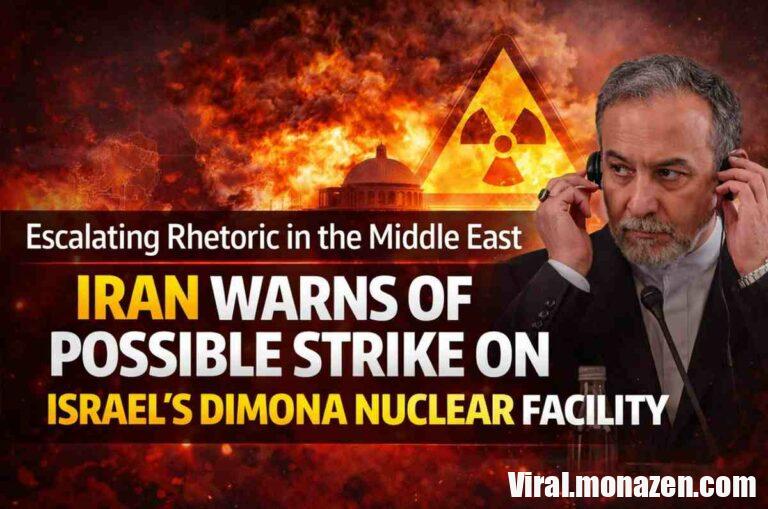
Tensions in the Middle East have entered another volatile phase after reports emerged from Iranian media quoting a senior official warning that Israel’s Dimona nuclear facility could become a target if the United States and Israel attempt actions aimed at destabilizing Iran’s government.
The statement, widely circulated across regional news platforms and social media, reflects the increasingly sharp rhetoric between Tehran and its adversaries. While such warnings are not uncommon in the region’s long history of geopolitical rivalry, the latest remarks have drawn renewed global attention because they involve one of Israel’s most sensitive strategic installations.
As diplomats and security analysts examine the implications, the situation underscores how fragile the regional balance remains—and how quickly words can translate into concerns about broader escalation.
What Is the Dimona Nuclear Facility?
The Dimona nuclear complex, located in Israel’s Negev desert, has long been at the center of international speculation about Israel’s nuclear capabilities.
Officially known as the Negev Nuclear Research Center, the facility was established in the late 1950s with assistance from France. Israel has never publicly confirmed possessing nuclear weapons, maintaining a long-standing policy known as “nuclear ambiguity.”
Under this policy, Israeli leaders neither confirm nor deny the existence of nuclear weapons. However, many international analysts believe the Dimona facility played a central role in the development of Israel’s strategic deterrent capabilities.
Because of its symbolic and strategic significance, any mention of Dimona in military rhetoric is taken seriously by global observers.
The Iranian Warning
According to reports in Iranian media, the statement attributed to a senior Iranian official suggested that if Israel and the United States attempted to “change the Iranian regime” through military or covert operations, Tehran would respond by targeting key Israeli infrastructure.
Among the potential targets mentioned was the Dimona nuclear facility, a reference that quickly attracted international headlines.
Iranian officials have repeatedly warned that attacks against Iranian territory or leadership would provoke strong retaliation.
At the same time, Western governments often view such statements as part of broader political messaging rather than an immediate operational plan.
Nonetheless, when strategic facilities like Dimona are mentioned, the rhetoric raises alarms among policymakers and defense analysts.
A Long History of Strategic Rivalry
The rivalry between Iran and Israel has deep historical roots stretching back decades.
Prior to the 1979 Iranian Revolution, Iran and Israel maintained limited cooperation. However, after the revolution established the Islamic Republic, the relationship changed dramatically.
Iran’s leadership adopted a strongly critical stance toward Israel, while Israel increasingly viewed Iran’s regional influence and nuclear ambitions as a major security concern.
Over the years, the two countries have engaged in what many experts describe as a “shadow conflict.”
This conflict has included:
- Cyber operations
- Covert intelligence activities
- Maritime incidents
- Air strikes targeting allied groups in neighboring countries
Although direct military confrontation between the two states has remained rare, tensions have periodically intensified through indirect actions.
The Nuclear Dimension
The nuclear issue has long been at the center of international concern regarding Iran and Israel.
Iran insists that its nuclear program is strictly for peaceful purposes, such as energy production and medical research.
However, Western governments and Israel have argued that aspects of the program could potentially be used to develop nuclear weapons.
This disagreement led to years of negotiations culminating in the 2015 Joint Comprehensive Plan of Action (JCPOA), an international agreement designed to limit Iran’s nuclear activities in exchange for sanctions relief.
The deal later faced major challenges and partial collapse after the United States withdrew from the agreement in 2018.
Since then, tensions surrounding Iran’s nuclear activities have increased again, contributing to the broader geopolitical climate in which statements like the recent warning about Dimona occur.
Why the Statement Matters
Security analysts say the mention of Dimona in Iranian rhetoric is significant for several reasons.
First, the facility represents one of Israel’s most sensitive strategic assets. Even symbolic threats directed at it can carry psychological and political weight.
Second, such statements can influence regional perceptions of deterrence. Both Iran and Israel seek to demonstrate that they possess the capability and willingness to respond forcefully if attacked.
Finally, references to nuclear-related sites inevitably raise concerns about potential escalation scenarios involving weapons of mass destruction.
Even if the probability of such an event remains low, the mere discussion of these possibilities can heighten global anxiety.
The U.S. Factor
The United States remains a central player in Middle Eastern security dynamics.
Washington maintains close military and strategic ties with Israel while also engaging in diplomatic efforts related to Iran’s nuclear program.
American officials have repeatedly stated that their goal is to prevent Iran from developing nuclear weapons while encouraging diplomatic solutions where possible.
However, relations between Washington and Tehran have remained strained for years due to sanctions, regional conflicts, and disagreements over nuclear oversight.
In this context, statements from Iranian officials often include references to both Israel and the United States as part of the broader geopolitical narrative.
Regional Reactions
Countries across the Middle East and beyond are closely monitoring developments.
Gulf nations, many of which have complex relationships with both Iran and Western powers, are particularly sensitive to rising tensions that could disrupt regional stability.
Energy markets are also paying attention.
The Middle East remains one of the world’s most important oil-producing regions, and any escalation involving major powers can influence global energy prices and shipping routes.
Even rhetorical confrontations can create uncertainty in markets that depend heavily on stability in the region.
The Role of Rhetoric in Geopolitics
Political rhetoric often plays a strategic role in international relations.
Statements about potential military actions can serve several purposes:
- Deterrence: signaling strength to discourage adversaries from acting
- Domestic messaging: reinforcing political support within a country
- Negotiation leverage: shaping diplomatic discussions
In many cases, strong language does not translate into immediate action. Instead, it becomes part of a broader dialogue between rival states.
However, history has shown that misinterpretations or miscalculations can sometimes transform rhetorical confrontations into real crises.
Diplomatic Paths Forward
Despite ongoing tensions, diplomatic channels remain active in addressing regional security issues.
International organizations, European governments, and regional mediators continue efforts to reduce tensions between Iran and Western powers.
Negotiations over nuclear oversight and sanctions relief have periodically resumed, though progress has often been slow.
Experts argue that sustained dialogue remains the most effective way to prevent misunderstandings and avoid escalation in a region where military confrontation could have far-reaching consequences.
A Region on Edge
The Middle East has long been characterized by complex alliances, historical grievances, and competing strategic interests.
Statements like the recent Iranian warning regarding Israel’s Dimona facility highlight how quickly tensions can rise in such an environment.
While rhetoric alone does not determine the course of events, it shapes perceptions and influences political decision-making.
For now, global attention remains focused on how regional actors and international powers manage these tensions in the months ahead.
Whether the latest exchange of warnings remains part of political messaging—or evolves into something more serious—will depend largely on diplomacy, restraint, and the willingness of leaders to prioritize stability over confrontation.
In a region where every word carries weight, careful communication may be just as important as military strength in preventing the next crisis.