
In an era where advanced militaries rely on satellite intelligence, precision-guided weapons, and artificial intelligence-assisted targeting, the idea that a simple visual trick could mislead billion-dollar defense systems sounds almost unbelievable.
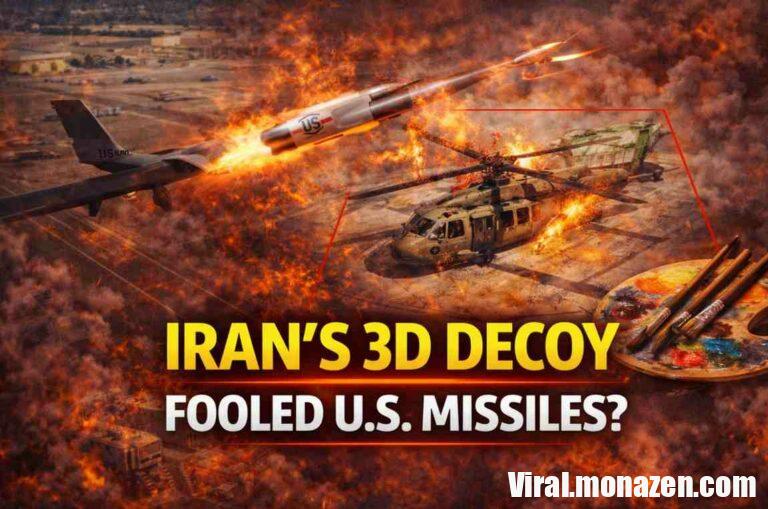
Yet a controversial debate now emerging among military analysts suggests that low-tech deception tactics—possibly including three-dimensional decoy imagery—may have successfully fooled advanced U.S. or allied targeting systems during recent operations in the Middle East.
If the claims circulating among analysts are even partially accurate, the implications would be profound: modern warfare may be entering a phase where inexpensive illusions can challenge some of the most expensive military technologies ever built.
And the central question being discussed in defense circles is striking:
Did Iran manage to trick American precision weapons with simple visual decoys?
A Viral Claim Sparks Debate
The controversy began when satellite imagery analysts and independent defense commentators began examining footage released after reported airstrikes against suspected military targets.
In at least one widely circulated discussion, observers questioned whether a supposed destroyed helicopter or aircraft on the ground might not have been a real target at all—but rather a carefully designed visual decoy created to resemble military equipment when viewed from above.
According to analysts familiar with deception tactics, these types of illusions can sometimes be created using anamorphic 3D painting techniques, where shadows, perspective, and color gradients are used to create the appearance of a three-dimensional object when viewed from a particular angle—such as from a drone or aircraft.
The technique is not new, but its potential application in modern warfare has raised eyebrows.
If such a decoy successfully convinced targeting systems—or human analysts—to classify the image as a real asset, it could lead to precision-guided munitions being launched against nothing more than paint and camouflage.
The Cost of Precision Warfare
The controversy also highlights a growing strategic concern for U.S. defense planners: the enormous cost of modern precision weapons.
Today’s advanced air-to-ground missiles, such as the AGM-114 Hellfire, can cost more than $150,000 each. Larger guided bombs equipped with satellite navigation systems can cost significantly more.
When these weapons are used to destroy high-value targets, the cost is considered justified.
But when they are used against false targets, the economic equation becomes much more complicated.
Military strategists refer to this challenge as the “cost exchange problem.”
In simple terms, if an adversary can trick a $500,000 missile into destroying a decoy that cost only a few hundred dollars to create, the attacker may technically win the engagement while still suffering a strategic loss.
The Return of Deception Warfare
Deception has always played a role in military strategy.
During World War II, Allied forces famously deployed inflatable tanks, wooden aircraft, and fake artillery pieces to mislead German reconnaissance planes. Entire units were dedicated to building fake armies designed to confuse enemy intelligence.
These operations were extraordinarily successful, influencing German decisions about where Allied forces were preparing to invade Europe.
Today’s decoys are far more sophisticated.
Some are designed not only to fool the human eye but also to mimic heat signatures, radar reflections, and electronic emissions associated with real military equipment.
This evolution means that deception can potentially target both human analysts and automated detection systems.
Why the United States Is Paying Attention
For the United States, the issue is particularly important because American military strategy relies heavily on precision strike capabilities.
The U.S. military possesses some of the most advanced targeting systems in the world, integrating satellite surveillance, drone reconnaissance, and high-resolution intelligence analysis.
But precision warfare depends on one critical assumption: the target being struck is real.
If adversaries can introduce large numbers of decoys into the battlefield, they may force the U.S. to spend enormous resources destroying objects that have little actual military value.
This could gradually reduce the effectiveness of precision strikes while increasing operational costs.
Psychological Impact and Strategic Messaging
Beyond the financial implications, deception tactics can also have powerful psychological effects.
If a country successfully convinces observers that American weapons were used against decoys, it can create a narrative suggesting that even the world’s most advanced military systems can be manipulated.
Such narratives can influence public opinion, military morale, and global perceptions of technological superiority.
In the information age, the perception of victory can sometimes matter almost as much as actual battlefield results.
The Intelligence Challenge
Detecting decoys is not easy.
Modern intelligence analysts rely on multiple layers of verification, including satellite imagery, signals intelligence, thermal signatures, and human sources.
But even with these tools, deception remains possible—particularly in environments where targets must be identified quickly.
In some cases, analysts may have only seconds to determine whether an object represents a legitimate threat.
Under those conditions, carefully designed decoys can still create confusion.
The Future of the Decoy War
As military technology continues to evolve, experts expect deception tactics to become even more sophisticated.
Artificial intelligence could soon be used to design decoys optimized specifically to fool automated recognition algorithms.
At the same time, defense researchers are developing new methods for identifying false targets using advanced sensors and machine learning systems.
The result may be a new technological race: the race between deception and detection.
A New Kind of Battlefield
If recent discussions prove accurate, the implications could reshape how modern militaries think about warfare.
The battlefield of the future may not be defined solely by missiles, drones, and stealth aircraft.
It may also be shaped by something far simpler—and far cheaper.
Paint. Shadows. Illusions.
And the possibility that the most advanced weapons in the world might sometimes be defeated not by superior technology—but by superior deception.